
Karteikarten
DNA
Karten in diesem Stapel (49)
- 1Nucleic AcidA polymer of repeating nucleic acid monomers
- 2DNADeoxyribonucleic acid
- 3RNARibonucleic acid
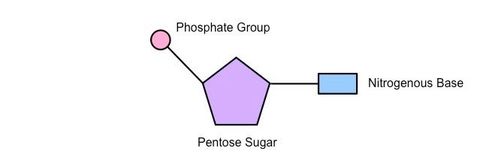
- 4NucleotideA pentose sugar, phosphate group and nitrogenous base linked together. They are the monomers of nucleic acid
- 5CCytosine
- 6GGuanine
- 7UUracil
- 8Pentose5 carbon suger eg deoxyribose, ribose
- 9Purine2 ring nitrogenous base-adenine and guanine
- 10Pyrimidine1 ring nitrogenous bas - cytosine, thymine and uracil
- 11Hydrogen BondWeak force that holds the two DNA strand together. Formed between complimentary bases
- 12Double HelixDouble stranded form of DNA- like a twisted ladder
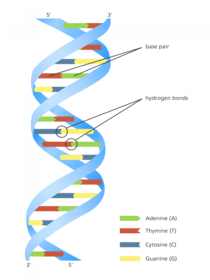
- 13AntiparallelEach strand of DNA runs in opposite directions. Direction indicated by free carbons as 5' and 3'
- 14Complimentary Base PairingBases will only pair due to the number of hydrogen bonds they form A to T/U & C to G
- 15Sugar-Phospahte BackboneEach strand of DNA or RNA has a backbone of repeating pentose sugars and phosphate groups
- 16DNA HelicaseThe enzyme that unwinds DNA during DNA replication
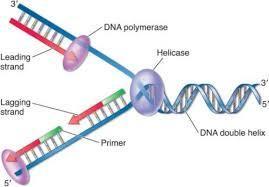
- 17DNA PolymeraseThe enzyme that adds new DNA nucleotides to the strands exposed by helicase
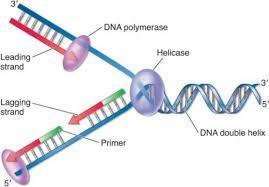
- 18Semi-ConservativeEach new DNA molecule has one strand form the original DNA molecule and one newly synthesised strand
- 19TranscriptionDNA template strand is copied by RNA polymerase, using complementary base pairing. This forms pre-mRNA and happens in the nucleus. Pre-mRNA undergoes post transcriptional modification where introns are removed before mRNA leaves the nucleus and goes to the ribosome
- 20Steps of Transcription1. The DNA code from a gene is copied into mRNA
2. RNA polymerase joins complementary RNA nucleotide
3. Exon's are expressed, introns are removed
4. mRNA exits the nucleus via nuclear pores - 21TranslationThe ribosome, read the mRNA code. tRNA has anticodons which are complementary and attach to the mRNA codons and brings the correct specific amino acid to the ribosome. The ribosome forms and peptide bond between the amino acids to form a polypeptide
- 22Steps for Translation1. mRNA binds to ribosome
2. tRNA brings specific amino acids
3. Anticodon on tRNA is complementary to codon on the mRNA
4. Amino acid joined by peptide bonds
5. Stop codons does not code for an amino acid
6. mRNA and polypeptide released from the ribosome////////// - 23mRNAMessneger RNA
Single stranded molecules formed ni the nucleus which is complementary to the code on a allele
It is formed during transcription in the nucleus and leaves the nucleus to go to ribosomes in the cytoplasm for translation
Location: nucleus and cytoplasm - 24rRNARibosomal RNA
Along with proteins is used to make ribosomes
Location: cytoplasm - 25tRNATransfer RNA
Brings specific amino acids to the ribosomes
Location: ribosomes - 26RNA polymeraseEnzyme used to make mRNA in the process of transcription
- 27RibosomeOrganelle and site of protein synthesis
Can be found free in the cytoplasm or attached to Endoplasmic Reticulum - 28Rough Endoplasmic ReticulumEndoplasmic Reticulum with ribosomes attached
- 29CodonThree letter code of bases
- 30UniversalUsed to describe DNA as it is found in all living organisms
- 31Amino AcidsMonomers used to build proteins
20 amino acids involved in protein synthesis - 32ProteinMade from amino acids
Functional roles e.g. enzymes, antibodies
Structural roles e.g. keratine - 33Genetic CodeThe sequence of bases in DNA form the genetic code
- 34DegenerateAmino acids are coded for by 3 letter bases sequences called codons
As there are more codons than amino acids the code is described as being degenerate as each amino acid can be coded for by more than one codon - 35Non-overlappingBases are read 3 at a time in a non-overlapping manner
- 36AnticodonThe three bases at the end of a tRNA molecule that are complimentary to the codon on mRNA
This means that amino acids are arranged in the correct order as coded for by mRNA - 37DNA probeA single stranded segment of radioactivity labelled DNA. Purpose: allows DNA/gene to be seen or identified
- 38Gel ElectrophoresisSeparates DND fragments based on size and charge
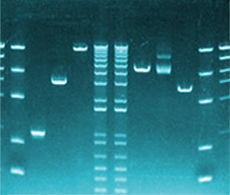
- 39Restriction enzymeRE cut at particular base sequence called a recognition sequence. Can be blunt or sticky end cuts. Found in bacteria
- 40DNA ligaseEnzyme that joins 2 DNA fragments at the sugar phosphate backbone
- 41Genetic EngineeringThe technique of making a new genetic code
- 42PlasmidSmall circular ring of DNA found in prokaryotes, can replicate independently of binary fission. Used in genetic engineering
- 43Recombinant DNAFormed when two pieces of DNA from different organisms are joined together
- 44Sticky endsWhen DNA is cut by some restriction enzymes, single bases are exposed at the ends of the DNA
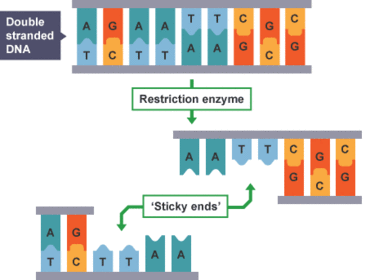
- 45Recognition SiteThe specific base sequence in DNA recognised by restriction enzymes
- 46AnnealingThis is when two complimentary sticky ends come together and for hydrogen bonds between their bases
- 47LigationThe use of DNA ligase to stick two pieces of DNA together making one piece of DNA
- 48MonomerSmall molecule
- 49PolymerRepeated monomers
Informationen
- Beschreibung
- Year 10 Biology Karteikarten am DNA, erstellt von Hannah McDonald am 26/10/2016.
- Erstellt von
- Hannah McDonald
- Aufrufe
- 17
- Tags
- Bewertung