
Karteikarten
AS -AQA Chemistry full course
Karten in diesem Stapel (94)
- 1Did you know that revision cards have something written on their back?This deck is work in progress
it will be updated all the time until exams in June 2017 - 2Proton and Neutron contribute to relative atomic mass by 1 Electrons do not.Atom is structured in the following way:
Dense nucleus made up of protons and neutrons (+ charge) is surrounded by densities where electrons are most likely to be found. - 3Dot-and-cross diagrams displayed formulae structure formulaeall can be used to represent structure of molecules
- 4each atom has its own Mr (mass number) and atomic (proton number) how would you find number of electrons?every non-charged atom has same number of electrons as it has protons. (the smaller number) +charged ions, have fewer electrons than protons.
-charged ions have more electrons than protons. - 5TOF Mass Spec. (time of flight mass spectrometer) is a straight tubeIt maintains Vacuum,
uses volatile solvent to vaporise the sample into gaseous (g) form - 6TOF mass spec produces ions with +1 charge only.This is significant when we look at calculating Mr (rel. molec. mass)
since M/Z values are seen and M (charge) is +1 - 7TOF mass spec. produces a graph with relative abundance on y axis and M/Z on x axis (mass to charge (charge = +1) ratio)you won't be asked what happens to an ion with charge other than +1
- 8TOF mass spec can be used to determine the Mr. but you'll have to combine all the isotope numbers first.The average atomic mass of an element is the sum of the masses of its isotopes, each multiplied by its natural abundance.
Source: Boundless. - 9The average atomic mass of an element is the sum of the masses of its isotopes, each multiplied by its natural abundance. Source: Boundless.Example:
A,B and C are isotopes of X
A=25% B=50% C=25%
0.25*A + 0.25*C + 0.5*B = X (Mr) - 10You'll be asked to give 'full electron configuration' of an element 1s2------------------------------> 2s2------------------------->2p6 3s2------------------------->3p6 4s2--------->3d10-------->4p6you may be asked to use 'noble gas configuration' which skips the boring initial steps 1s2, 2s2, 2p6....
[He], [Ne] or [Ar],
you can't go lower than that at AS/ A2 - 11Periodic table is split into 4 groups of sub-levels: S, P, d, F each can handle 2,6,10,14 electrons respectively You won't be asked about f block
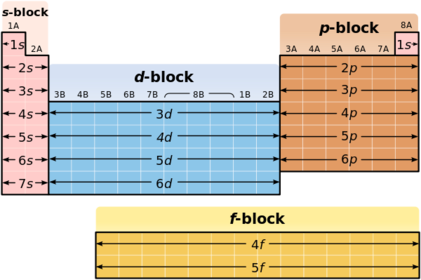
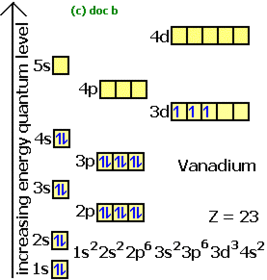
- 12When finding electron configuration d block does something weird 4s2 is followed by 3d10, not 4d10 why? (this is the only period of such nature I've seen asked at exams, dont get caught out)transition metal (d) block has lower energy, and acts as if it was 1 period higher on the periodic table.
- 13Initial Ionisation energy - energy required to remove outermost electron [x] ---> [x+] + e-Ionization energy is the energy required to remove an electron from a gaseous atom or ion. The first or initial ionization energy or Ei of an atom or molecule is the energy required to remove one mole of electrons from one mole of isolated gaseous atoms or ions.
By http://chemistry.about.com/od/chemistryglossary/a/ionizationenerg.htm - 14—Mg--->Al new P subshell
P--->S P subshell is half filled
electrons start to double up and repel each other.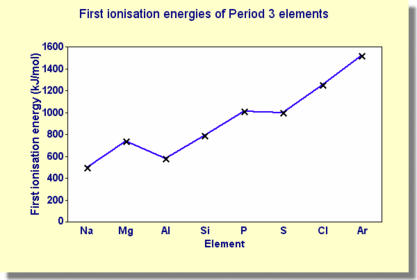
- 15You will be asked to complete a box diagram for electron configuration of a subshell level. we use half arrows pointing up and down to represent electrons in the same density spinning in opposite ways. boxes are filled by single electrons, until they have to pair up.
- 16—Down the Group 2 trends:
SHIELDING increases
ATOMIC RADIUS increases
so e- Attraction to nucleus Decreases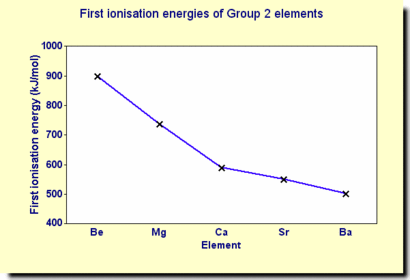
- 17Group 2 solubilityBaSO4 is insoluble tracer.
Ca(OH)2 vs Flue Gases
(Factory gas waste)
Ca (OH)2 + 2HCl → CaCl2 + 2H2O
Ca (OH)2 + 2HF → CaF2 + 2H2O
Ca (OH)2 + SO2 → CaSO3 + H2O
Ca (OH)2 + SO2 + 0.5O2 → CaSO4 +H2O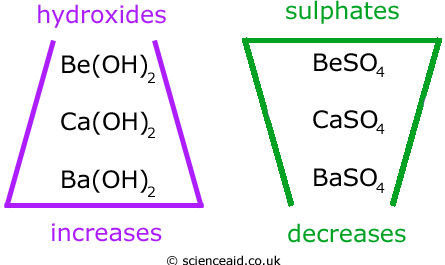
- 18Relative Molecular Mass (Mr) Mr = mass of one Mole of (molecule) relative to 1/12 of one Mole of Carbon 12Ar (atomic mass)
is not used often. you'll see it used at the start of AS. we mostly look at molecules at AS/A2 so we tend to use Mr - 19Carbon mass 12 Oxygen mass 16 Hydrogen mass 1remember these, it will save you a lot of time. they are used very commonly, so you'll be investing your time well.
- 20Mol grams/Mr = Mol = Conc. x Vol.(dm3) 1 mol of Carbon12 is 12 grams exactlyMole / Mol
is a mathematical number which helps us to look at 'amounts of tiny things' - 21Avogadro's constant how many of these are in a Mol? H atoms? H2O molecules ? Tomato Pizzas?6.022 × 10^23 mol^-1
this will be given to you - 22Ideal Gas Equation PV=nRT pressure(bar) x volume(Litres) = Mol x Constant(8.22) x temperature(Kelvin) you'll be asked to "find x"to find Kelvin, its Centigrade + 273
standard conditions:
273 K
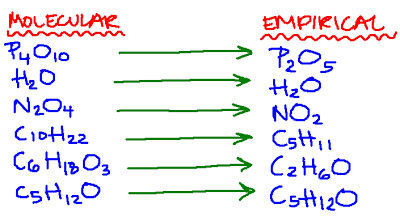
100 kPa (1 bar/atmosphere) - 23Empirical formulae - simplest whole number ratio of atoms - In the old days, people had a list of atoms and their ratios to work with. this was used to find the actual molecular formulaeyou'll be asked to work forwards and backwards between Empirical Ratio/Formula and Molecular Formula
- 24Find Empirical formulae of: C6O6H12 by mass C 83.33% H 16.67%COH2
C5H12
which is also the molecular formula - 25Using mass percentage/ratio to get empirical formula. by mass C 83.33% H 16.67% divide by individual's Mr C 6.94 H 16.67 divide by the smallest (6.94) C 1 H 2.4 Multiply both by a number such to get whole number ratio. (x5 in this case) C 5 H 12you'll always create a small table for these 'calculations by percentage/ratio'
- 26Ionic Equations split (aq) aqueous solutions into ions. common ones: KOH---> K+ OH- NaI----> Na+ I-Create ionic equation by writing it out, having split (aq)
then, remove ions which appear on both sides.
this gives you clear sight as to what actually reacts, and if you could use KCl instead of NaCl or LiCl is some reaction. - 27Write equations out CH3CH2CH3 for propane instead of C3H8apparently you do not loose marks for this, and you show examiners that you know your stuff.
- 28You'll do titration of acid into base or base into acidForget 'alkali' we don't use that word at AS/A2
we use Bases and Basic solutions
acids and acidic solutions
Don't concern yourself with buffers until A2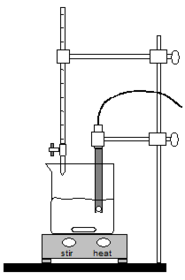
- 29Acid is H+ Base is OH- water can dissociate to form theseH+ is very reactive, it reacts with water straight away:
H+ H2O--> H3O+ (still acid)
impress your friends, H3O+ is called
Hydronium Ion - 30Atom economy (by mass) (mass of needed product)/(mass of reactants) x 100 same as "percentage of" calculationIn industry we need to know if we are wasting too much, and be able to compare different reaction pathways for efficiency and cost.
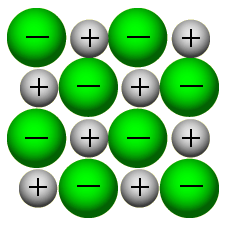
- 31Ionic Bonding (a potentially infinite lattice) electrostatic attractions between anions and cations
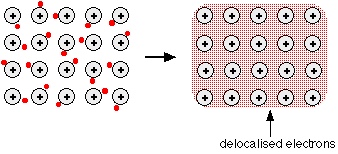
- 32Metallic Bonding (a potentially infinite lattice) Attraction between Cation (metal) like Fe+ and the shared sea of delocalised electrons
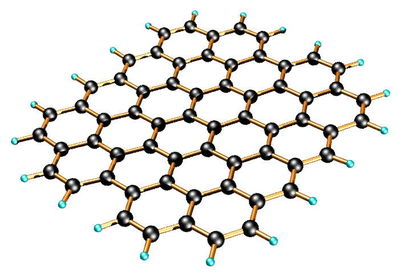
- 33Macromolecular (giant covalent) (a potentially infinite lattice) attraction to shared pair of electrons
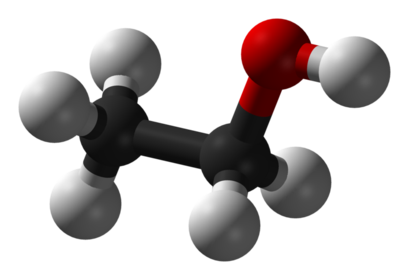
- 34Molecular (simple covalent) has a definite number of atoms strong attractions between atoms in the molecule (intra-molecular). weak attractions between molecules (inter-molecular).
- 35Dative Covalent Bond atoms attracted to shared pair of electrons, provided entirely by one of the atomsrepresented by an arrow.
behaves just like a normal bond.
often used with ammonia NH3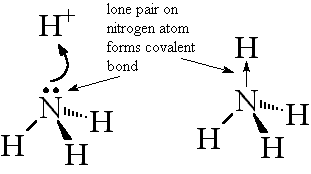
- 36electronegativity is the power of an atom to attract electron density from a covalent bond Fluorine has the highest electronegativityF has the smallest atomic radius and least shielding
hence largest attraction of electrons to the positive nucleus
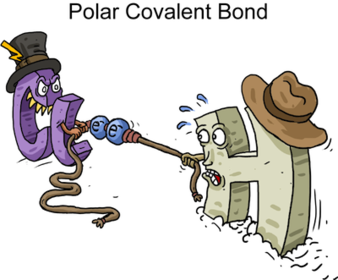
This means that F in a covalent bond, most often escapes as F- when the bond is broken. - 37Polar Bonds certain combinations cause electron pair to be closer to one of the atomsPermanent Dipole forces such as those in HCl happen because electron bonding pair is always more likely to be near Cl than H, making Cl slightly negative and H slightly positive. these can then bond as half-sized ions
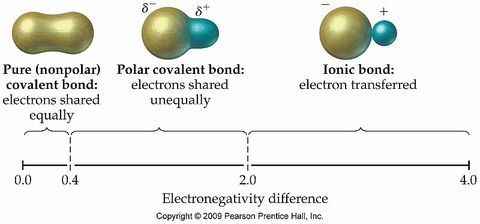
- 38Certain atom combinations of different electronegativity create stronger dipolespermanent dipoles are stronger intermolecular forces than plain VanDerWaal's (London) attractions
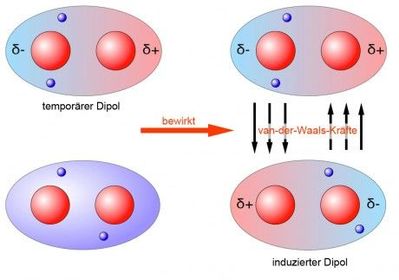
- 39Van Der Waal's attractions (vdW) (London inter-molecular Forces) There's a chance that electrons will be closer to one end of non-polar molecule than the other. What does this suggest?The molecule momentarily becomes slightly negative on one end, and slightly positive at the other.
- 40Hydrogen Bonds are in a way similar to dative covalent bonds. but these are much much weaker.the sign next to the atoms is 'delta' delta+ means slightly positive.
Always draw O--H |||||| :O at 180*
since this is similar to covalent bond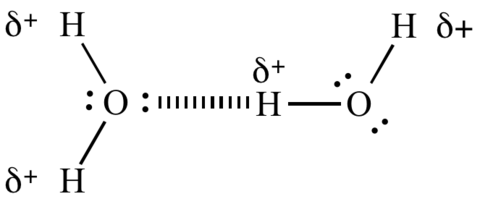
- 41Carboxyllic Acid A has boiling point 170* Same carbon chain length alkane B has boiling point of 80* why is that?Carboxyllic acid can hydrogen bond with itself (strong attraction)
Alkane can only form vdW attractions
(weak intermolecular forces) - 42ΔH Symbol for enthalpy change. Remember the units?kJ/mol
Symbolises energy needed to break bond(s) - 43ΔH Cø Enthalpy change when 1mol of substance has been combusted in excess oxygen Ø(in standard conditions)Ø
Standard conditions are 0C (273K)
1atm/ 1bar / 100pA - 44ΔH fø Enthalpy change when 1mol of substance has been made from its constituent elements Ø(in standard conditions)Ø
Standard conditions are 0C (273K)
1atm/ 1bar / 100pA - 45q=mcΔTq= energy required to heat a unit of mass by 1C*
m= mass
c= specific heat capacity
ΔT= temperature change - 46—
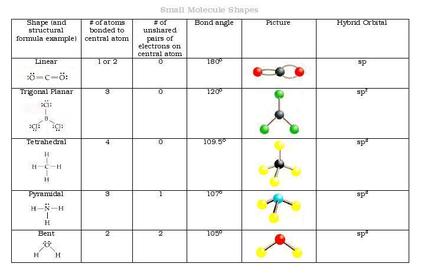
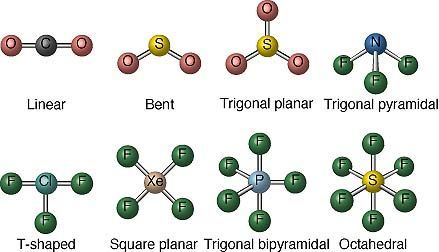
- 47meth- eth- pro- but- pent- hex-Identify the longest carbon chain.
Identify all of the substituents (weird nobbly bits not H)
number the carbons to give most important substituents lowest numbers - 48the following (end Points) are on carbon 1 carboxyllic acid nitrile group aldehydes aminesFunctional group Prefix Suffix
carboxylic acids none -oic acid
aldehydes none -al
ketones none -one
alchols hydroxy- -ol
amines amino- -amine
ethers alkoxy- -ether
fluorine fluoro- none
chlorine chloro- none
bromine bromo- none
iodine iodo- none - 49—Isomers have same molecular formulae but different arrangement of atoms in physical space.
this results in different properties.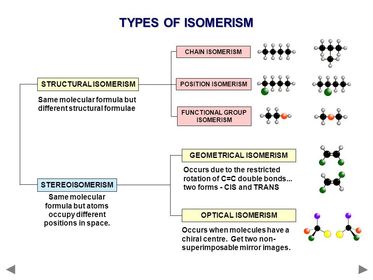
- 50Fractional distillation works because....?different lengths of carbon chains have different boiling points due to different amounts of intermolecular vdW forces they exert.
- 51during Frac. Distillation we get lots of thick, long-chained groups. how do we use these for better causes?we CRACK the chains.
Catalyst cracking produces 1 saturated chain and many unsaturated chains.
Alkenes can be used to make polymers - 52Zeolite catalyst- looks like a lattice of donuts produces chain-isomer alkanes + alkenes how's this useful?Chain-isomer alkanes + alkenes have weaker vdW forces, so they burn better.
Alkenes can be used to make polymers - 53Zeolite cracking: aromatic H-Carbons Fuels Many alkenes and ring carbons H temp. M pressure. Zeo CatalystThermal Cracking
Straight chain
some alkanes
MANY alkenes
H temp. H pressure - 54C(x)H(2x+2) C2H5, C50H102, etc can combust with O22(C2H5) + 6.5(O2) ---> 4(CO2) + 5(H2O)
- 55Car Fuels have impurities sulfur and its oxides, carbon monoxide, methane, Nitrous oxides. We use platinum catalysts to remove these. O2 reacts with them to form less harmful gasses
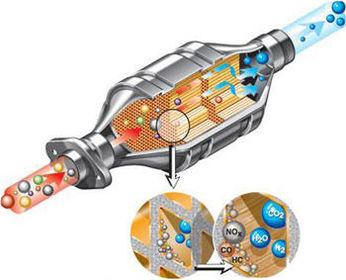
- 56Hess' Law remember it?It doesn't matter which pathway reaction takes, the overall ΔH will be the same
Hess' triangle- follow the arrows, reverse the ΔH sign if going against the arrow. - 57catalysts what do they do? Maxwell BoltzmannProvide an 'alternative route' for the reaction.
On Maxwell Boltzmann distribution, they move Ea (activation Energy) further back. - 58Collision TheoryAtoms must have:
Ea (activation energy)
collide wits sufficient force
hence must be close to each other
collide at good angle (head on) - 59—Maxwell–Boltzmann distribution
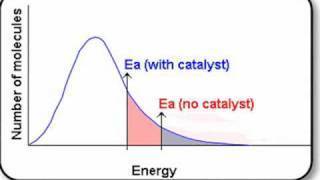
- 60-ΔH reaction is exothermic +ΔH reaction is endothermic (endothermic is uncommon)Exothermic> releases heat> Likes cold
Endothermic> absorbs heat> Likes hot
Both need sufficient Ea (activation Energy) - 61How do you increase rate of reaction? (Or rate at which reaction reaches equilibrium?)Induce kinetic energy by increasing heat.
Increase surface area/concentration/pressure to get molecules closer together.
Induce kinetic energy directly by stirring.
Introduce a catalyst to provide an alternate reaction path. - 62If a system at equilibrium is disturbed, conditions favor the reaction which tends to reduce the disturbanceLe Chatelier's -
physical reasons as to why a certain change of conditions has a predictable effect - 63Equilibrium is in closed system You won't see an example where temperature or pressure are changing live, whilst reactions are underwayThese lot affect Yield
Pressure (gas), Concentration (liquid), Temperature
But temperature is the only one which affects the mathematical Kc equation - 64Mathematical Kc expression. purely algebraic representation.each temperature (25*, 37.5*, 545.64658*) has its own value of Kc. this Kc MUST stay constant. do not relate this to
Le Chatelier's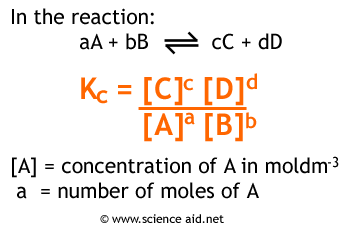
- 65Kc = 0.00063652 when mostly reactants are present; its tiny. Kc = 1254.95 when mostly products are present, it's massiveMathematical Kc expression can be rearranged 'to find X'
- 66CH4(g) + 2H2O(g) <--> CO2(g) + 4H2(g) Initially, 1.0 mol of methane and 2.0 mol of steam were placed in a flask and heated until equilibrium was established. The equilibrium mixture contained 0.25 mol of CO2. a)i) Calculate the amounts, in moles, of methane, steam and hydrogen in the equilibrium mixture.Always make a table for these lot.
initially: |-1.0-|-2.0-|-0.0-|-0.0-|
equilibrium: |xxxx|xxxx|0.25|xxxx| .
now we know the factors. Consider each reagent individually, by comparing it to known Mol amounts, taking into account the factor 1:1, or 1:2 or 1:3 or 1:4 by Mol. - 67OIL RIG Oxidation is Loss (of electrons) Reduction is Gain (of electrons) and when you cause it, you're its agent.Enter text here...
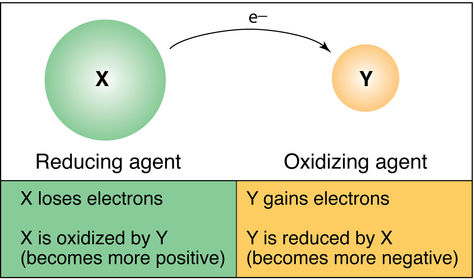
- 68Common Oxidation States group 1 metals +1 group 2 metals +2 Fluorine -1 . Cl -1 (but work it out) Oxygen -2 E. Hydrogen +1 E.Exceptions don't apply to most cases you'll see. at AS use normal numbers.
Oxygen -2 Expt.(-1 peroxides H2O2)
Expt.(+2 with F)
Hydrogen +1 (-1 with metals {A2}) - 69make x2 half equations by considering both reactants separately.balance half equations by:
Oxygen: add H2O
Hydrogen: add H+
Charges: add e- - 70Mathematical value Kc Reacts to temperature only. If pressure changes and more X is found at equilibrium, Kc does not change since it measures rate of reaction at equilibrium.It's important you fully understand this Kc topic. It took me 2 days (worth of time) to discover it for myself.
- 71Group 7 Halogens Are most electronegative. F is the best example. Why is that?Electronegativity is high when proton amount is high, shielding is low, atomic radius is small so new electrons have the best pull to the nucleus.
F has all of these: tiny radius, least shielding many protons. - 72Testing for halogens using Silver Nitrate. Remember the results?F- does not produce any precipitate
Cl- white
Br- cream
I- yellow - 73Testing for halide ions (ii) Add Silver Nitrate (White, cream, yellow) Then see if (Cl Br I) solute in ammonia. What should happen?AgCl dissolves easily in Dilute NH3
AgBr has difficulties dissolving in Concentrated NH3
AgI does not even dissolve in concentrated NH3 - 74We write compounds as CH3CH2COOH (Propanoic acid) instead of C3H6O2we use 'condensed structural formulae' because they show shape, which is vital in organic chemistry.
- 75Displayed formulaStructural formula
CH3 CH2 CH(OH) CH2 COOH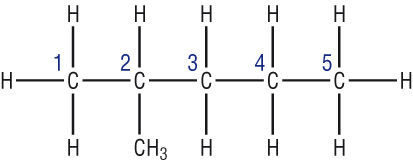
- 76In the old days, people had ratios of atoms to work with. they knew that (carbon is responsible for 63% of the mass, rest seems to be Hydrogen) So we called that simplest ratio Empirical. Just like Americans love their inches, Chemists refuse to give up this ancient system. Comes in handy sometimes, it's obvious when it's needed.
- 77Molecular FormulaSkeletal Formula
-i Love these!
Used most commonly in Organic. Easy to sketch.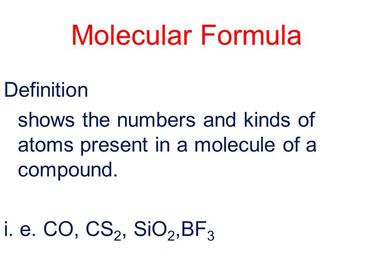
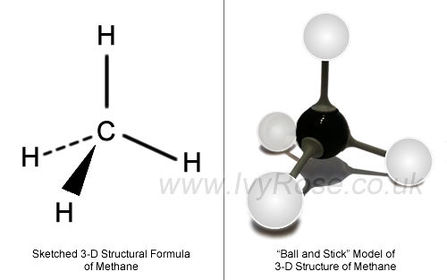
- 78Carbon chain can be named. name has a base: -Meth- -Eth- -Pro- -Bu- name has a prefix for any appropriate groups: Methyl-, Hydroxy- Name has a Suffix: -yde, -ol, -one, -al etc Name's prefix has a rule: -between-numbers-&-words: 6-methylNaming: most important groups on carbon chain, those which need smaller Number in IUPAC name.
1 Those which can ONLY be on 1st carbon: aldehydes, carboxylic acids.
2 Those with bigger (sub-)molecular mass: -CN, -OH, =O, -I, -Br, -Cl, -F. - 79Alkanes are straight AlkENEs have a Double bond alkenes and (CycloAlkanes) have the same molecular formulae. It took them wayyy too long to figure out that alkenes can become cyclic.
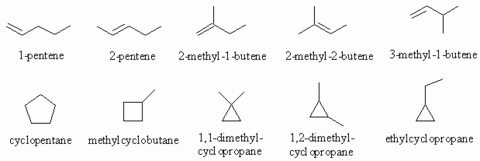
- 80—Meth- Methane
Eth- Ethanol
Pro- Propanoic acid
But- Butanal
Pent- Pentan-2,3-diol
Hex- CycloHexane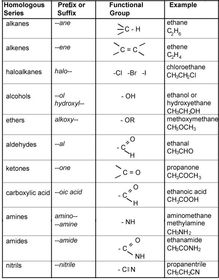
- 81Nucleophiles really want to get rid of some of their electrons. Electrophiles are twitchy, and will not stop until their electron-gain hunger is fulfilled.Nucleophiles- typically double bonds, and ammonia ::NH3
Electrophiles- Typically Cations(+), non-saturated atoms ( Al Cl3) - 82How to know if reaction is Called NucleophillicX or ElectrophyllicX?look at the First arrow in the mechanism:
Nu:-------> (X)
or
El <-------- (X) - 83How to know if reaction is XSubstitution, or XAddition?Substitution (AS) has 2 reactants,
2 products. Parent compound 'releases' something.
Addition (AS) has 2 reactants, 1 product.
parent compound looses a double bond, or (changes structure(rare)) - 84Elimination Vicious reaction, in a hurling, swirling HOT ACID. The poor alkane can't help but to loose H2 and form a double bond!Free Radical Substitution
Up high, at peaceful horizon, Cl2 breaks apart due to prickly sun rays. 2xCl* are restless molecules.
Cl* + O3 -----> O2 + ClO*
ClO* + O3 --> 2xO2 + Cl*
until two* collide: Cl* + ClO* -> Cl2 + O2 - 85Infrared Spectrum- each living bond absorbs a specific wavelength of infrared light.
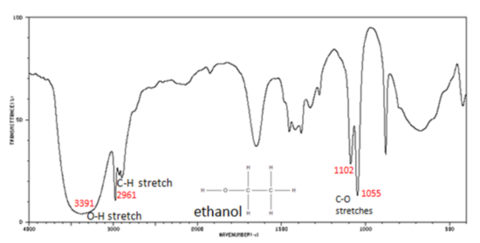
- 86which ranges in general does InfraRed spectrum show?<1400 - fingerprint region, every substance to ever exist will have a slightly different combination here.
~3500 C-C bond, we usually ignore this for alkanes. it CAN merge with other absorption spectra at times. - 87Remember good old TOF Mass Spec.? why do ions accelerate through drift region?Ions are +charged (courtesy of the charged gas capillary) and are attracted to the -charged detector.
- 88what are chain isomers?Isomers with the same molecular formula, but different structural formula due to length and position of branches on the chain.
- 89what are position isomers?(you don't need help with this one)
they involve some kind of functional group being in a different POSITION on the chain. - 90What are functional group isomers?have the same molecular formula, but involve a different functional group:
aldehyde<>ketone
alcohol<>ether
more to come at A2 - 91What are optical E-Z isomers?same molecular formula but different arrangement in physical space.
>C=C< double bond
"It is Z same!" for a Z isomer - 92how would you know which group on a molecule is more important?1st carbon functional group
Mr -Molecular mass - 93Testing for aldehyde in a mixture of alcohol, aldehyde and acid.mix with Fehling's - orange for aldehyde
mix with Tollens - silver mirror for ald.
Mix with PotassiumdiChromate - orange for alcohol + aldehyde
mix with Na2CO3 (carbonate) CO2 bubbles -positive for acid. - 94Test for Halide Ions Mix with Acidified Silver Nitrate (solubility- mix with Ammonia)White -Cl Soluble in NH3
Cream -Br Soluble in conc. NH3
Yellow -I Insoluble in NH3
Informationen
- Beschreibung
- Mixed cards with questions, images, concepts etc. for the entire AS year
- Erstellt von
- Maxim Korvatskyy
- Aufrufe
- 182
- Tags
- Bewertung