
Karteikarten
C0 Definitions
Karten in diesem Stapel (49)
- 1AxiomAn axiom is a statement that mathematicians agree to treat as true.
- 2DefinitionA definition is a precise statement of the meaning of a mathematical word.
- 3EvenA number n is even if and only if (iff) there exists an integer k
such that n = 2k. - 4A Rational numberA rational number r, denoted by r ∈ Q, can be written as r =
p/q, where p,q = 0 are integers, denoted by p,q ∈ Z - 5The Implication connective =>Given two statements P and Q. The assertion that if P is true then Q is true, denoted by P ⇒ Q or Q ⇐ P.
We call P the Hypothesis and Q the Conclusion. - 6ConverseThe statement ‘Q ⇒ P’ is the converse of the statement ‘P ⇒ Q’.
- 7Logically equivalentThe statement ‘ ¬Q ⇒¬P’, is logically equivalent to ‘P ⇒ Q’ .
- 8"iff" <=>f ‘P ⇒ Q’ and ‘Q ⇒ P” then P ⇔ Q - read as ’P if and only if (iff) Q’
- 9TheoremA theorem is a statement about mathematical objects. It consists of a hypothesis, or set of hypotheses, and a conclusion, or set of conclusions.
- 10ProofA proof of a theorem is a logical argument, a sequence of logical steps, that guarantees the conclusion holds when the hypothesis is satisfied
- 11Proof by ContradictionProof by contradiction shows a statement A is true by first assuming that A
is false. A logical argument with this hypothesis continues until a contradiction is arrived at. Thus A cannot be false and so must be true. - 12Proof by inductionProof by Induction
Proof by mathematical induction involves proving a statement P(n) is true for all ∀n ≥ n0, where n ∈ N the set of natural numbers (strictly positive integers). First we prove P(n0) is true, then assuming P(k) is true for n0 ≤ k ≤ n − 1, we deduce that P(n) is true. - 13A SetA set is any well-defined collection of distinct elements. If x is an element of a set
A, we write x ∈ A, otherwise we write x /
∈ A. - 14CardinalityThe number of elements of a set A
is called its cardinality, denoted by |A| - 15IntegersZ = {...,−2,−1,0,1,2,...}
- 16Natural numbersN = Z+ = {1,2,3,...}
- 17Rational numbersThe set of rational numbers, Q, is defined by
Q = {p/q | p,q ∈ Z, q = 0}. - 18Equal setsTwo sets A and B are said to be equal, denoted by A = B, if they contain precisely the same elements, i.e. A = B means x ∈ A ⇐⇒ x ∈ B.
- 19The Universal setThe universal set, denoted by U, is the set that contains all possible objects of interest.
- 20The empty setThe empty set, denoted by ∅, is the unique set with no elements and zero cardinality.
- 21A subsetA set A is a subset of a set B, denoted by A ⊆ B or B ⊇ A, if every element of a set A is also an element of a set B.
- 22A proper subsetA set A is a proper subset
of B, denoted by A ⊂ B, if A ⊆ B and A does not equal B, A = ∅. - 23Set IntersectionGiven two sets A and B, the intersection of A and B, denoted by A ∩ B, is the set of all elements which are elements of both A and B. Thus
A ∩ B = B ∩ A = {x ∈ U | x ∈ A and x ∈ B} - 24Distinct/disjoint setsWe say two sets are distinct, or disjoint, if
A ∩ B = ∅ (no elements in common). - 25Set unionGiven two sets A and B, the union of A and B, denoted by A ∪ B, is the set of all elements that are elements of either A or B, or both. Thus
A ∪ B = B ∪ A = {x ∈ U | x ∈ A or x ∈ B} - 26Set differenceGiven two sets A and B, the difference of A and B, denoted by A \ B, is the set of all elements that are elements of A but not of B. Thus
A \ B = {x ∈ U | x ∈ A and x /
∈ B} - 27Relative complement of setsThe difference A \ B, is called the (relative) complement of B in A. Given a universal set U
- 28The absolute complement of setsThe (absolute) complement of a set A ⊂ U, denoted by Ac, is the set of all elements of U that are not elements of A.
Ac = U \ A = {x ∈ U | x /
∈ A} =⇒ (Ac)
c
= A - 29Cartesian ProductThe Cartesian product of two sets X and Y is the set, denoted by X × Y , whose elements are ordered pairs of the form
X × Y = {(x,y) |x ∈ X and y ∈ Y } - 30The real numbersR denotes the set of real numbers consisting of both rational and irrationals.
- 31A Field (F)A field F is a set of numbers with two operations addition (+) and multiplication (×). {see axioms in n, s&s).
- 32Ordered fieldsA set of numbers F is said to be ordered if they satisfy the ordering axioms (see n,s&s)
- 33Upper/lower bounds of setsWe say B is an upper (lower) bound of a set X if ∀x ∈ X, x ≤ B (x ≥ B). A set X is bounded if it has both a lower and upper bound.
- 34Supremum of a setThe least upper bound is known as the supremum
- 35A complete setAn ordered field F is said to complete if every non-empty bounded
subset has a supremum in F - 36Smallest ordered and complete fieldR is the smallest set of numbers which is
a complete, ordered field. - 37Interval
- 38Modulus function
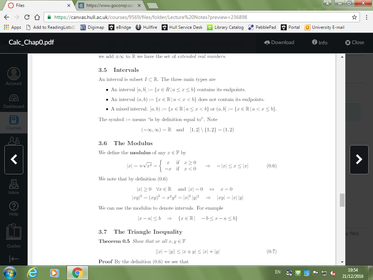
- 39Triangle Inequalityx,y ∈ F
||x| − |y|| ≤ |x ± y| ≤ |x| + |y| - 40e-neighbourhoodGiven ε > 0, an ε-neighbourhood Nε(c) of a point c ∈ R is the set of points
Nε(c) := (c − ε,c + ε) = {x ∈ R | |x − c| < ε} ⊂ R - 41Deleted/punctured e-neighbourhoodGiven ε > 0, a deleted, or punctured, ε-neighbourhood Nε(c)\
{c} of a point c ∈ R is the set of points
Nε(c) \ {c} := (c − ε,c) ∪ (c,c + ε) = {x ∈ R | 0 < |x − c| < ε} ⊂ R - 42Interior pointA point c ∈ R is called an interior point of a set S ⊆ R if ∃
ε > 0 such that the set of points Nε(c) ⊂ S. The set of all interior points of S is called the interior of S and is denoted by S0. - 43Exterior pointA point c ∈ R is called an exterior point of a set S ⊆ R if ∃
ε > 0 such that the set of points Nε(c) ⊂ Sc = R \ S. - 44Boundary pointA point c ∈ R is called an boundary point of a set S ⊂ R if every
ε-neighbourhood of c contains both points of S and Sc, or ∀ ε > 0, Nε(c) ∩ S = ∅
and Nε(c) ∩ Sc = ∅. The set of all boundary points of S is called the boundary of S and is denoted by ∂S. - 45Limit pointA point c ∈ R is called an limit point of a set S ⊆ R if every deleted ε-neighbourhood of c contains a point a ∈ S, or ∀ ε > 0, ∃ a ∈ S such that 0 < |c − a| < ε, or Nε(c) \ {c} ∩ S = ∅. The set of all limit points of S is denoted by S′.
- 46Closure point & closure of a setA point c ∈ R is called a closure point of a set S ⊆ R if every ε-neighbourhood of c contains a point of S, or ∀ ε > 0, Nε(c) ∩ S = ∅. The set of all closure points of S is called the closure of S and is denoted by ¯
S - 47Topology identitiesS0 ⊆ S,S′ ⊆ ¯
S or ¯
S = S0 ∪ ∂S = S ∪ S′, ∂S = ¯
S \ S0 - 48Open setA set S ⊆ R is said to be an open set if it contains only interior points, S = S0, or ∀ x ∈ S, ∃ ε > 0 such that Nε(x) ⊂ S.
- 49Closed setA set S ⊆ R is said to be closed if it contains all its limit points,
S′ ⊆ S, or if it has no limit points, S′ = ∅, so in both cases S = ¯
S.