
Flussdiagramm
APH
Inhalt des Flussdiagramms
Antepartum Haemorrhage
"APH is defined as bleeding from or in the genital tract, occurring from 24+0 weeks of pregnancy and prior to the birth of the baby" (RCOG, 2011)
Most common causes:
- Abruption
- Placenta Praevia
- Uterine Rupture
- Vasa Praevia
3-5% of pregnancies affected by APH
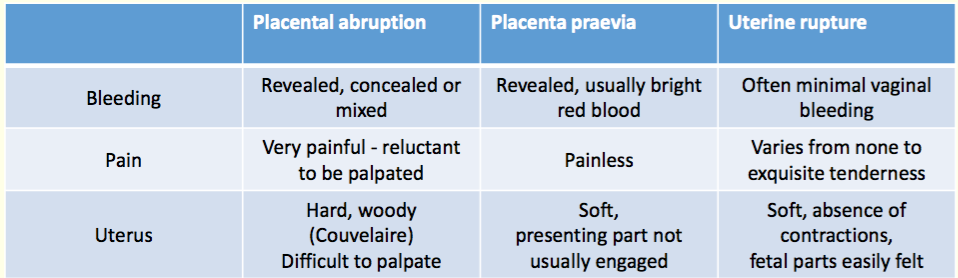
Abruption
Placenta Praevia
Uterine Rupture
"Complete or partial separation of a normally situated placenta after 24th week of pregnancy and prior to delivery"
Recognition
- Sudden severe abdominal pain and hypovolaemic shock
- Board-like uterus + excess pain
- Fetal parts difficult to palpate
- Placental separation triggered by bleeding into decidua basalis
- Blood seen doesn't represent severity s abruption may be concealed
- Bleeding may be revealed, concealed or mixed
- May be history of reduced or excessive FMs
- Where <1000ml blood lost = hypoxic foetus
- Where >1500ml women is in shock and foetus dead
Risk Factors
- Previous abruption (4.4% incidence of recurrent abruption. Recurs in 19-25% of women who've had two previous pregnancies complicated by abruption)
- Pre-eclampsia: High blood pressure means high force blood flow
- Fetal Growth Restriction: Poor placental function
- Polyhydramnios: sudden decrease in pressure, causing abruption
- Advanced maternal age: likely to have other risk factors due to this
Incidence
2 maternal deaths from placental abruption from 2009-2012 in UK & Ireland (MBRRACE, 2014)
"Placenta praevia exists when the placenta is inserted wholly or in part into lower segment of uterus"
Major: Placenta lies over internal cervical os
Minor/ Partial: Leading edge of placenta is in lower uterine segment but not covering cervical os
Recognition
- Bleeding PAINLESS, FRESH RED AND RECURRENT
- SOFT uterus and NON-TENDER
- PRESENTING PART high not central
TRANS-VAGINAL USS is safe + more accurate than trans-abdominal
Clinical suspicion raised:
- Vaginal bleeding >20wks
- High presenting part
- Abnormal lie
- Painless provoked bleeding
- Irrespective of previous USS, a more low lying placenta at present
(RCOG, 2011)
Incidence
1 maternal death from placental praevia from 2009-2012 in UK & Ireland (MBRRACE, 2014)
Risk factors:
- Prev placenta praevia
- Prev C-sections: the more = higher risk
- Prev termination of pregnancy: scar tissue
- Multiparty: placenta sites over os due to lack of space
- Advanced maternal age: likely to have other risk factors from this
Uterine dehiscence: disruption of uterine muscle with intact serosa (outer layer of uterus or perimetric)
Uterine Rupture: disruption of uterine muscle extending to and involving the uterine serosa or disruption of uterine muscle with extension to bladder or broad ligament
(RCOG, 2007)
Incidence
4 maternal deaths from uterine rupture from 2009-2012 in UK & Ireland (MBRRACE, 2014)
Recognition
- Symptoms vary from NONE to severe abdominal pain
- Hypovolaemic shock
- Fetal parts easy to palpate
- Fetal HR - compromise
- Subrapubic pain present between contractions and often felt despite analgesia
- Exquisite tenderness on palpation of lower segment
- Rising maternal pulse
- Intrapartum vaginal bleeding
- Sudden cessation of contractions
- Palpations detects malpresention/ fetal parts easily palpable
- Fetal presenting part moves up on VE
- Maternal shock and collapse
- Haematuria
Risk Factors
- Previous CS
- 2 X risk if induced - prostaglandins + oxytocin causes hyper stimulation + weaken previous scars making them susceptible to rupture
Delivery
- If woman still pregnant, birth of baby must be planned
- Time: essential to stabilise woman, time of day, steroids for baby
- Team: Senior staff essential
- Place: Appropriate facilities e.g. theatre NICU
- Route: C/S or vaginally
- Increased maternal age
- Increased risk if over >42 weeks
- Increased risk if fetus >4000g
- Cases documented in primips with no risk factors
- Multiple pregnancy: sites over os due to lack of space
- Smoking: larger placenta to compensate for poor blood flow
- Assisted conception
- Deficient endometrium due to uterine scar, fibroid, manual removal of placenta
- Multiparty: 2nd twin issue of placenta coming away too soon
- Low BMI: poor nutritional state therefore poor placenta function
- Assisted reproductive technique pregnancy
- Intrauterine infection: impair placental function
- PROM: increase chance of infection
- Abdominal trauma: DV or RTC
- Smoking + drug misuse: vasoconstriction to placental blood flow causing hypoperfusion and ischemia
( RCOG, 2011)
MOANS team
M - mother, senior midwife, 2nd midwife
O - Obstetrician, Reg, SHO
A - Anaesthetist, ODP
N - NICU, Haematologist, HCA, MSW, Porter
S - Scribe
Mother - inform her of what's happening, and depending on severity then the chance of going to theatre
Senior Cons/ Reg - Prepare women for delivery/ theatre with Ranitidine 50mg, Metoclopramide 10mg or Sodium Citrate 30mls
Gain consent implied/ verbal for theatre
Senior Midwife - put out 2222 crash call, give advice from senior knowledge, delegate roles
2nd Midwife - Catheterise with hourly bag, and cannulate, taking bloods = FBC, Clotting, G&S, X match, Blood cultures
SHO - Cannulate other hand and put up IV fluids - Colloids 500ml+ Crystalloid 1L x2
Anaesthetist - Manage
Airway: Facial O2
Breathing: Resps, O2 sats
Circulation: HR, Cap refill
Disability
Exposure
Hypovolaemic shock
ODP - Alert theatre, gown for mother
Neonatal Team/ NICU: Inform NICU unexpected admission, senior neonatal team for NLS as baby will be compromised
Cord bloods/ gases required
Scribe: Document obs on Meows + fluid balance, drug charts HDU chart. Documents roles, drugs, times, routes, amounts
Transcribed by midwife after adding rationale and storing notes with mother and baby's notes for 25 years in line with NMC Code (2015)
LTC - Mother
- Anaemia
- Infection
- Maternal Shock
- Renal Tubular Necrosis
- Consumptive Coagulopathy
- PPH
Prolonged hospital stay
- Psychological stress
- Complications of blood transfusions
(RCOG, 2011)
LTC - Baby
- Fetal hypoxia
- SGA + IUGR
- PREM
- Fetal death
(RCOG, 2011)
TIME CRITICAL EMERGENCY
Informationen
- Beschreibung
- MCQ Midwifery (Emergency Midwifery Skills) Flussdiagramm am APH, erstellt von Molly Frost am 07/05/2017.
- Erstellt von
- Molly Frost
- Aufrufe
- 268
- Tags
- Bewertung