
Mindmap
Nervous System
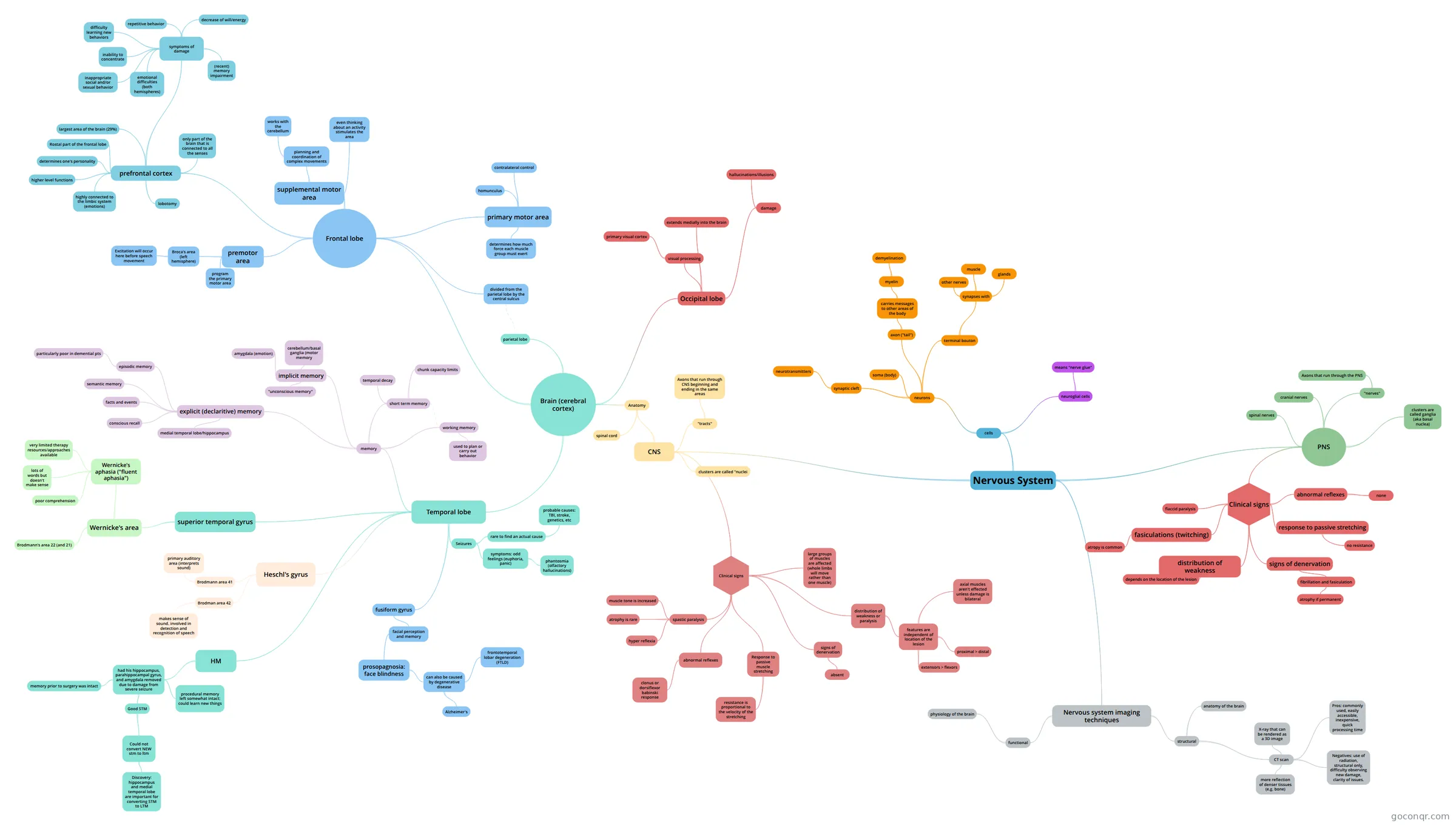
Mind map: Nervous system
Inhalt der Mindmap
Nervous System
CNS
- Anatomy
- Brain (cerebral cortex)
- Occipital lobe
- visual processing
- primary visual cortex
- extends medially into the brain
- damage
- hallucinations/illusions
- visual processing
- Frontal lobe
- prefrontal cortex
- Rostal part of the frontal lobe
- higher level functions
- •The ability to concentrate and attend, elaboration of thought. Executive functioning (judgment, inhibition). Personality and emotional traits. •Planning, it reigns in the impulsive aspects of our behavior.
- determines one's personality
- symptoms of damage
- (recent) memory impairment
- inability to concentrate
- difficulty learning new behaviors
- inappropriate social and/or sexual behavior
- emotional difficulties (both hemispheres)
- decrease of will/energy
- repetitive behavior
- highly connected to the limbic system (emotions)
- largest area of the brain (29%)
- only part of the brain that is connected to all the senses
- lobotomy
- premotor area
- Broca's area (left hemisphere)
- Excitation will occur here before speech movement
- program the primary motor area
- Broca's area (left hemisphere)
- supplemental motor area
- planning and coordination of complex movements
- works with the cerebellum
- even thinking about an activity stimulates the area
- planning and coordination of complex movements
- primary motor area
- homunculus
- contralateral control
- determines how much force each muscle group must exert
- divided from the parietal lobe by the central sulcus
- prefrontal cortex
- parietal lobe
- Temporal lobe
- The temporal lobes process emotions, fight-or-flight reactions, and are important for short-term memory.
- Heschl's gyrus
- Brodmann area 41
- primary auditory area (interprets sound)
- Brodman area 42
- makes sense of sound. involved in detection and recognition of speech
- Brodmann area 41
- superior temporal gyrus
- Wernicke's area
- Brodmann's area 22 (and 21)
- Wernicke's aphasia ("fluent aphasia")
- lots of words but doesn't make sense
- poor comprehension
- very limited therapy resources/approaches available
- Wernicke's area
- Seizures
- occurs when part(s) of the brain receives a burst of abnormal electrical signals that temporarily interrupts normal electrical brain function.
- symptoms: odd feelings (euphoria, panic)
- phantosmia (olfactory hallucinations)
- rare to find an actual cause
- probable causes: TBI, stroke, genetics, etc
- memory
- explicit (declaritive) memory
- semantic memory
- memory that is independent of context. That thing in the sky is a plane
- episodic memory
- particularly poor in demential pts
- facts and events
- conscious recall
- medial temporal lobe/hippocampus
- semantic memory
- implicit memory
- amygdala (emotion)
- cerebellum/basal ganglia (motor memory
- "unconscious memory"
- short term memory
- temporal decay
- chunk capacity limits
- working memory
- used to plan or carry out behavior
- explicit (declaritive) memory
- HM
- had his hippocampus, parahippocampal gyrus, and amygdala removed due to damage from severe seizure
- memory prior to surgery was intact
- Good STM
- Could not convert NEW stm to ltm
- Discovery: hippocampus and medial temporal lobe are important for converting STM to LTM
- Could not convert NEW stm to ltm
- procedural memory left somewhat intact: could learn new things
- had his hippocampus, parahippocampal gyrus, and amygdala removed due to damage from severe seizure
- fusiform gyrus
- facial perception and memory
- prosopagnosia: face blindness
- Prosopagnosia can be socially crippling. Individuals with the disorder often have difficulty recognizing family members and close friends. They often use other ways to identify people, such as relying on voice, clothing, or unique physical attributes, but these are not as effective as recognizing a face. Children with congenital prosopagnosia are born with the disability and have never had a time when they could recognize faces
- •Most prosopagnosics learn to cope early on. They distinguish people based on cues like hairstyle, voice, gait or body shape. They avoid places where they could unexpectedly run into someone they know. They pretend to be lost in thought while walking down the street. They act friendly to everyone--or to no one. In short, they become expert at masking their dysfunction. "This is probably why [the disorder] went unnoticed for so long,"
- can also be caused by degenerative disease
- Alzheimer's
- frontotemporal lobar degeneration (FTLD)
- prosopagnosia: face blindness
- facial perception and memory
- Occipital lobe
- spinal cord
- Brain (cerebral cortex)
- "tracts"
- Axons that run through CNS beginning and ending in the same areas
- clusters are called "nuclei
- Clinical signs
- spastic paralysis
- hyper reflexia
- atrophy is rare
- muscle tone is increased
- large groups of muscles are affected (whole limbs will move rather than one muscle)
- abnormal reflexes
- clonus or dorsiflexor babinski response
- Response to passive muscle stretching
- resistance is proportional to the velocity of the stretching
- signs of denervation
- absent
- The motoneuron is intact and exerts its essential trophic effect. There may be no atrophy at all, because the excess muscle tone provides significant exercise -- or may atrophy due to disuse.
- absent
- distribution of weakness or paralysis
- features are independent of location of the lesion
- extensors > flexors
- proximal > distal
- axial muscles aren't effected unless damage is bilateral
- features are independent of location of the lesion
- spastic paralysis
- Anatomy
PNS
- "nerves"
- Axons that run through the PNS
- cranial nerves
- spinal nerves
- clusters are called ganglia (aka basal nuclea)
- Clinical signs
- flaccid paralysis
- fasiculations (twitching)
- atropy is common
- distribution of weakness
- depends on the location of the lesion
- signs of denervation
- fibrillation and fasiculation
- atrophy if permanent
- fibrillation and fasiculation
- response to passive stretching
- no resistance
- abnormal reflexes
- none
- "nerves"
cells
- neurons
- soma (body)
- axon ("tail")
- carries messages to other areas of the body
- myelin
- demyelination
- myelin
- carries messages to other areas of the body
- terminal bouton
- synapses with
- other nerves
- muscle
- glands
- synapses with
- synaptic cleft
- neurotransmitters
- neuroglial cells
- means "nerve glue"
- neurons
Nervous system imaging techniques
- functional
- physiology of the brain
- structural
- anatomy of the brain
- CT scan
- X-ray that can be rendered as a 3D image
- more reflection of denser tissues (e.g. bone)
- Pros: commonly used, easily accessible, inexpensive, quick processing time
- Negatives: use of radiation, structural only, difficulty observing new damage, clarity of issues.
- functional
Informationen
- Beschreibung
- Neural Bases (Exam 1) Mindmap am Nervous System, erstellt von Stashia Casimir am 20/09/2017.
- Erstellt von
- Stashia Casimir
- Aufrufe
- 0
- Bewertung