
Mindmap
Pattern Formation
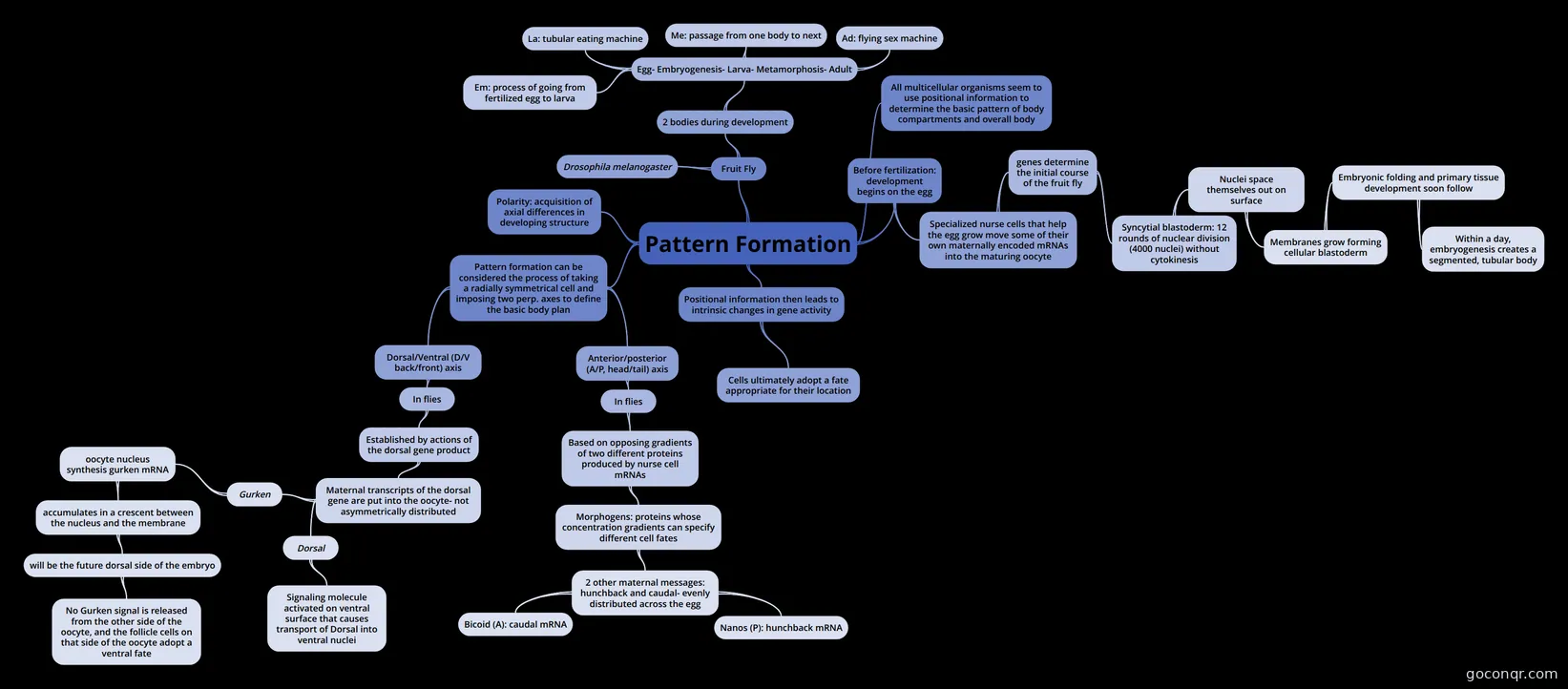
Mind map: Pattern formation
Inhalt der Mindmap
Pattern Formation
All multicellular organisms seem to use positional information to determine the basic pattern of body compartments and overall body
Positional information then leads to intrinsic changes in gene activity
- Cells ultimately adopt a fate appropriate for their location
Pattern formation can be considered the process of taking a radially symmetrical cell and imposing two perp. axes to define the basic body plan
- Anterior/posterior (A/P, head/tail) axis
- In flies
- Based on opposing gradients of two different proteins produced by nurse cell mRNAs
- Morphogens: proteins whose concentration gradients can specify different cell fates
- 2 other maternal messages: hunchback and caudal- evenly distributed across the egg
- Bicoid (A): caudal mRNA
- Nanos (P): hunchback mRNA
- 2 other maternal messages: hunchback and caudal- evenly distributed across the egg
- Morphogens: proteins whose concentration gradients can specify different cell fates
- Based on opposing gradients of two different proteins produced by nurse cell mRNAs
- In flies
- Dorsal/Ventral (D/V back/front) axis
- In flies
- Established by actions of the dorsal gene product
- Maternal transcripts of the dorsal gene are put into the oocyte- not asymmetrically distributed
- Gurken
- oocyte nucleus synthesis gurken mRNA
- accumulates in a crescent between the nucleus and the membrane
- will be the future dorsal side of the embryo
- No Gurken signal is released from the other side of the oocyte, and the follicle cells on that side of the oocyte adopt a ventral fate
- will be the future dorsal side of the embryo
- accumulates in a crescent between the nucleus and the membrane
- oocyte nucleus synthesis gurken mRNA
- Dorsal
- Signaling molecule activated on ventral surface that causes transport of Dorsal into ventral nuclei
- Gurken
- Maternal transcripts of the dorsal gene are put into the oocyte- not asymmetrically distributed
- Established by actions of the dorsal gene product
- In flies
- Anterior/posterior (A/P, head/tail) axis
Polarity: acquisition of axial differences in developing structure
Fruit Fly
- Drosophila melanogaster
- 2 bodies during development
- Egg- Embryogenesis- Larva- Metamorphosis- Adult
- Em: process of going from fertilized egg to larva
- La: tubular eating machine
- Me: passage from one body to next
- Ad: flying sex machine
- Egg- Embryogenesis- Larva- Metamorphosis- Adult
Before fertilization: development begins on the egg
- Specialized nurse cells that help the egg grow move some of their own maternally encoded mRNAs into the maturing oocyte
- genes determine the initial course of the fruit fly
- Syncytial blastoderm: 12 rounds of nuclear division (4000 nuclei) without cytokinesis
- Nuclei space themselves out on surface
- Membranes grow forming cellular blastoderm
- Embryonic folding and primary tissue development soon follow
- Within a day, embryogenesis creates a segmented, tubular body
- Embryonic folding and primary tissue development soon follow
- Membranes grow forming cellular blastoderm
- Nuclei space themselves out on surface
- Syncytial blastoderm: 12 rounds of nuclear division (4000 nuclei) without cytokinesis
- genes determine the initial course of the fruit fly
- Specialized nurse cells that help the egg grow move some of their own maternally encoded mRNAs into the maturing oocyte
Informationen
- Beschreibung
- Biology (Chapter 19: Mechanisms of Development) Mindmap am Pattern Formation, erstellt von Alicia McCormack am 16/11/2017.
- Erstellt von
- Alicia McCormack
- Aufrufe
- 0
- Bewertung