
Mindmap
ENZYMES AND CELL PROCESSES
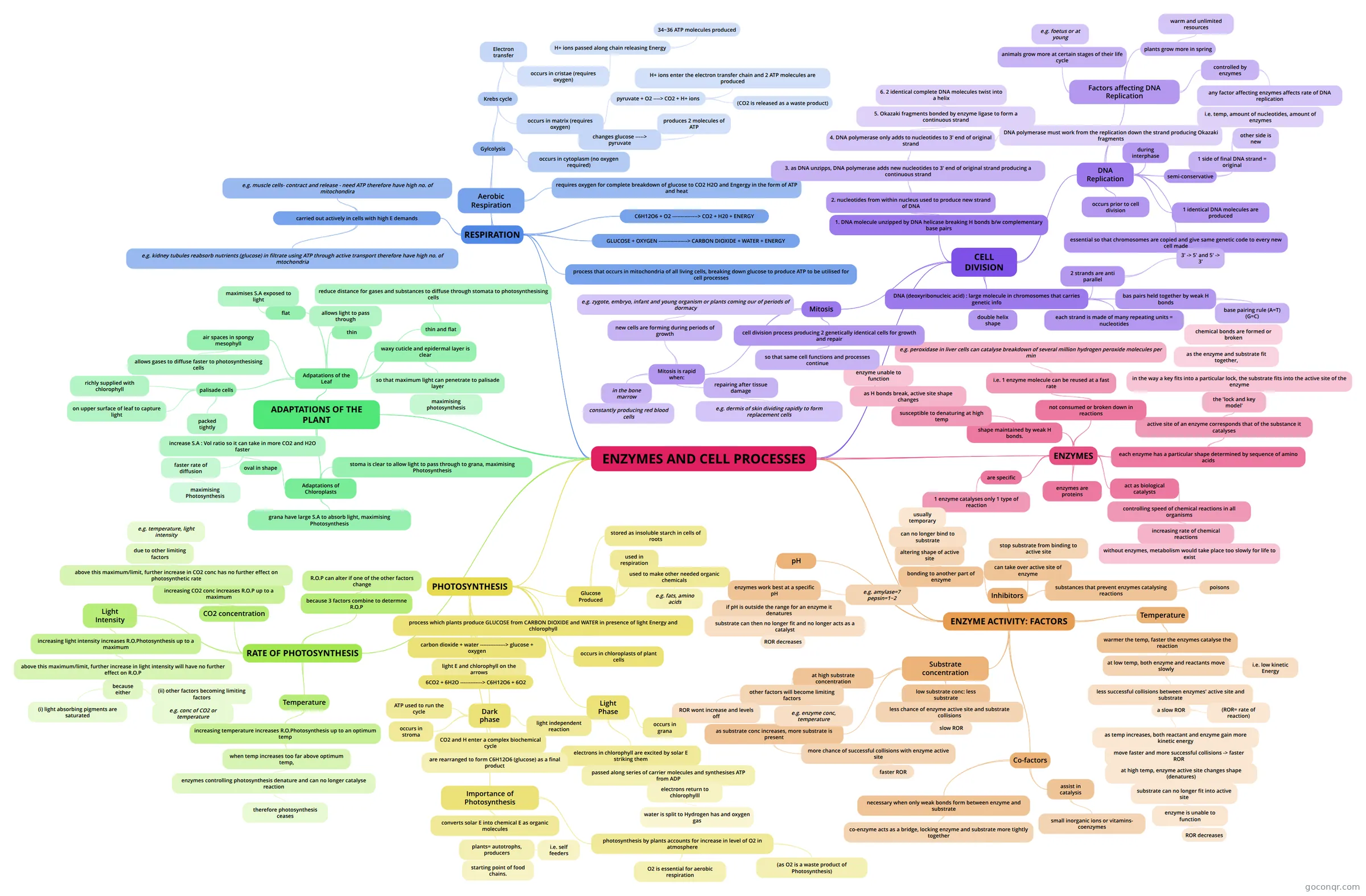
Mind map: Enzymes and cell processes
Inhalt der Mindmap
ENZYMES AND CELL PROCESSES
ENZYMES
- enzymes are proteins
- act as biological catalysts
- controlling speed of chemical reactions in all organisms
- increasing rate of chemical reactions
- without enzymes, metabolism would take place too slowly for life to exist
- increasing rate of chemical reactions
- controlling speed of chemical reactions in all organisms
- are specific
- 1 enzyme catalyses only 1 type of reaction
- each enzyme has a particular shape determined by sequence of amino acids
- active site of an enzyme corresponds that of the substance it catalyses
- the 'lock and key model'
- in the way a key fits into a particular lock, the substrate fits into the active site of the enzyme
- as the enzyme and substrate fit together,
- chemical bonds are formed or broken
- as the enzyme and substrate fit together,
- in the way a key fits into a particular lock, the substrate fits into the active site of the enzyme
- the 'lock and key model'
- active site of an enzyme corresponds that of the substance it catalyses
- not consumed or broken down in reactions
- i.e. 1 enzyme molecule can be reused at a fast rate
- e.g. peroxidase in liver cells can catalyse breakdown of several million hydrogen peroxide molecules per min
- i.e. 1 enzyme molecule can be reused at a fast rate
- shape maintained by weak H bonds.
- susceptible to denaturing at high temp
- as H bonds break, active site shape changes
- enzyme unable to function
- as H bonds break, active site shape changes
- susceptible to denaturing at high temp
ENZYME ACTIVITY: FACTORS
- Temperature
- warmer the temp, faster the enzymes catalyse the reaction
- at low temp, both enzyme and reactants move slowly
- i.e. low kinetic Energy
- less successful collisions between enzymes' active site and substrate
- a slow ROR
- as temp increases, both reactant and enzyme gain more kinetic energy
- move faster and more successful collisions -> faster ROR
- at high temp, enzyme active site changes shape (denatures)
- substrate can no longer fit into active site
- enzyme is unable to function
- ROR decreases
- enzyme is unable to function
- substrate can no longer fit into active site
- at high temp, enzyme active site changes shape (denatures)
- move faster and more successful collisions -> faster ROR
- (ROR= rate of reaction)
- as temp increases, both reactant and enzyme gain more kinetic energy
- a slow ROR
- at low temp, both enzyme and reactants move slowly
- warmer the temp, faster the enzymes catalyse the reaction
- Substrate concentration
- low substrate conc: less substrate
- less chance of enzyme active site and substrate collisions
- slow ROR
- less chance of enzyme active site and substrate collisions
- as substrate conc increases, more substrate is present
- more chance of successful collisions with enzyme active site
- faster ROR
- more chance of successful collisions with enzyme active site
- at high substrate concentration
- other factors will become limiting factors
- ROR wont increase and levels off
- e.g. enzyme conc, temperature
- other factors will become limiting factors
- low substrate conc: less substrate
- pH
- enzymes work best at a specific pH
- if pH is outside the range for an enzyme it denatures
- substrate can then no longer fit and no longer acts as a catalyst
- ROR decreases
- substrate can then no longer fit and no longer acts as a catalyst
- e.g. amylase=7 pepsin=1~2
- if pH is outside the range for an enzyme it denatures
- enzymes work best at a specific pH
- Co-factors
- assist in catalysis
- small inorganic ions or vitamins- coenzymes
- necessary when only weak bonds form between enzyme and substrate
- co-enzyme acts as a bridge, locking enzyme and substrate more tightly together
- assist in catalysis
- Inhibitors
- substances that prevent enzymes catalysing reactions
- poisons
- can take over active site of enzyme
- stop substrate from binding to active site
- bonding to another part of enzyme
- altering shape of active site
- can no longer bind to substrate
- usually temporary
- can no longer bind to substrate
- altering shape of active site
- substances that prevent enzymes catalysing reactions
- Temperature
PHOTOSYNTHESIS
- occurs in chloroplasts of plant cells
- process which plants produce GLUCOSE from CARBON DIOXIDE and WATER in presence of light Energy and chlorophyll
- carbon dioxide + water ---------------> glucose + oxygen
- light E and chlorophyll on the arrows
- 6CO2 + 6H2O -------------> C6H12O6 + 6O2
- Light Phase
- occurs in grana
- electrons in chlorophyll are excited by solar E striking them
- passed along series of carrier molecules and synthesises ATP from ADP
- electrons return to chlorophylll
- water is split to Hydrogen has and oxygen gas
- electrons return to chlorophylll
- passed along series of carrier molecules and synthesises ATP from ADP
- Dark phase
- light independent reaction
- occurs in stroma
- CO2 and H enter a complex biochemical cycle
- are rearranged to form C6H12O6 (glucose) as a final product
- ATP used to run the cycle
- Glucose Produced
- stored as insoluble starch in cells of roots
- used in respiration
- used to make other needed organic chemicals
- e.g. fats, amino acids
- Importance of Photosynthesis
- converts solar E into chemical E as organic molecules
- plants= autotrophs, producers
- i.e. self feeders
- starting point of food chains.
- plants= autotrophs, producers
- photosynthesis by plants accounts for increase in level of O2 in atmosphere
- O2 is essential for aerobic respiration
- (as O2 is a waste product of Photosynthesis)
- converts solar E into chemical E as organic molecules
RATE OF PHOTOSYNTHESIS
- Temperature
- increasing temperature increases R.O.Photosynthesis up to an optimum temp
- when temp increases too far above optimum temp,
- enzymes controlling photosynthesis denature and can no longer catalyse reaction
- therefore photosynthesis ceases
- enzymes controlling photosynthesis denature and can no longer catalyse reaction
- when temp increases too far above optimum temp,
- increasing temperature increases R.O.Photosynthesis up to an optimum temp
- Light Intensity
- increasing light intensity increases R.O.Photosynthesis up to a maximum
- above this maximum/limit, further increase in light intensity will have no further effect on R.O.P
- because either
- (i) light absorbing pigments are saturated
- (ii) other factors becoming limiting factors
- e.g. conc of CO2 or temperature
- because either
- above this maximum/limit, further increase in light intensity will have no further effect on R.O.P
- increasing light intensity increases R.O.Photosynthesis up to a maximum
- CO2 concentration
- increasing CO2 conc increases R.O.P up to a maximum
- above this maximum/limit, further increase in CO2 conc has no further effect on photosynthetic rate
- due to other limiting factors
- e.g. temperature, light intensity
- due to other limiting factors
- above this maximum/limit, further increase in CO2 conc has no further effect on photosynthetic rate
- increasing CO2 conc increases R.O.P up to a maximum
- because 3 factors combine to determne R.O.P
- R.O.P can alter if one of the other factors change
- Temperature
ADAPTATIONS OF THE PLANT
- Adaptations of Chloroplasts
- grana have large S.A to absorb light, maximising Photosynthesis
- stoma is clear to allow light to pass through to grana, maximising Photosynthesis
- oval in shape
- increase S.A : Vol ratio so it can take in more CO2 and H2O faster
- faster rate of diffusion
- maximising Photosynthesis
- faster rate of diffusion
- increase S.A : Vol ratio so it can take in more CO2 and H2O faster
- Adpatations of the Leaf
- waxy cuticle and epidermal layer is clear
- so that maximum light can penetrate to palisade layer
- maximising photosynthesis
- so that maximum light can penetrate to palisade layer
- thin and flat
- reduce distance for gases and substances to diffuse through stomata to photosynthesising cells
- thin
- allows light to pass through
- flat
- maximises S.A exposed to light
- air spaces in spongy mesophyll
- allows gases to diffuse faster to photosynthesising cells
- palisade cells
- richly supplied with chlorophyll
- on upper surface of leaf to capture light
- packed tightly
- waxy cuticle and epidermal layer is clear
- Adaptations of Chloroplasts
RESPIRATION
- process that occurs in mitochondria of all living cells, breaking down glucose to produce ATP to be utilised for cell processes
- GLUCOSE + OXYGEN -----------------> CARBON DIOXIDE + WATER + ENERGY
- C6H12O6 + O2 ---------------> CO2 + H20 + ENERGY
- Aerobic Respiration
- requires oxygen for complete breakdown of glucose to CO2 H2O and Engergy in the form of ATP and heat
- Gylcolysis
- occurs in cytoplasm (no oxygen required)
- changes glucose -----> pyruvate
- produces 2 molecules of ATP
- changes glucose -----> pyruvate
- Krebs cycle
- occurs in matrix (requires oxygen)
- pyruvate + O2 ----> CO2 + H+ ions
- (CO2 is released as a waste product)
- H+ ions enter the electron transfer chain and 2 ATP molecules are produced
- pyruvate + O2 ----> CO2 + H+ ions
- Electron transfer
- occurs in cristae (requires oxygen)
- H+ ions passed along chain releasing Energy
- 34~36 ATP molecules produced
- H+ ions passed along chain releasing Energy
- occurs in cristae (requires oxygen)
- occurs in matrix (requires oxygen)
- occurs in cytoplasm (no oxygen required)
- carried out actively in cells with high E demands
- e.g. muscle cells- contract and release - need ATP therefore have high no. of mitochondira
- e.g. kidney tubules reabsorb nutrients (glucose) in filtrate using ATP through active transport therefore have high no. of mtochondria
CELL DIVISION
- DNA (deoxyribonucleic acid) : large molecule in chromosomes that carries genetic info
- double helix shape
- each strand is made of many repeating units = nucleotides
- bas pairs held together by weak H bonds
- base pairing rule (A=T) (G=C)
- 2 strands are anti parallel
- 3' -> 5' and 5' -> 3'
- DNA Replication
- essential so that chromosomes are copied and give same genetic code to every new cell made
- occurs prior to cell division
- 1 identical DNA molecules are produced
- semi-conservative
- 1 side of final DNA strand = original
- other side is new
- 1 side of final DNA strand = original
- Factors affecting DNA Replication
- controlled by enzymes
- any factor affecting enzymes affects rate of DNA replication
- i.e. temp, amount of nucleotides, amount of enzymes
- any factor affecting enzymes affects rate of DNA replication
- plants grow more in spring
- warm and unlimited resources
- animals grow more at certain stages of their life cycle
- e.g. foetus or at young
- controlled by enzymes
- during interphase
- 1. DNA molecule unzipped by DNA helicase breaking H bonds b/w complementary base pairs
- 2. nucleotides from within nucleus used to produce new strand of DNA
- 3. as DNA unzipps, DNA polymerase adds new nucleotides to 3' end of original strand producing a continuous strand
- 4. DNA polymerase only adds to nucleotides to 3' end of original strand
- DNA polymerase must work from the replication down the strand producing Okazaki fragments
- 5. Okazaki fragments bonded by enzyme ligase to form a continuous strand
- 6. 2 identical complete DNA molecules twist into a helix
- 4. DNA polymerase only adds to nucleotides to 3' end of original strand
- 3. as DNA unzipps, DNA polymerase adds new nucleotides to 3' end of original strand producing a continuous strand
- 2. nucleotides from within nucleus used to produce new strand of DNA
- Mitosis
- cell division process producing 2 genetically identical cells for growth and repair
- so that same cell functions and processes continue
- Mitosis is rapid when:
- new cells are forming during periods of growth
- e.g. zygote, embryo, infant and young organism or plants coming our of periods of dormacy
- repairing after tissue damage
- e.g. dermis of skin dividing rapidly to form replacement cells
- in the bone marrow
- constantly producing red blood cells
- new cells are forming during periods of growth
- cell division process producing 2 genetically identical cells for growth and repair
- DNA (deoxyribonucleic acid) : large molecule in chromosomes that carries genetic info
Informationen
- Beschreibung
- Christine Lee 6th Sept 2014
- Erstellt von
- CChristine
- Aufrufe
- 40
- Tags
- Bewertung