
Mindmap
Piaget
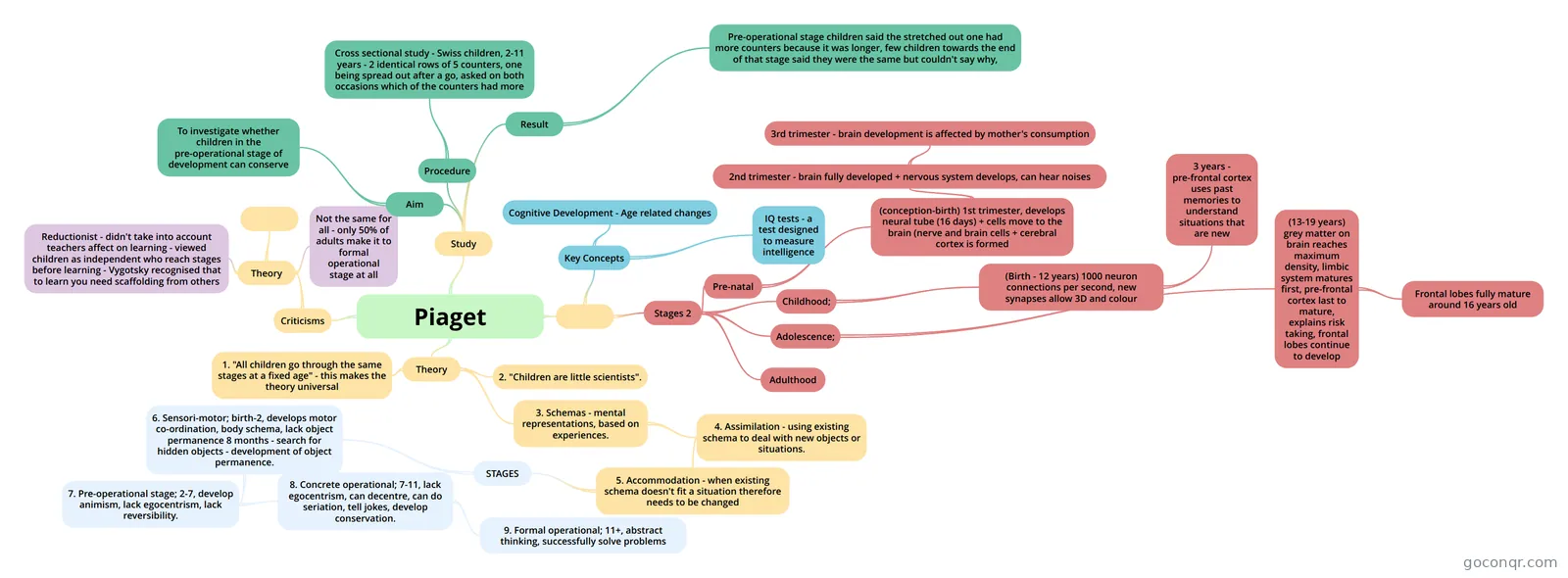
Mind map: Piaget's Theory: Study, Criticisms, Schemas
Inhalt der Mindmap
Piaget
Theory
- 1. "All children go through the same stages at a fixed age" - this makes the theory universal
- 2. "Children are little scientists".
- 3. Schemas - mental representations, based on experiences.
- 4. Assimilation - using existing schema to deal with new objects or situations.
- 5. Accommodation - when existing schema doesn't fit a situation therefore needs to be changed
- STAGES
- 6. Sensori-motor; birth-2, develops motor co-ordination, body schema, lack object permanence 8 months - search for hidden objects - development of object permanence.
- 7. Pre-operational stage; 2-7, develop animism, lack egocentrism, lack reversibility.
- 8. Concrete operational; 7-11, lack egocentrism, can decentre, can do seriation, tell jokes, develop conservation.
- 9. Formal operational; 11+, abstract thinking, successfully solve problems
- 8. Concrete operational; 7-11, lack egocentrism, can decentre, can do seriation, tell jokes, develop conservation.
- 7. Pre-operational stage; 2-7, develop animism, lack egocentrism, lack reversibility.
- 6. Sensori-motor; birth-2, develops motor co-ordination, body schema, lack object permanence 8 months - search for hidden objects - development of object permanence.
- STAGES
- 5. Accommodation - when existing schema doesn't fit a situation therefore needs to be changed
- 4. Assimilation - using existing schema to deal with new objects or situations.
Study
- Aim
- To investigate whether children in the pre-operational stage of development can conserve
- Procedure
- Cross sectional study - Swiss children, 2-11 years - 2 identical rows of 5 counters, one being spread out after a go, asked on both occasions which of the counters had more
- Result
- Pre-operational stage children said the stretched out one had more counters because it was longer, few children towards the end of that stage said they were the same but couldn't say why,
- Aim
Criticisms
- Theory
- Reductionist - didn't take into account teachers affect on learning - viewed children as independent who reach stages before learning - Vygotsky recognised that to learn you need scaffolding from others
- Not the same for all - only 50% of adults make it to formal operational stage at all
- Theory
·
- Key Concepts
- Cognitive Development - Age related changes
- IQ tests - a test designed to measure intelligence
- Stages 2
- Childhood;
- (Birth - 12 years) 1000 neuron connections per second, new synapses allow 3D and colour
- 3 years - pre-frontal cortex uses past memories to understand situations that are new
- (Birth - 12 years) 1000 neuron connections per second, new synapses allow 3D and colour
- Adolescence;
- (13-19 years) grey matter on brain reaches maximum density, limbic system matures first, pre-frontal cortex last to mature, explains risk taking, frontal lobes continue to develop
- Frontal lobes fully mature around 16 years old
- (13-19 years) grey matter on brain reaches maximum density, limbic system matures first, pre-frontal cortex last to mature, explains risk taking, frontal lobes continue to develop
- Pre-natal
- (conception-birth) 1st trimester, develops neural tube (16 days) + cells move to the brain (nerve and brain cells + cerebral cortex is formed
- 2nd trimester - brain fully developed + nervous system develops, can hear noises
- 3rd trimester - brain development is affected by mother's consumption
- 2nd trimester - brain fully developed + nervous system develops, can hear noises
- (conception-birth) 1st trimester, develops neural tube (16 days) + cells move to the brain (nerve and brain cells + cerebral cortex is formed
- Adulthood
- Childhood;
- Key Concepts