
Cognitive Development
657 resources created by 472 users
This Cognitive Development page on GoConqr gathers community-made mind maps, flashcards, quizzes, notes and slide sets, from Piaget's stages and Vygotsky's social theory to theory of mind and infant perception. It's built for university students and professional candidates, school students, and teachers after ready-made material. There are over 600 resources here, including more than 40 quizzes, over 400 mind maps and more than 100 flashcard decks, shared by over 450 contributors. Pick a topic and try a quiz to find your gaps.
Top Cognitive Development resources
-
102 cardsTheory Of Mind in Autism
-
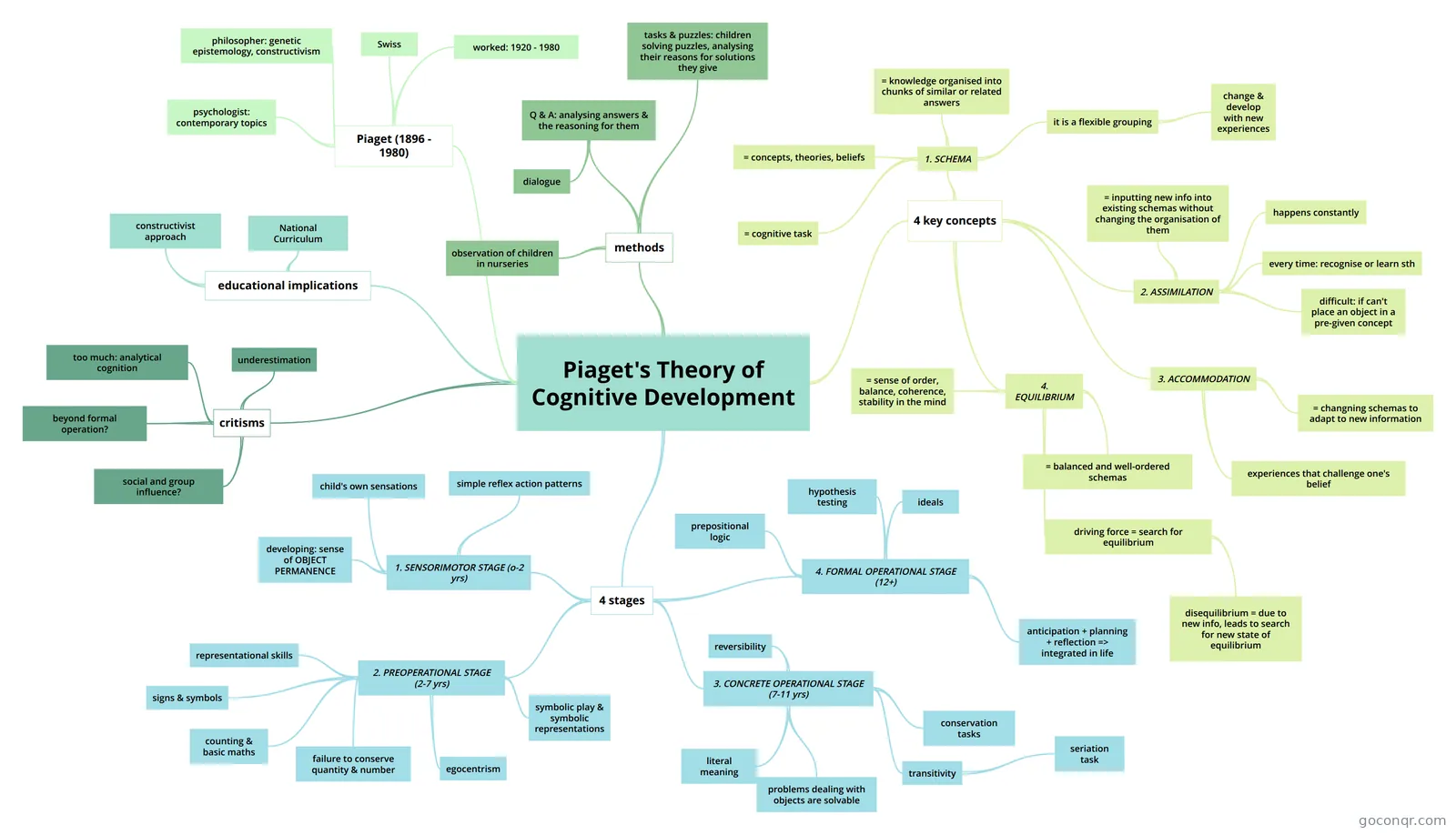 Mind map Piaget's Theory of Cognitive Development
-
83 cardsDevelopmental Piaget's 4 stages of development: *development happens in stages, each stage is an adaptation to overcome e...
-
67 questionsChapter 9 Review Piaget described human thought in terms of two basic concepts:
-
45 cardsCognitive Foundations Chapter 3
-
36 cardsFlashcards for Piaget topic What is genetic epistemology in Piagetian theory
-
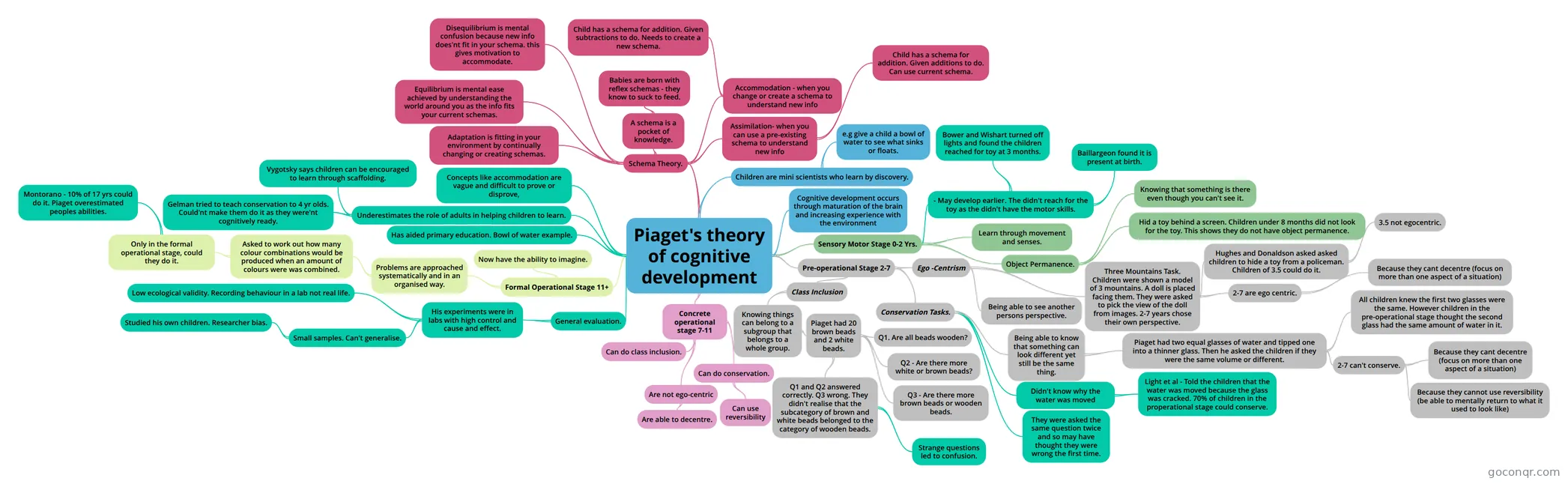 Mind map Piaget's theory of cognitive development Mind map including sensory - motor, pre-op, conc-op and formal - op. used for PSYB3
-
Mind map Samuel and Bryant 1984 Samuel, J. and Bryant, P. (1984) Asking only one question in the conservation experiment
Quizzes
See all 52 quizzes-
67 questionsChapter 9 Review Piaget described human thought in terms of two basic concepts:
-
6 questionsWeek 5 - Piaget
-
51 questionsAdvanced Development Exam 2
-
35 questionsCh 9 Psych Early Development: Growth and Basic Abilities Before Birth After Birth Basic infant abilities Piaget’s Theo...
-
10 questionsCognitive Development Quiz You are babysitting a 4 year old twins (Sarah and Seraphim). You get a juice box for each of the twins, but...
-
32 questionsChapter 6: Infant Studies Assimilation, taking in info that is compatible with what one already knows, is acoordining to which theorist?
-
21 questionsAlternative cognitive development which psychologist studied object permanence and concluded it is innate.
-
18 questionsLecture 4 Developmental Outline the stages of the information model of learning
Mind maps
See all 434 mind maps-
Piaget's Theory of Cognitive Development
-
Piaget's theory of cognitive development Mind map including sensory - motor, pre-op, conc-op and formal - op. used for PSYB3
-
Samuel and Bryant 1984 Samuel, J. and Bryant, P. (1984) Asking only one question in the conservation experiment
-
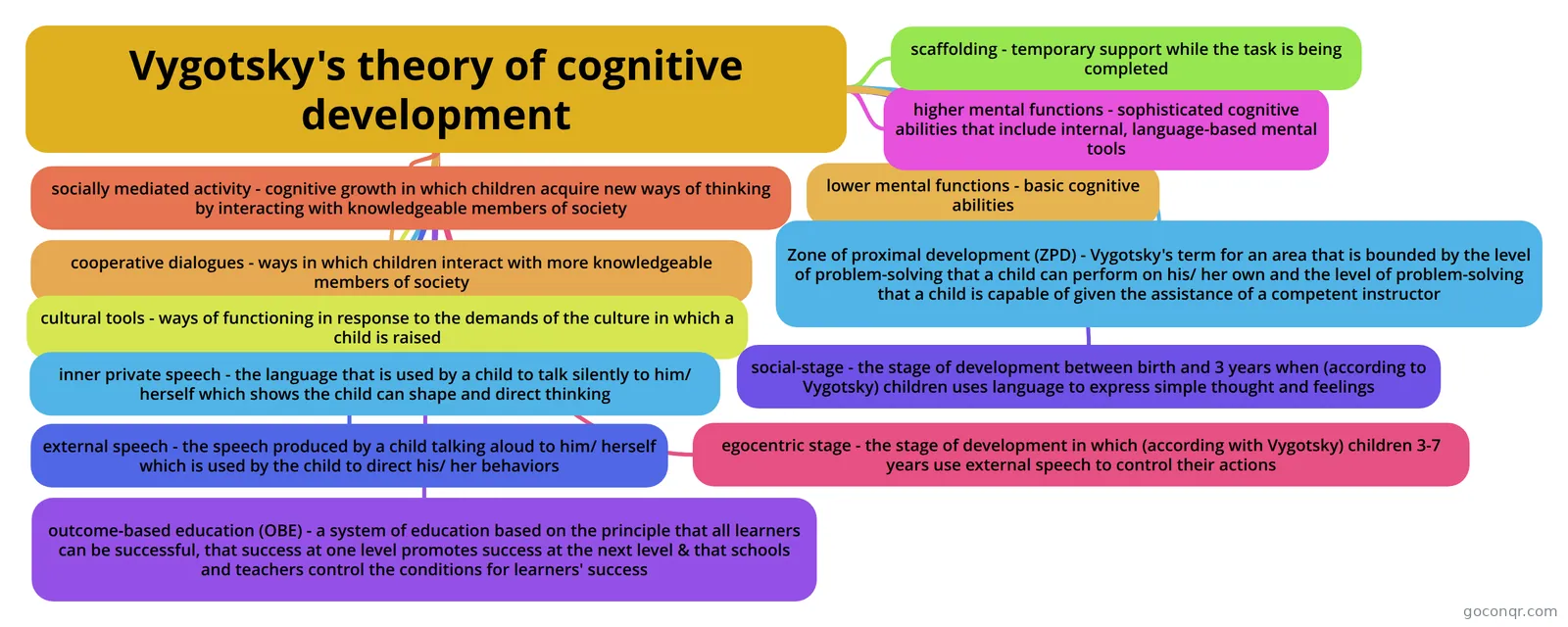 Vygotsky's theory of cognitive development
-
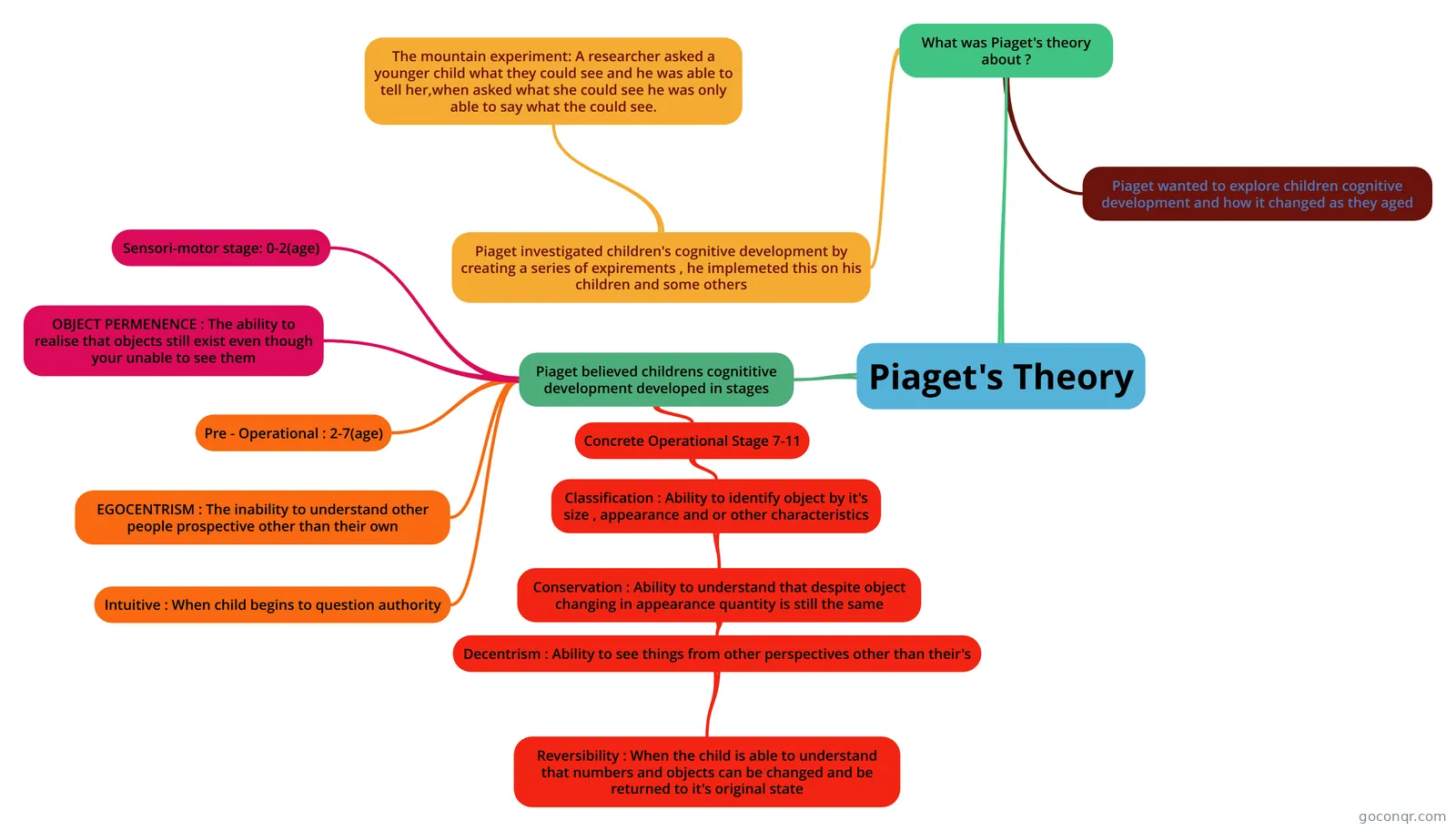 Piaget's Theory
-
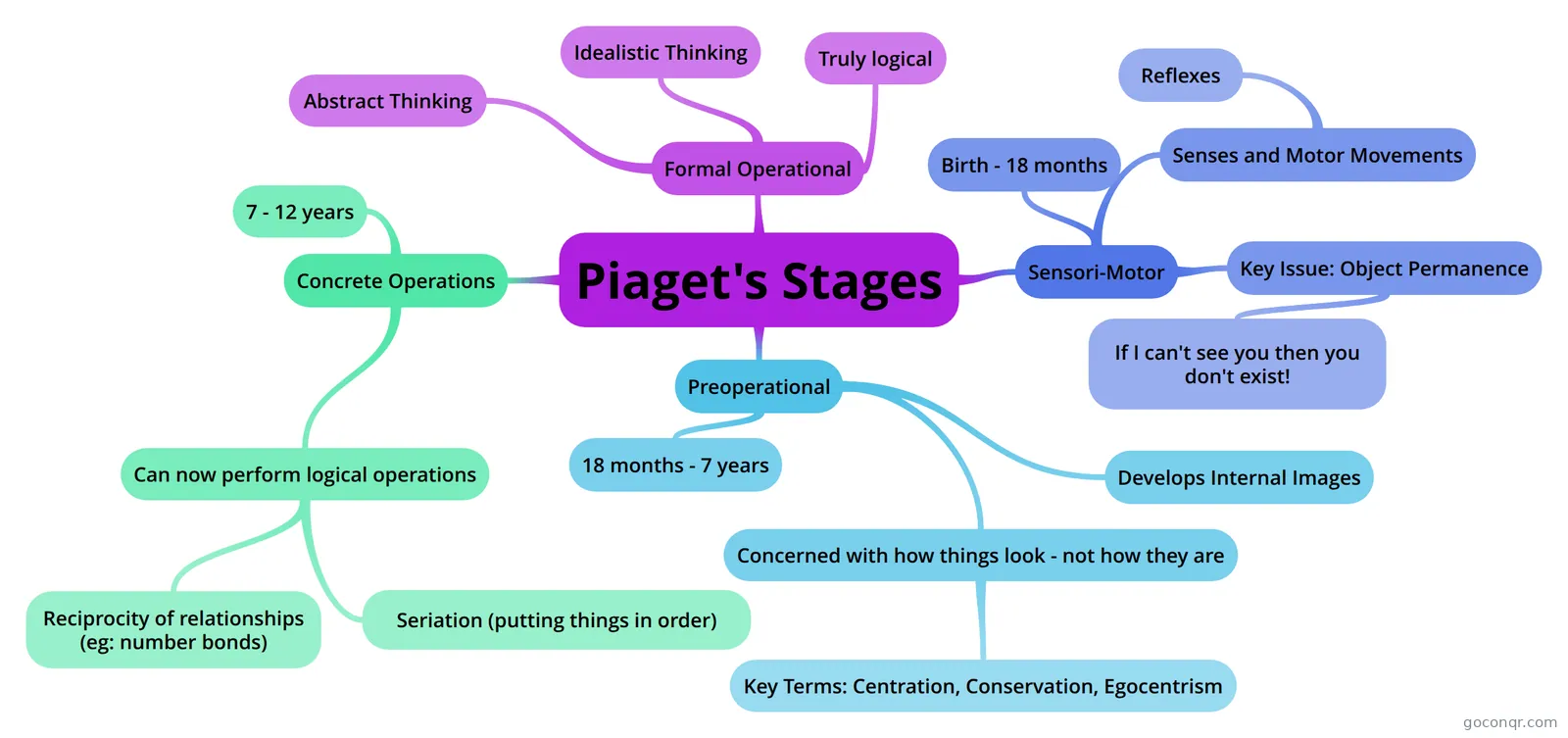 Piaget's Stages Piaget's stages in a mind map
-
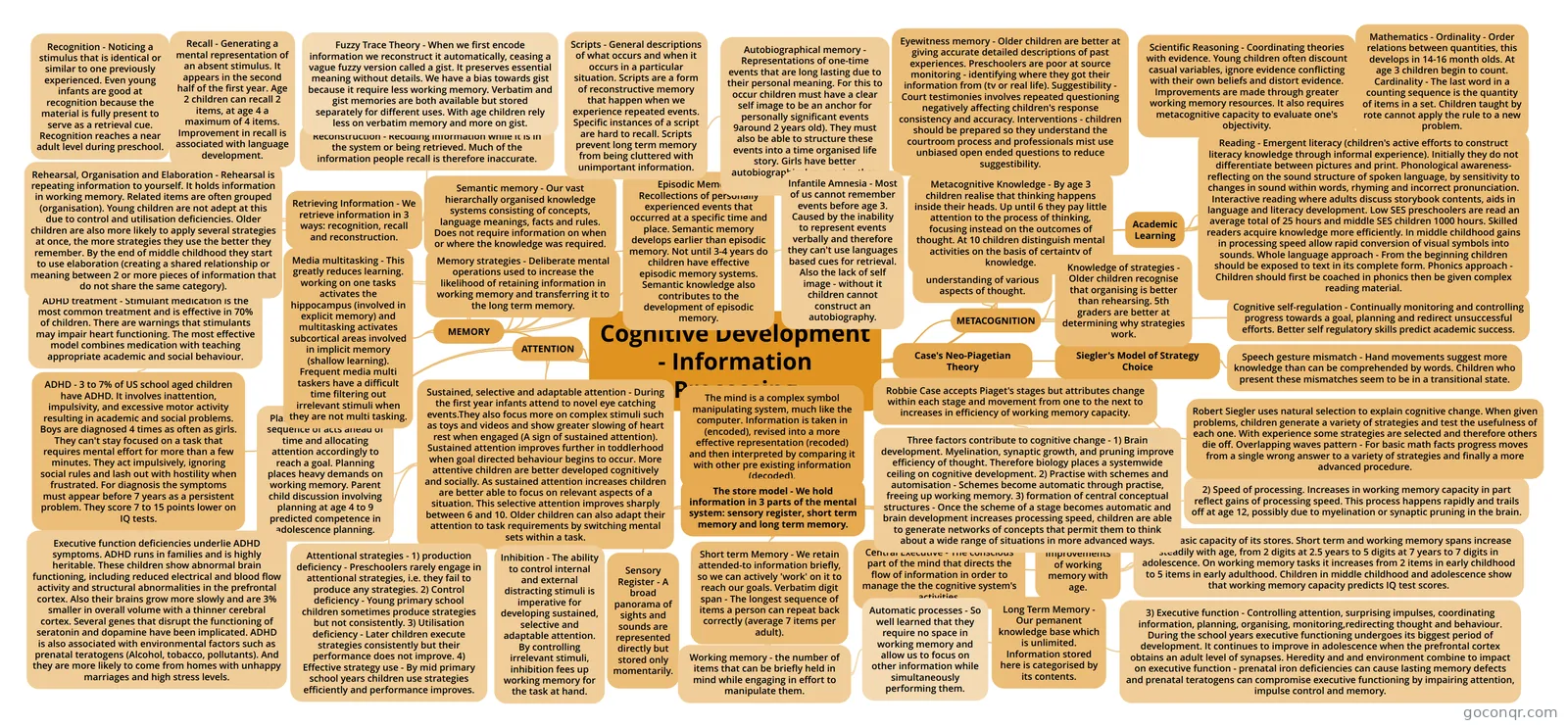 Cognitive Development - Information Processing
-
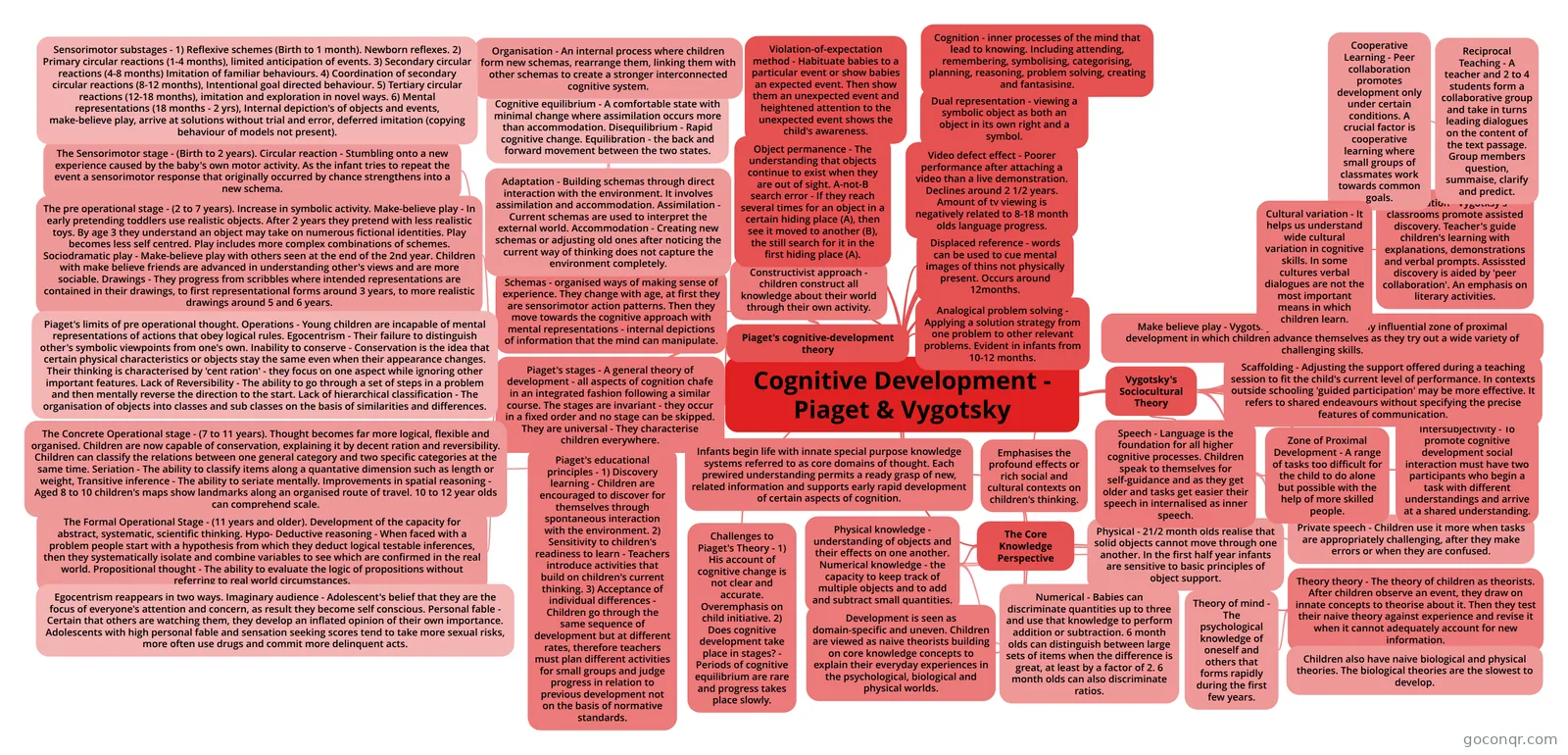 Cognitive Development - Piaget & Vygotsky
Flashcards
See all 128 flashcards-
102 cardsTheory Of Mind in Autism
-
83 cardsDevelopmental Piaget's 4 stages of development: *development happens in stages, each stage is an adaptation to overcome e...
-
45 cardsCognitive Foundations Chapter 3
-
36 cardsFlashcards for Piaget topic What is genetic epistemology in Piagetian theory
-
50 cardsDevelopmental Psych Chapter 6 Piaget’s word for the basic actions of knowing, including both physical actions (sensorimotor schemes, such...
-
32 cardsChapter 9 - Cognitive Development Chapter 9 from the book "an introduction to developmental psychology"
-
33 cardsTerms/Phenomenon/Tests Final Exam
-
23 cardsThe development of thinking What 3 themes are associated with Piaget's theory of the development of thinking?
More Psychology topics
About Cognitive Development
GoConqr OriginalWhat this unit covers
The page is centred on how children think and how that thinking changes. Piaget is the largest thread. You will find maps on his stages, on assimilation, accommodation and equilibrium, and on the formal operational stage. There are also flashcard decks such as Piaget Stages and Piaget terms.
Beyond Piaget
- Vygotsky: the mind map on Vygotsky's theory of cognitive development looks at learning through interaction with knowledgeable members of society.
- Theory of mind: the flashcard deck Theory Of Mind in Autism covers false belief tests, including the unexpected transfer task by Wimmer and the study by Baron Cohen and colleagues.
- Infant abilities: there are notes and slides on Baillargeon, plus the mind map Perceptual Development: Infant Studies.
- Other accounts: look for maps on information processing, memory, attention, language and numeracy, plus a deck on Bruner.
Where to start
Begin with the mind map Piaget's Stages. It gives you the order of the stages and the key issue in each, such as object permanence in the sensorimotor stage. Then open Piaget's Theory of Cognitive Development for the wider picture. Next, move to Vygotsky and compare the two with the flashcards on comparing Piaget and Vygotsky.
Using quizzes and maps together
Read a map first, then take a quiz on the same topic. The quiz Piaget's Theory of Cognitive Development quiz is a natural match. A missed question tells you which branch to go back to. Then use flashcards for terms and for studies such as Samuel and Bryant, which tested Piaget's ideas on conservation.
Resources come from school and university courses, and some mention A-level Psychology, GCSE Psychology or AP Psychology, so check that a resource matches your course.
Where it fits
This unit sits in the Developmental Psychology strand of Psychology. Its topics link closely to language, social understanding and memory in children.
When you are ready, choose one theory, work through its map and quiz, and then make your own revision set.
Frequently asked questions
Which resource should I open first?
Start with the mind map Piaget's Stages. It lays out each stage with its age range and key issue, so it gives you a frame for everything else. After that, try the quiz Piaget's Theory of Cognitive Development quiz to check what stuck.
What do the mind maps cover?
There are over 400 mind maps. They cover Piaget's stages and adaptation, Vygotsky and social constructivism, theory of mind, infant perception, memory and attention, language, numeracy and conservation. Some are short topic summaries, while others follow a full lecture or a single study.
Are the resources free to use?
Yes. Every resource listed here is free to open, study and take, with no account needed. They were made by GoConqr users, not by GoConqr itself, so it is worth checking that a resource matches your own course.
Which levels and exams do these resources suit?
Most of the resources are at university level, with a quarter aimed at school students. Some mention A-level Psychology, GCSE Psychology or AP Psychology. Titles such as GCSE PSYCHOLOGY - COGNITIVE DEVELOPMENT make it easy to spot school-level material.
Is there anything on theory of mind?
Yes. You can use flashcard decks including Origins of Theory of Mind and Theory Of Mind in Autism, a map on why children fail theory of mind tasks, notes on empathy, and a Theory of Mind quiz. Together they cover false belief tests and key studies.
What if I can't find my topic?
Try a related term, such as conservation, symbolism or Bruner, since topics are often filed under different names. If it is still missing, you can make your own mind map, flashcards or quiz on it with a free account, which also saves your quiz scores.