
Mindmap
Public Attitudes
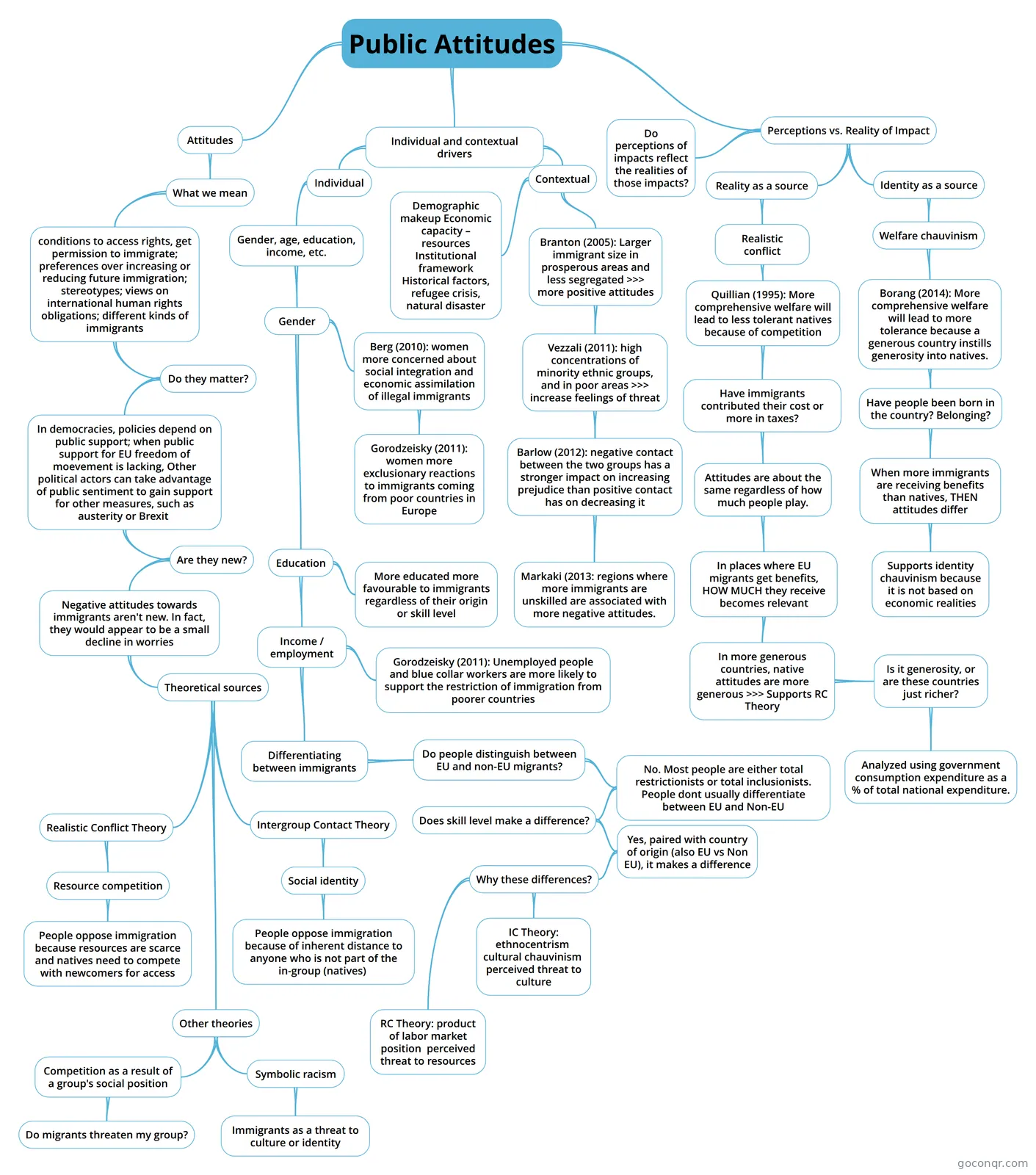
Mind map: Public attitudes
Inhalt der Mindmap
Public Attitudes
Attitudes
- What we mean
- conditions to access rights, get permission to immigrate; preferences over increasing or reducing future immigration; stereotypes; views on international human rights obligations; different kinds of immigrants
- Do they matter?
- In democracies, policies depend on public support; when public support for EU freedom of moevement is lacking, Other political actors can take advantage of public sentiment to gain support for other measures, such as austerity or Brexit
- Are they new?
- Negative attitudes towards immigrants aren't new. In fact, they would appear to be a small decline in worries
- Theoretical sources
- Realistic Conflict Theory
- Resource competition
- People oppose immigration because resources are scarce and natives need to compete with newcomers for access
- Resource competition
- Intergroup Contact Theory
- Social identity
- People oppose immigration because of inherent distance to anyone who is not part of the in-group (natives)
- Social identity
- Other theories
- Competition as a result of a group's social position
- Do migrants threaten my group?
- Symbolic racism
- Immigrants as a threat to culture or identity
- Competition as a result of a group's social position
- Realistic Conflict Theory
- Theoretical sources
- Negative attitudes towards immigrants aren't new. In fact, they would appear to be a small decline in worries
- Are they new?
- In democracies, policies depend on public support; when public support for EU freedom of moevement is lacking, Other political actors can take advantage of public sentiment to gain support for other measures, such as austerity or Brexit
- Do they matter?
- conditions to access rights, get permission to immigrate; preferences over increasing or reducing future immigration; stereotypes; views on international human rights obligations; different kinds of immigrants
- What we mean
Individual and contextual drivers
- Individual
- Gender, age, education, income, etc.
- Gender
- Berg (2010): women more concerned about social integration and economic assimilation of illegal immigrants
- Gorodzeisky (2011): women more exclusionary reactions to immigrants coming from poor countries in Europe
- Education
- Income / employment
- Gorodzeisky (2011): Unemployed people and blue collar workers are more likely to support the restriction of immigration from poorer countries
- Differentiating between immigrants
- Do people distinguish between EU and non-EU migrants?
- No. Most people are either total restrictionists or total inclusionists. People dont usually differentiate between EU and Non-EU
- Does skill level make a difference?
- Yes, paired with country of origin (also EU vs Non EU), it makes a difference
- Why these differences?
- RC Theory: product of labor market position perceived threat to resources
- IC Theory: ethnocentrism cultural chauvinism perceived threat to culture
- Why these differences?
- Yes, paired with country of origin (also EU vs Non EU), it makes a difference
- Does skill level make a difference?
- No. Most people are either total restrictionists or total inclusionists. People dont usually differentiate between EU and Non-EU
- Do people distinguish between EU and non-EU migrants?
- More educated more favourable to immigrants regardless of their origin or skill level
- Income / employment
- Berg (2010): women more concerned about social integration and economic assimilation of illegal immigrants
- Gender
- Gender, age, education, income, etc.
- Contextual
- Demographic makeup Economic capacity – resources Institutional framework Historical factors, refugee crisis, natural disaster
- Branton (2005): Larger immigrant size in prosperous areas and less segregated >>> more positive attitudes
- Vezzali (2011): high concentrations of minority ethnic groups, and in poor areas >>> increase feelings of threat
- Barlow (2012): negative contact between the two groups has a stronger impact on increasing prejudice than positive contact has on decreasing it
- Markaki (2013: regions where more immigrants are unskilled are associated with more negative attitudes.
- Barlow (2012): negative contact between the two groups has a stronger impact on increasing prejudice than positive contact has on decreasing it
- Vezzali (2011): high concentrations of minority ethnic groups, and in poor areas >>> increase feelings of threat
- Individual
Perceptions vs. Reality of Impact
- Identity as a source
- Welfare chauvinism
- Borang (2014): More comprehensive welfare will lead to more tolerance because a generous country instills generosity into natives.
- Have people been born in the country? Belonging?
- When more immigrants are receiving benefits than natives, THEN attitudes differ
- Supports identity chauvinism because it is not based on economic realities
- When more immigrants are receiving benefits than natives, THEN attitudes differ
- Have people been born in the country? Belonging?
- Borang (2014): More comprehensive welfare will lead to more tolerance because a generous country instills generosity into natives.
- Welfare chauvinism
- Reality as a source
- Realistic conflict
- Quillian (1995): More comprehensive welfare will lead to less tolerant natives because of competition
- Have immigrants contributed their cost or more in taxes?
- Attitudes are about the same regardless of how much people play.
- In places where EU migrants get benefits, HOW MUCH they receive becomes relevant
- In more generous countries, native attitudes are more generous >>> Supports RC Theory
- Is it generosity, or are these countries just richer?
- Analyzed using government consumption expenditure as a % of total national expenditure.
- Is it generosity, or are these countries just richer?
- In more generous countries, native attitudes are more generous >>> Supports RC Theory
- In places where EU migrants get benefits, HOW MUCH they receive becomes relevant
- Attitudes are about the same regardless of how much people play.
- Have immigrants contributed their cost or more in taxes?
- Quillian (1995): More comprehensive welfare will lead to less tolerant natives because of competition
- Realistic conflict
- Do perceptions of impacts reflect the realities of those impacts?
- Identity as a source
Informationen
- Beschreibung
- Economics Mindmap am Public Attitudes, erstellt von Ana Alanis am 11/04/2019.
- Erstellt von
- Ana Alanis
- Aufrufe
- 1
- Bewertung
Mehr zu Migration Policy and Human Rights