
Mindmap
ATOMIC STRUCTURE + PERIODIC TABLE
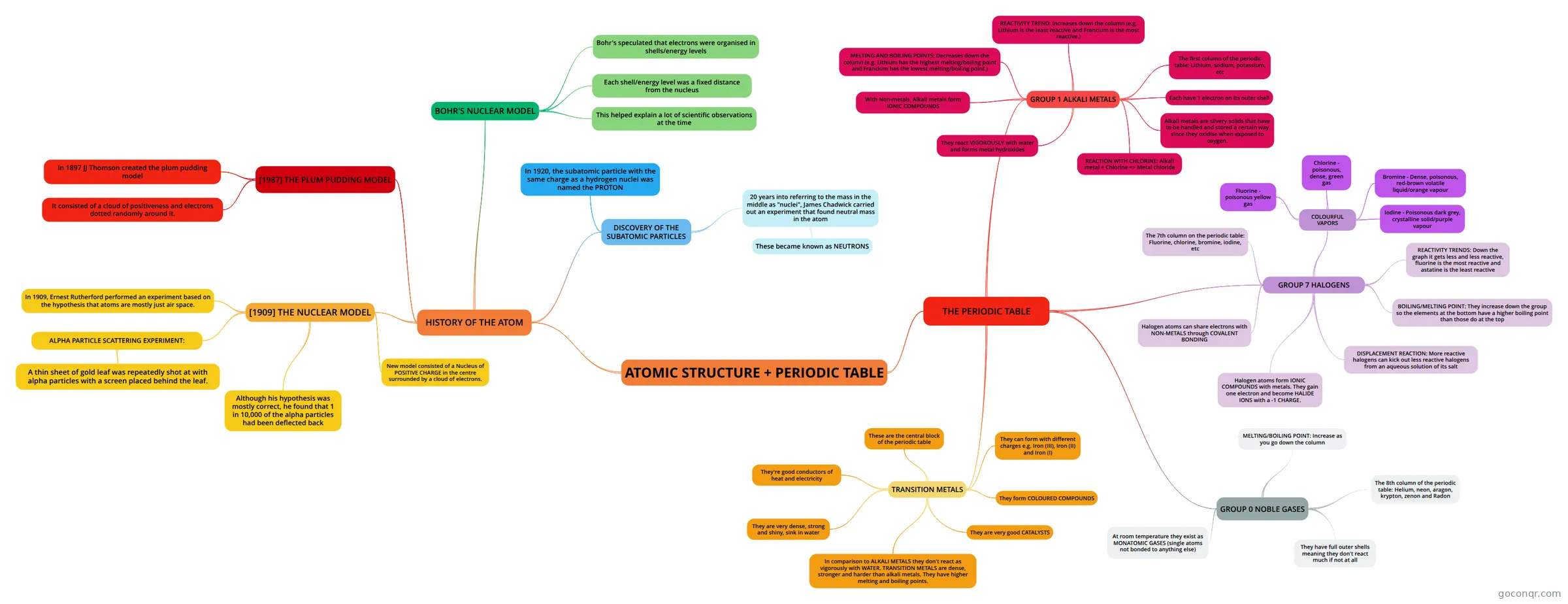
Mind map: Atomic structure and periodic table
Inhalt der Mindmap
ATOMIC STRUCTURE + PERIODIC TABLE
HISTORY OF THE ATOM
- [1987] THE PLUM PUDDING MODEL
- In 1897 JJ Thomson created the plum pudding model
- It consisted of a cloud of positiveness and electrons dotted randomly around it.
- [1909] THE NUCLEAR MODEL
- In 1909, Ernest Rutherford performed an experiment based on the hypothesis that atoms are mostly just air space.
- ALPHA PARTICLE SCATTERING EXPERIMENT:
- A thin sheet of gold leaf was repeatedly shot at with alpha particles with a screen placed behind the leaf.
- Although his hypothesis was mostly correct, he found that 1 in 10,000 of the alpha particles had been deflected back
- New model consisted of a Nucleus of POSITIVE CHARGE in the centre surrounded by a cloud of electrons.
- BOHR'S NUCLEAR MODEL
- Bohr's speculated that electrons were organised in shells/energy levels
- Each shell/energy level was a fixed distance from the nucleus
- This helped explain a lot of scientific observations at the time
- DISCOVERY OF THE SUBATOMIC PARTICLES
- In 1920, the subatomic particle with the same charge as a hydrogen nuclei was named the PROTON
- 20 years into referring to the mass in the middle as "nuclei", James Chadwick carried out an experiment that found neutral mass in the atom
- These became known as NEUTRONS
- [1987] THE PLUM PUDDING MODEL
THE PERIODIC TABLE
- GROUP 1 ALKALI METALS
- The first column of the periodic table: Lithium, sodium, potassium, etc
- Each have 1 electron on its outer shell
- Alkali metals are silvery solids that have to be handled and stored a certain way since they oxidise when exposed to oxygen.
- REACTIVITY TREND: Increases down the column (e.g. Lithium is the least reactive and Francium is the most reactive.)
- MELTING AND BOILING POINTS: Decreases down the column (e.g. Lithium has the highest melting/boiling point and Francium has the lowest melting/boiling point.)
- With Non-metals, Alkali metals form IONIC COMPOUNDS
- They react VIGOROUSLY with water and forms metal hydroxides
- REACTION WITH CHLORINE: Alkali metal + Chlorine => Metal chloride
- GROUP 7 HALOGENS
- The 7th column on the periodic table: Fluorine, chlorine, bromine, iodine, etc
- COLOURFUL VAPORS
- Fluorine - poisonous yellow gas
- Chlorine - poisonous, dense, green gas
- Bromine - Dense, poisonous, red-brown volatile liquid/orange vapour
- Iodine - Poisonous dark grey, crystalline solid/purple vapour
- REACTIVITY TRENDS: Down the graph it gets less and less reactive, fluorine is the most reactive and astatine is the least reactive
- BOILING/MELTING POINT: They increase down the group so the elements at the bottom have a higher boiling point than those do at the top
- Halogen atoms can share electrons with NON-METALS through COVALENT BONDING
- Halogen atoms form IONIC COMPOUNDS with metals. They gain one electron and become HALIDE IONS with a -1 CHARGE.
- DISPLACEMENT REACTION: More reactive halogens can kick out less reactive halogens from an aqueous solution of its salt
- GROUP 0 NOBLE GASES
- The 8th column of the periodic table: Helium, neon, aragon, krypton, zenon and Radon
- They have full outer shells meaning they don't react much if not at all
- At room temperature they exist as MONATOMIC GASES (single atoms not bonded to anything else)
- MELTING/BOILING POINT: Increase as you go down the column
- TRANSITION METALS
- These are the central block of the periodic table
- They're good conductors of heat and electricity
- They are very dense, strong and shiny, sink in water
- In comparison to ALKALI METALS they don't react as vigorously with WATER. TRANSITION METALS are dense, stronger and harder than alkali metals. They have higher melting and boiling points.
- They can form with different charges e.g. Iron (III), Iron (II) and Iron (I)
- They form COLOURED COMPOUNDS
- They are very good CATALYSTS
- GROUP 1 ALKALI METALS
Informationen
- Beschreibung
- For me to revise, or not idk
- Erstellt von
- Yzabelle Demegillo
- Aufrufe
- 19
- Bewertung