
Mindmap
Eating behaviours
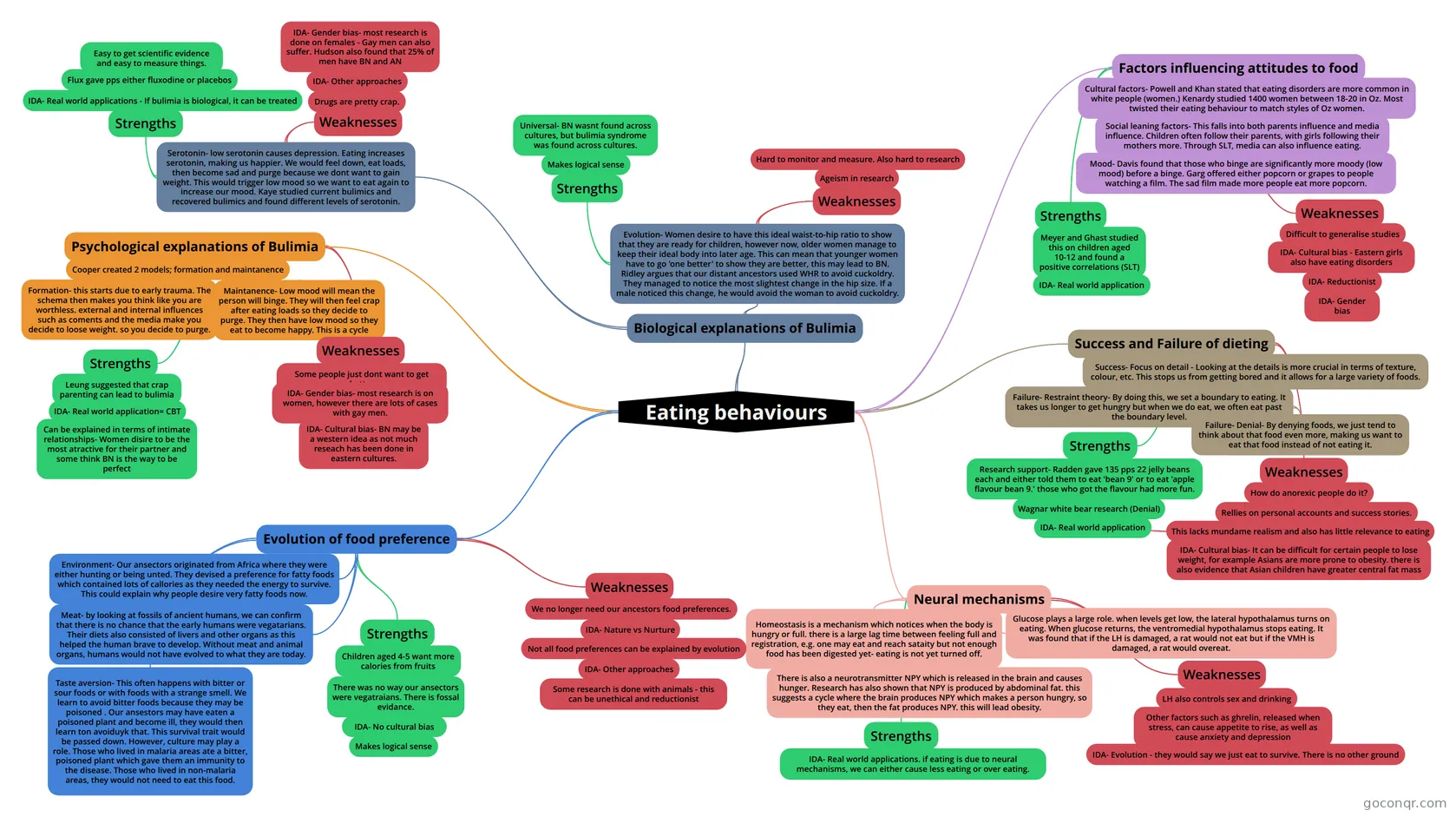
Mind map: Eating behaviours
Inhalt der Mindmap
Eating behaviours
Factors influencing attitudes to food
- Cultural factors- Powell and Khan stated that eating disorders are more common in white people (women.) Kenardy studied 1400 women between 18-20 in Oz. Most twisted their eating behaviour to match styles of Oz women.
- Social leaning factors- This falls into both parents influence and media influence. Children often follow their parents, with girls following their mothers more. Through SLT, media can also influence eating.
- Mood- Davis found that those who binge are significantly more moody (low mood) before a binge. Garg offered either popcorn or grapes to people watching a film. The sad film made more people eat more popcorn.
- Social leaning factors- This falls into both parents influence and media influence. Children often follow their parents, with girls following their mothers more. Through SLT, media can also influence eating.
- Strengths
- Meyer and Ghast studied this on children aged 10-12 and found a positive correlations (SLT)
- IDA- Real world application
- Meyer and Ghast studied this on children aged 10-12 and found a positive correlations (SLT)
- Weaknesses
- Difficult to generalise studies
- IDA- Cultural bias - Eastern girls also have eating disorders
- IDA- Reductionist
- IDA- Gender bias
- IDA- Reductionist
- IDA- Cultural bias - Eastern girls also have eating disorders
- Difficult to generalise studies
- Cultural factors- Powell and Khan stated that eating disorders are more common in white people (women.) Kenardy studied 1400 women between 18-20 in Oz. Most twisted their eating behaviour to match styles of Oz women.
Success and Failure of dieting
- Success- Focus on detail - Looking at the details is more crucial in terms of texture, colour, etc. This stops us from getting bored and it allows for a large variety of foods.
- Failure- Restraint theory- By doing this, we set a boundary to eating. It takes us longer to get hungry but when we do eat, we often eat past the boundary level.
- Failure- Denial- By denying foods, we just tend to think about that food even more, making us want to eat that food instead of not eating it.
- Failure- Restraint theory- By doing this, we set a boundary to eating. It takes us longer to get hungry but when we do eat, we often eat past the boundary level.
- Strengths
- Research support- Radden gave 135 pps 22 jelly beans each and either told them to eat 'bean 9' or to eat 'apple flavour bean 9.' those who got the flavour had more fun.
- Wagnar white bear research (Denial)
- IDA- Real world application
- This lacks mundame realism and also has little relevance to eating
- IDA- Cultural bias- It can be difficult for certain people to lose weight, for example Asians are more prone to obesity. there is also evidence that Asian children have greater central fat mass
- Wagnar white bear research (Denial)
- Research support- Radden gave 135 pps 22 jelly beans each and either told them to eat 'bean 9' or to eat 'apple flavour bean 9.' those who got the flavour had more fun.
- Weaknesses
- How do anorexic people do it?
- Rellies on personal accounts and success stories.
- How do anorexic people do it?
- Success- Focus on detail - Looking at the details is more crucial in terms of texture, colour, etc. This stops us from getting bored and it allows for a large variety of foods.
Neural mechanisms
- Homeostasis is a mechanism which notices when the body is hungry or full. there is a large lag time between feeling full and registration, e.g. one may eat and reach sataity but not enough food has been digested yet- eating is not yet turned off.
- There is also a neurotransmitter NPY which is released in the brain and causes hunger. Research has also shown that NPY is produced by abdominal fat. this suggests a cycle where the brain produces NPY which makes a person hungry, so they eat, then the fat produces NPY. this will lead obesity.
- Glucose plays a large role. when levels get low, the lateral hypothalamus turns on eating. When glucose returns, the ventromedial hypothalamus stops eating. It was found that if the LH is damaged, a rat would not eat but if the VMH is damaged, a rat would overeat.
- Weaknesses
- LH also controls sex and drinking
- Other factors such as ghrelin, released when stress, can cause appetite to rise, as well as cause anxiety and depression
- IDA- Evolution - they would say we just eat to survive. There is no other ground
- Other factors such as ghrelin, released when stress, can cause appetite to rise, as well as cause anxiety and depression
- LH also controls sex and drinking
- Strengths
- IDA- Real world applications. if eating is due to neural mechanisms, we can either cause less eating or over eating.
- Homeostasis is a mechanism which notices when the body is hungry or full. there is a large lag time between feeling full and registration, e.g. one may eat and reach sataity but not enough food has been digested yet- eating is not yet turned off.
Evolution of food preference
- Environment- Our ansectors originated from Africa where they were either hunting or being unted. They devised a preference for fatty foods which contained lots of callories as they needed the energy to survive. This could explain why people desire very fatty foods now.
- Meat- by looking at fossils of ancient humans, we can confirm that there is no chance that the early humans were vegatarians. Their diets also consisted of livers and other organs as this helped the human brave to develop. Without meat and animal organs, humans would not have evolved to what they are today.
- Taste aversion- This often happens with bitter or sour foods or with foods with a strange smell. We learn to avoid bitter foods because they may be poisoned . Our ansestors may have eaten a poisoned plant and become ill, they would then learn ton avoiduyk that. This survival trait would be passed down. However, culture may play a role. Those who lived in malaria areas ate a bitter, poisoned plant which gave them an immunity to the disease. Those who lived in non-malaria areas, they would not need to eat this food.
- Strengths
- Children aged 4-5 want more calories from fruits
- There was no way our ansectors were vegatraians. There is fossal evidance.
- IDA- No cultural bias
- Makes logical sense
- IDA- No cultural bias
- There was no way our ansectors were vegatraians. There is fossal evidance.
- Children aged 4-5 want more calories from fruits
- Weaknesses
- We no longer need our ancestors food preferences.
- IDA- Nature vs Nurture
- Not all food preferences can be explained by evolution
- IDA- Other approaches
- Some research is done with animals - this can be unethical and reductionist
- IDA- Other approaches
- Not all food preferences can be explained by evolution
- IDA- Nature vs Nurture
- We no longer need our ancestors food preferences.
Psychological explanations of Bulimia
- Cooper created 2 models; formation and maintanence
- Formation- this starts due to early trauma. The schema then makes you think like you are worthless. external and internal influences such as coments and the media make you decide to loose weight. so you decide to purge.
- Maintanence- Low mood will mean the person will binge. They will then feel crap after eating loads so they decide to purge. They then have low mood so they eat to become happy. This is a cycle
- Formation- this starts due to early trauma. The schema then makes you think like you are worthless. external and internal influences such as coments and the media make you decide to loose weight. so you decide to purge.
- Strengths
- Leung suggested that crap parenting can lead to bulimia
- IDA- Real world application= CBT
- Can be explained in terms of intimate relationships- Women disire to be the most atractive for their partner and some think BN is the way to be perfect
- IDA- Real world application= CBT
- Leung suggested that crap parenting can lead to bulimia
- Weaknesses
- Some people just dont want to get better
- IDA- Gender bias- most research is on women, however there are lots of cases with gay men.
- IDA- Cultural bias- BN may be a western idea as not much reseach has been done in eastern cultures.
- IDA- Gender bias- most research is on women, however there are lots of cases with gay men.
- Some people just dont want to get better
- Cooper created 2 models; formation and maintanence
Biological explanations of Bulimia
- Serotonin- low serotonin causes depression. Eating increases serotonin, making us happier. We would feel down, eat loads, then become sad and purge because we dont want to gain weight. This would trigger low mood so we want to eat again to increase our mood. Kaye studied current bulimics and recovered bulimics and found different levels of serotonin.
- Strengths
- IDA- Real world applications - If bulimia is biological, it can be treated
- Flux gave pps either fluxodine or placebos
- Easy to get scientific evidence and easy to measure things.
- Flux gave pps either fluxodine or placebos
- IDA- Real world applications - If bulimia is biological, it can be treated
- Weaknesses
- Drugs are pretty crap.
- IDA- Other approaches
- IDA- Gender bias- most research is done on females - Gay men can also suffer. Hudson also found that 25% of men have BN and AN
- Strengths
- Evolution- Women desire to have this ideal waist-to-hip ratio to show that they are ready for children, however now, older women manage to keep their ideal body into later age. This can mean that younger women have to go 'one better' to show they are better, this may lead to BN. Ridley argues that our distant ancestors used WHR to avoid cuckoldry. They managed to notice the most slightest change in the hip size. If a male noticed this change, he would avoid the woman to avoid cuckoldry.
- Strengths
- Makes logical sense
- Universal- BN wasnt found across cultures, but bulimia syndrome was found across cultures.
- Weaknesses
- Ageism in research
- Hard to monitor and measure. Also hard to research
- Strengths
- Serotonin- low serotonin causes depression. Eating increases serotonin, making us happier. We would feel down, eat loads, then become sad and purge because we dont want to gain weight. This would trigger low mood so we want to eat again to increase our mood. Kaye studied current bulimics and recovered bulimics and found different levels of serotonin.
Informationen
- Beschreibung
- Mindmap am Eating behaviours, erstellt von Oli Brown am 08/06/2015.
- Erstellt von
- Oli Brown
- Aufrufe
- 0
- Bewertung
Mehr zu Attitudes to food and eating