
Mindmap
Part 2 - Ch 8: Differential Association
Inhalt der Mindmap
Part 2 - Ch 8: Differential Association
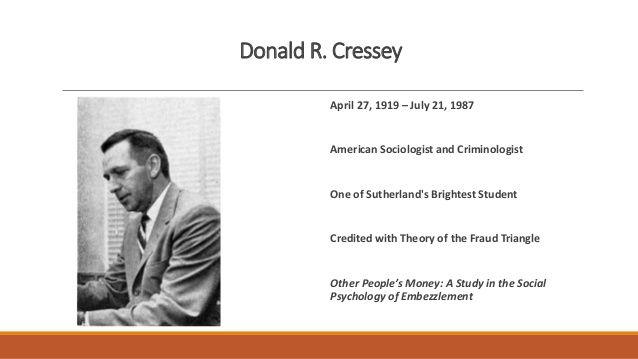
Sutherland & Cressey believe crime is learned as is all other behavior
- crime and deviance more likely to be learned from intimate associates: families and peer groups
- S & C say crime and deviance are learned by watching others model crime, learning how to do it effecitively, and convincing rationalizations & neutralizations making this behavior acceptable and as the number of deviant friends increases
- crime and deviance more likely to be learned from intimate associates: families and peer groups
#1 - Criminal behavior is learned
- It is not inherited
- the person who is not already trained in crime does not also invent criminal behavior
- It is not inherited
#2 - Criminal behavior is learned in interaction with other persons in a process of communication
- verbal communication & "the communication of gestures"
#3 - The principal part of the learning of criminal behavior occurs within intimate personal groups
- impersonal agencies of communication (movies, newspapers) play an unimportant part in the genesis of criminal behavior
#4 - Learning criminal behavior includes...
- (a) techniques of committing the crime, which are sometimes very complicated or very simple
- (b) the specific direction of motive, drives, rationalizations and attitudes
- (a) techniques of committing the crime, which are sometimes very complicated or very simple
#5 - The specific direction of motives and drives is learned from definitions of the legal codes as favorable or unfavorable
- in American society, legal codes are defined by some people as rules to be observed and by others whose definitions are favorable to the violation of the legal codes
- the consequences are we have culture conflict in relation to the legal codes
- in American society, legal codes are defined by some people as rules to be observed and by others whose definitions are favorable to the violation of the legal codes
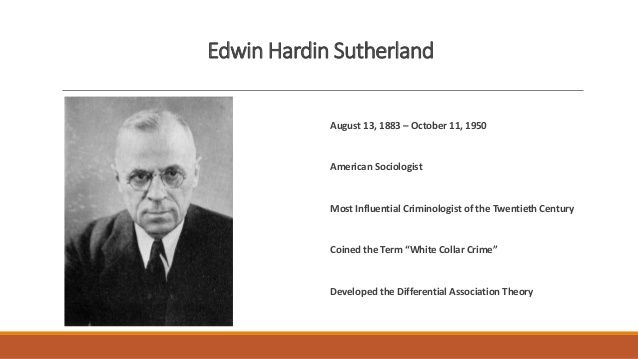
#6 - A person becomes delinquent because of an excess of definitions favorable to violation of law over definitions unfavorable to violation of law (PRINCIPLE OF DIFFERENTIAL ASSOCIATION)
- Refers to both criminal and anticriminal associations
- Deals with counteracting forces
- Persons become criminal because of contacts with criminal patterns and also because of isolation from anticriminal patterns
- An individual will assimilate a surrounding culture unless there is a conflicting pattern
- Neutral associations have not effect, as far as crime is concerned, on the genesis of criminal behavior (i.e., brushing one's teeth)
- Neutral behavior will occupy one's time so he is not engaged or in contact with criminal activities or behavior
- Neutral associations have not effect, as far as crime is concerned, on the genesis of criminal behavior (i.e., brushing one's teeth)
- An individual will assimilate a surrounding culture unless there is a conflicting pattern
- Persons become criminal because of contacts with criminal patterns and also because of isolation from anticriminal patterns
- Deals with counteracting forces
- Refers to both criminal and anticriminal associations
#7 - Differential associations may vary in frequency, duration, priority and intensity
- Frequency & duration are self explanitory
- "Priority" important because lawful & unlawful behavior developed in early childhood may persist throughout life
- "Intensity" has to do with the prestige of the source of criminal or anticriminal pattern and with emotional reactions related to the associations
- "Priority" important because lawful & unlawful behavior developed in early childhood may persist throughout life
- Frequency & duration are self explanitory
#8 - The process of learning criminal behavior by association with criminal and anticriminal patterns involves all of the mechanisms that are involved in any other learning
- learning criminal behavior is not limited to the process of imitation
#9 - While criminal behavior is an expression of general needs and values, it is not explained by those general needs and values, since noncriminal behavior is an expression of the same needs and values
- general drives and values such as the happiness principle, striving for social status, the money motive, or frustration explain both lawful and criminal behavior
Explaining the associations a person has is very complex
- Many aspects of social organization affect the kinds of associations a person has
- Differential social organization (or social disorganization) - crime is rooted in the social organization and is an expression of that social organization
- Differential group organizations as an explanation of variations in crime rates is consistent with the differential association theory of the processes by which persons become criminals
- Differential social organization (or social disorganization) - crime is rooted in the social organization and is an expression of that social organization
- Many aspects of social organization affect the kinds of associations a person has
Bilder und Dateien der Mindmap
Informationen
- Beschreibung
- Ch 8: Differential Association
- Erstellt von
- missylew69
- Aufrufe
- 122
- Tags
- Bewertung