
Mindmap
SENSATION and PERCEPTION
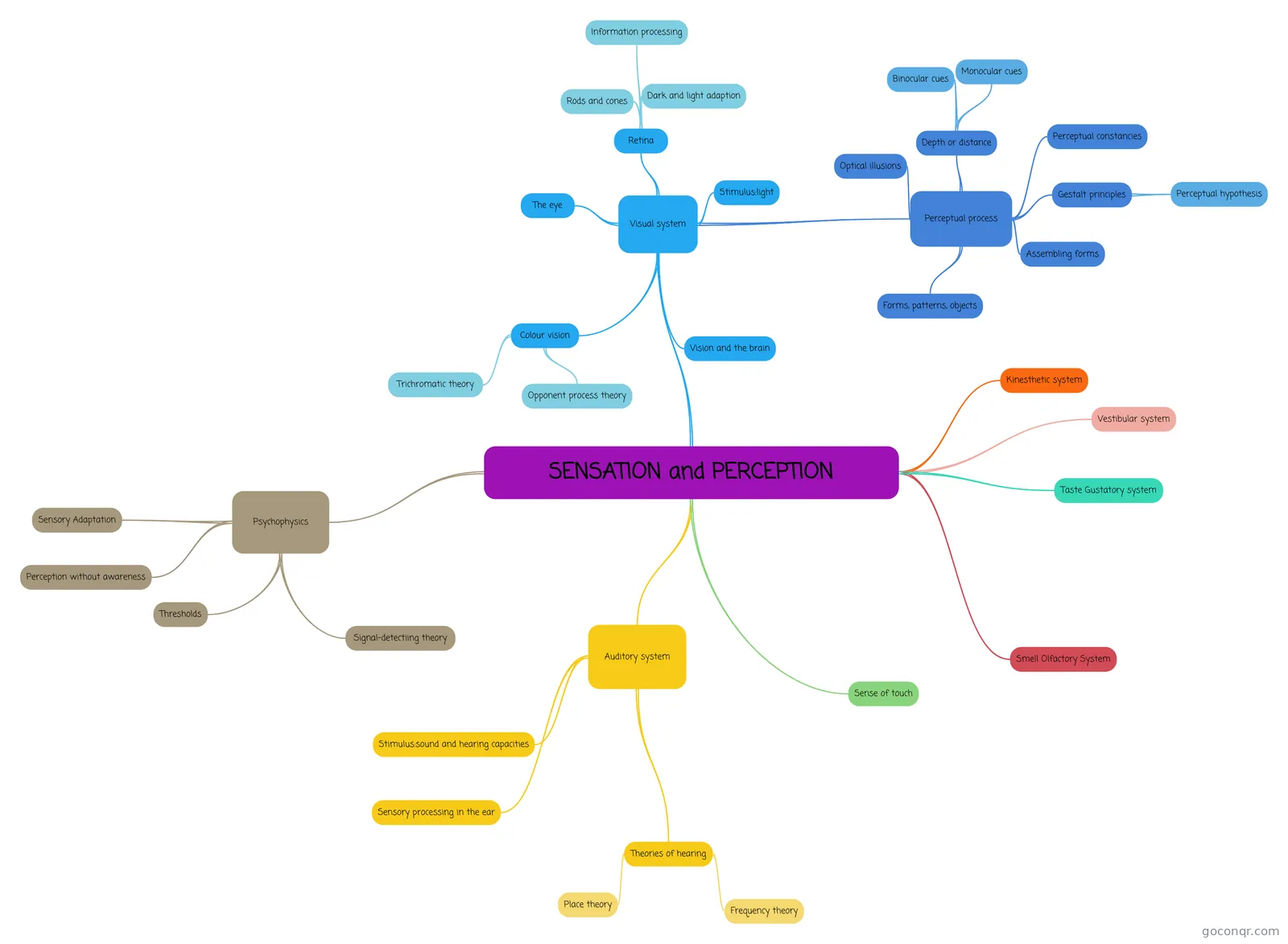
Mind map: Sensation and perception
Inhalt der Mindmap
SENSATION and PERCEPTION
Psychophysics
- Study of how physical stimuli are translated into psychological experience.
- Thresholds
- It is a dividing point between energy levels that do and do not have a detectable effect Absolute treshold - minimum amount of stimulation that an organism can detect. Just noticeable difference - smallest difference in the amount of stimulation that a specific sense can detect.
- Signal-detectiing theory
- Detection of stimuli involves decision processes as well as sensory processes which are both influenced by a variety of factors besides stimulus intensity. hit - detect signals when they are present miss - fail to detect present signals false alarm - detecting signals when they are not present correct rejections - not detecting absent signals
- Perception without awareness
- Subliminal perception - registration of sensoty input without conscious awareness
- Sensory Adaptation
- Gradual decline in sensetivity due to prolonged stimulation
Taste Gustatory system
- Physical stimuli for sense of taste - chemical substances that are soluble. The gustatory receptors are clusters of taste cells found in the taste buds that located on the tongue. Stimuli are dissolved in mouth's saliva. Taste cells live for 10 days and are constantly being replaced. Neural impulses are routed through the thalamus and on to insular cortex in the frontal lobe 4 primary tastes - sweet, sour, bitter, salty + scientists suggest to add unami - for meets and cheeses.
Smell Olfactory System
- The stimuli are volatile chemical substances that can evaporate and be carried in the air. They are dissolved in the mucus of the nose. Primary odors cant be identified, there are too many of them. The receptors for smell are olfactory cilia, hairlike structure in the upper portion of the nasal passages. They live 30-60 days and are constantly being replaced. Neural impulses are routed through the olfactory bulb and then sent directly to the olfactory cortex in temporal lobe and other cortical areas. Smell is the only sensory input not routed throguh the thalamus.
Sense of touch
- The stimuli are mechanical, thermal and chemical energy that impinge on the skin. Receptors in the skin can register pressure, warmth, cold and pain. 4 types of primary receptors in skin - merkel receptors, meissner corpuscle, ruffini cylinder, pacinian corpuscle - respond to pressure, whereas free nerve endings in skin respond to pain, warmth and cold. Neural impulses are routed through the brainstem and thalamus and on to somatosensory cortex in the parietal lobe.
Kinesthetic system
- Monitors the positions of the various parts of the body.
Vestibular system
- Responds to gravity and keeps you informed of your body's location in space. Shares space in inner ear with the auditory system.
Auditory system
- Stimulus:sound and hearing capacities
- Sound waves are vibrations of molecules which means that thye must travel through some physical medium such as air. Humans can hear wavelenghts between 20 and 20 000 Hz. The human ear is the most sensetive to sounds at frequency near 2000 Hz Amplitude (physical property) - loudness (related perception) - measured in decibels dB Frequency - pitch - measured in hertz Hz Purity - timbre Exposure to sounds over 120 decibels can be painful and can cause damage to your auditory system.
- Sensory processing in the ear
- The receptors for hearing are tiny hair cells that line the basilar membrane that runs through the length of the cochlea, a fluid-filled, coiled tunnel in the inner ear. Neural impulses are routed through the thalamus and then sent to the primary auditory cortex which is mostly located in temporal lobe.
- Theories of hearing
- Place theory
- Perception of pitch corresponds to the vibration of different portions or places along the basilar membrane. Hair cells at different locations respond independantly, different sets of hair cells are vibrated by different sound frequencies and the brain detects the frequency of the tone according to which basilar membrane is more active.
- Frequency theory
- Perception of pitch corresponds to the rate or frequency at which the entire basilar membrane vibrates. The brain detects the frequency of a tone by the rate at which the auditory nerve fibres fire.
- Place theory
- Stimulus:sound and hearing capacities
Visual system
- Stimulus:light
- Light is electromagnetic radiation that travels in waves. Humans can only register a slim portion of the total range of wavelengths from 400 to 700 nanometres. Light waves vary in amplitude, wavelenght and purity which influence perceptions as shown below.
- The eye
- Eyes channel light to the neural tissue that receives it, called retina and they house that tissue. Light enters the eye through cornea. Lens is transparent eye structure that focuses the light rays falling on the retina. Lens gets rounder when you look at close objects and flattens when you look on distant objects. Nearsightness - close objects are seen clearly but distand objects appear blurry - focus of light from distant objects falls a little short of retina. Farsightness - distant objects are seen clearly but close objects appear blurry. - focus of light from close objects falls behind retina Pupil - opening in the centre of the iris that helps regulate the amount of light passing into the rear chamber of the eye. When pupil constricts it lets less light into the eye but it sharpens the image falling on retina ( in bright light pupils constrict). In dim light pupils dialate, let more light in but the image is less sharp. Eye movements are referred to as saccades.
- Retina
- Its neural tissue lining the inside back surface of the eye, it absobs light, processes images and sends visual info to the brain. It contains millions of receptor cells - rods and cones. Optic disk - a hole in the retina where the optic nrve fibres exit the eye. It is a blind spot.
- Rods and cones
- Rods play a key role in night and peripheral vision, cones play a key role in daylight and colour vision.
- Dark and light adaption
- Dark adaption - the process in which the eyes become more sensetive to light in low illuminations. Complete in 30 minutes, progress occurs in the first 10 minutes. Light adaption - the eyes become less sensetive to light in high illumination (from dark to light).
- Information processing
- Neural impulses are routed through the LGN in the thalamus and then distributed to the primary visual cortex in occipital lobe.
- Vision and the brain
- You see everything with your brain. Optic chiasm - the point at which the optic nerves from the inside half of each eye cross over and then project to the opposite half of the brain. Simple cells respond best to a line of the correct width, oriented at the correct angle and located in the correct position in its receptive fields. Complex cells respond to any position in their receptive fields. Cells in visual cortex are highly specialized. Visual agnosia - inability to recognize objects. Prosopagnosia - inability to recognize familiar faces, including your own.
- Colour vision
- Colour is psychological interpretation. Its not a physical property. Perception of colour (hue) are primarily a function of light wavelenght while amplitude affects brightness and purity affects saturation. 2 types of colour mixing - additive and subtractive. Colour perception depends on processes that resemble additive colour mixing.
- Trichromatic theory
- The human eye has 3 types pf receptors with differing sensitivities to different light wavelenghts associated with red, green and blue. People can see all colours of rainbow because the eye does its own colour mixing by varying the ratio of neural activity among these 3 types of receptors. Colour blindness encompasses a variety of deficiences in the ability to distinguish among colours.
- Opponent process theory
- Colour perception depends on receptors that make antagonistic responses to 3 pairs pf colours - red vs green, yellow vs blue, black vs white.
- Perceptual process
- Forms, patterns, objects
- Reversible figure - drawing that is compatible with 2 interpretations that can shift back and forth. Perceptual set - readiness to perceive a stimulus in a particular way.
- Assembling forms
- Feature analysis - process of detecting specific elements in visual input and assembling them into a more complex form. You start with lines, edges, corners and build tham into perceptions of triangles, bicycles, telephones, squares. Bottom-up processing - progression from individual elements to the whole. Top-down - progression from the whole to the elements. Subjective countours - perception of contours where none actually exist.
- Gestalt principles
- Phi phenomenon - the illusion of movement created by presenting visual stimuli in rapid succession. On TV you see smooth motion but in reality moving objects merely take slightly different positions in successive frames. Principles: 1) Figure (looked at) and ground (background against which it stands) 2)Proximity - things that are close to ine another seem to belong together 3) Closure- people often group elements to create a sense of closure or completeness. 4)Similarity - people tend to group stimuli that are similar 5)Simplicity - people tend to group elements that combine to form a good figure. 6) Continuity - people tend to follow whatever direction they have been led.
- Perceptual hypothesis
- Inference about which distal stimuli could be responsible for the proximal stimuli sensed. Distal stimuli - lie in distance Proximal - stimulus energies that impinge directly on sensory receptors.
- Depth or distance
- Depth perception involves interpretation pf visual cues that indicate how near or far away objects are.
- Binocular cues
- Clues about distance based on the differing views of the 2 eyes. Cues such retinal disparity and convergence can contribute to depth perception.
- Monocular cues
- Clues about distance based on the image in either eye alone. If you cover your eye and move your head side to side, closer objects appear to move more than distant objects. Pictorial cues - such as texture gradient, linear perspective, light and shadow, interposition, relative size and height in plane.
- Optical illusions
- Demonstrate that perceprual hypotheses can be inaccurate and that perceptions are not simple reflections of objective reality
- Perceptual constancies
- Tendency to experience a stable perception in the face of continually changing sensory input. People tend to view objects as having a stable size, shape, brightness, hue and texture.
- Forms, patterns, objects
- Stimulus:light
Informationen
- Beschreibung
- Mindmap am SENSATION and PERCEPTION, erstellt von julia.driedzic am 20/02/2016.
- Erstellt von
- julia.driedzic
- Aufrufe
- 0
- Bewertung