
39523399


| Question | Answer |
| What is the goal of sensation & perception? (general, not the course) | to find out about the external world |
| What is sensation? How do we feel it? | The starting point where we receive our info of the world -- through the sensory receptors in our senses |
| What are our senses sensitive to? | The physical properties & stimuli in the world |
| What is perception? | The end point - our experience of the world |
| How is perception described as a process? | a complex, multi-stage process often not even replicable by man-kind |
| What are our 5 senses? | vision, audition, taste, touch (tactile), smell |
| Why is it useful to study perception? | for prac. appl. purposes (like helping making the environment more acceptable or comfortable for autistic ppl, making food more appealing for those without smell), understanding ageing & diseases, designing artificial perceptual systems (AI, essentially) |
| Perception underlies... | all our interactions with the environment |
| What does perception allow for/aid with? | our survival |
| all perceptual systems follow the... | same perceptual process |
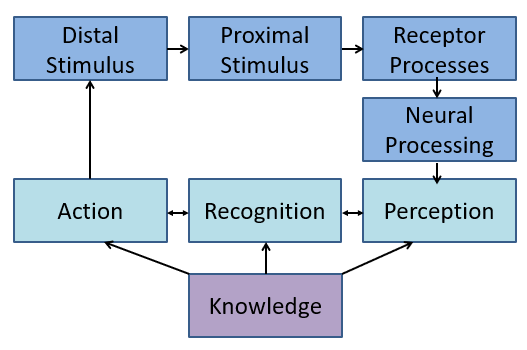
| name the components of the perceptual process | |
| what is the distal stimulus? | the physical object in the world |
| what is a proximal stimulus? | our representation of the distal stimulus based on the information of differing physical environmental energies received through our sensory receptors |
| give examples of physical environmental energies | light, sound waves, chemicals (taste & smell), pressure |
| what occurs during the receptor processes? | where the environmental energies are converted into electrical energy to be passed along neurons |
| what is this process known as? | transduction |
| what occurs during neural processing? | converted electrical signals are transmitted from one neuron to another, signal changing as the neurons interact |
| what processes are considered the end-goal of perception? | perception, recognition & action |
| define perception & recognition in technical terms (we know you understand the process) | perception: conscious sensory experience recognition: placing the object in a category |
| what is a good way where we are able to observe & differentiate the perception & recognition processes? | visual form agnosia - inability to recognise objects |
| what does action concern? | deciding how to act once you recognise the object |
| when is the perceptual process considered to have completed/reached its end-point? | when action is reached - then our cycle repeats from the beginning |
| why do P, R, & A have bidirectional arrows? | the processes all influence each other |
| how is knowledge defined in S&P? | existing assumptions & memories that influence perception, recognition & action |
| what are the two types of processing? | top-down processing: processing based on prior knowledge & experience & assumptions bottom-up processing: processing based on incoming sensory info |
| what processing does perception involve? | both top-down & bottom-up |
| why is top-down processing important? | helps simplify complex perceptual processes |
| what are the two approaches to studying perception? | physiological: objective measure of whats going on in the brain psychophysical: subjective experiences of what we perceive |
| what are some of the ways physiological measures are.. well, measured? | single cell recording, brain imaging (fMRI, EEG, PET, etc.), micro-imaging, lesioning & TMS |
| what are the thresholds measured i psychophysics? | absolute: detection, smallest magnitude of a sense we can identify difference: discrimination, smallest difference we can perceive |
Want to create your own Flashcards for free with GoConqr? Learn more.