
39532865


| Question | Answer |
| Roughly how many ganglion cells do we have in proportion to photoreceptors? (ratio) | G:PR = 1:126 |
| what is the function of ganglion cells? | to condense raw information from photoreceptors & select the most important info from the retinal image |
| how do ganglion cells carry out this function? (in terms of detecting stimulus) | they identify changes in patterns on light -- but simply between light and dark, NOT illumination level nor orientation of light |
| what objective measure/experiment has helped us learn all this about retinal ganglion cells? | single cell recording |
| what approach is this from | physiological approach |
| who was the first test experiment for this process SCR? | a cat unethical to do it on humans |
| explain the process of single cell recording | an electrode is inserted into the axon of a singular individual neuron & its activity - nerve impulses/action potentials - are recorded |
| what units does it record | voltage |
| if a neuron is active - does it increase in voltage or frequency? | only frequency, voltage remains the same. |
| how is the single cell recording experiment initially started off? | where no stimulus is presented and only darkness is visible |
| what has been found to be recorded with this? | there were occasional nerve impulses fired off by ganglion cells & was not completely inactive |
| what is this known as? | the baseline activity of a ganglion cell |
| what are other words to describe baseline activity? | the activity of a ganglion cell when at rest |
| what is the point of the single cell recording experiments? | to find a stimulus that presents a change in baseline activity of ganglion cell - whether its an increase or decrease |
| what stimulus is used for retinal ganglion cells' being recorded? | light |
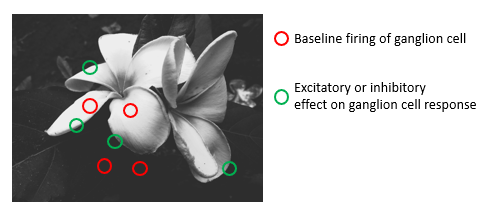
| What is the receptive field? | the mapped out area on a retina where, when stimulated by light, elicits a change in the firing rate of nerve impulses of the ganglion cell |
| how many regions does it have? what are they? | two regions: excitatory & inhibitory |
| what happens if a brighter spot of light is shone on the excitatory region? | increased, higher frequency in action potentials fired |
| what about in the inhibitory regions? | a further decreased rate of frequency of nerve impulses |
| what is the effect of shining light on inhibitory regions on the baseline activity of ganglion cells? | a suppression of nerve impulses -- there is a decrease in firing rate, lower than the baseline activity rate |
| why are ganglion cells only influenced by a certain area on the retina? |
due to neural convergence
Image:
Neural Convergence (Embed)
|
| why does this convergence create two types of response regions | due to lateral inhibition |
| what is lateral inhibition | where inhibition is transmitted laterally across the retina by horizontal and amacrine cells |
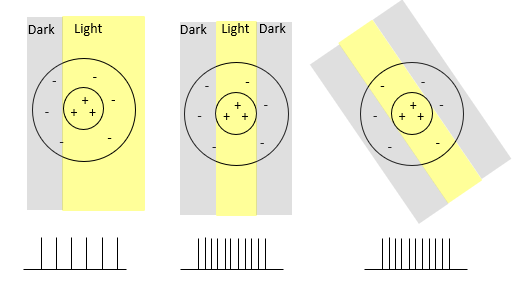
| what is the term used to describe the organisation of receptive field regions for the retinal ganglion cells | centre-surround antagonism |
| what are the 2 types of this organisation? | on centre, off surround (+, -) off centre, on surround (-, +) |
| why do we have such an organisation? | makes it ideal for detecting spots of light, edges & boundaries between areas of light & dark |
| what does it not detect, however? | orientation of light illumination level of light |
| why is it important for ganglion cells to recognise this change in pattern of light & dark? | carry the most !! visual info |
| Each photoreceptor is... | part of more than one ganglion cells' receptive field |
| resulting in an overlap of... | receptive fields with neighbouring ganglion cells |
| what does this mean overall? (a statement) | receptive fields of all ganglion cells together cover the whole visual field |

Want to create your own Flashcards for free with GoConqr? Learn more.