
Mindmap
Comparing rates of transpiration using a potometer
Inhalt der Mindmap
Comparing rates of transpiration using a potometer
Measure water uptake, but most of the water taken up by a leafy shoot is lost through transpiration, so the rate of uptake is almost the same as rate of transpiration
- can be used to measure water uptake by the same shoot under different conditions or can compare the uptake by leafy shoots of different species under the same conditions
How to set up a potometer:
- 1) cut leafy shoot under water, so no air enters xylem
- 2) Under water, fill potometer with water, ensure no air bubbles
- 3) fit leafy shoot to potometer with rubber tubing under water, to prevent air bubbles forming in apparatus of xylem
- 4) remove potometer and shoot from water, seal joints with Vaseline and dry carefully
- 5) Introduce an air bubble or meniscus into capillary tube
- 6) Measure distance air bubble or meniscus moves in a given time
- 7) use water reservoir to bring air bubble or meniscus back to the start point. Repeat measurement number of times and calculate mean distance
- 8) experiment may be repeated to compare rates of water uptake under different conditions, eg altered light intensity or air movement
- 7) use water reservoir to bring air bubble or meniscus back to the start point. Repeat measurement number of times and calculate mean distance
- 6) Measure distance air bubble or meniscus moves in a given time
- 5) Introduce an air bubble or meniscus into capillary tube
- 4) remove potometer and shoot from water, seal joints with Vaseline and dry carefully
- 3) fit leafy shoot to potometer with rubber tubing under water, to prevent air bubbles forming in apparatus of xylem
- 2) Under water, fill potometer with water, ensure no air bubbles
- 1) cut leafy shoot under water, so no air enters xylem
Practical Exercises
- Method using a constant time:
- 1) Set up the potometer as described below
- 2) Ensure air bubble is moving along scale
- 3) Measure distance, mm, that air bubble travels in 300 seconds
- 4) Repeat reading 4 more times, moving air bubble to beginning of scale with water from reservoir, as necessary, and calculate mean distance
- 5) rate of air bubble movement calculated as: mean rate of air bubble movement = mean distance moved by air bubble in 300 secs / 300
- mm s^-1
- 5) rate of air bubble movement calculated as: mean rate of air bubble movement = mean distance moved by air bubble in 300 secs / 300
- 4) Repeat reading 4 more times, moving air bubble to beginning of scale with water from reservoir, as necessary, and calculate mean distance
- 3) Measure distance, mm, that air bubble travels in 300 seconds
- 2) Ensure air bubble is moving along scale
- 1) Set up the potometer as described below
- Alternative method using constant distance
- 1) set up potometer
- 2) Ensure air bubble moving along scale
- 3) Record time taken, secs, for air bubble to move 20mm
- 4) repeat 4 times
- 5) mean rate of air bubble movement = 20 / mean time to move 20mm
- mm s^-1
- 5) mean rate of air bubble movement = 20 / mean time to move 20mm
- 4) repeat 4 times
- 3) Record time taken, secs, for air bubble to move 20mm
- 2) Ensure air bubble moving along scale
- 1) set up potometer
- Method using a constant time:
Converting rate of air bubble movement into rate of transpiration:
- 1) measure diameter of capillary in mm with ruler. Area of cross section is (pi r^2)
- 2) distance the air bubble has moved in given time (h) is found as above
- 3) volume of water taken up into shoot = (pi r^2 h) mm^3s^-1
- 2) distance the air bubble has moved in given time (h) is found as above
- 1) measure diameter of capillary in mm with ruler. Area of cross section is (pi r^2)
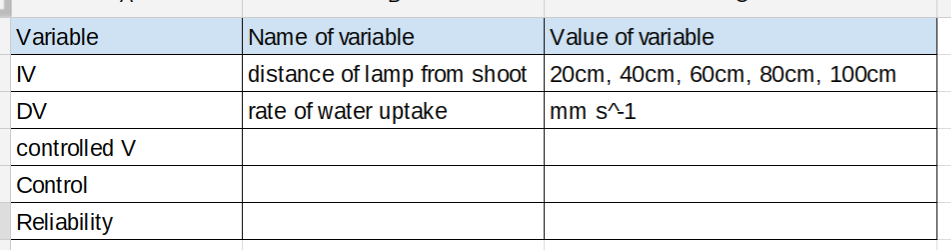
Experiment to determine the effect of light intensity on transpiration
- Further work - determine effect of wind speed on transpiration, as above, with the apparatus shielded from air movementand using a hand held hair drier on lowest temp, point at the shoot.
- Different air speed settings can show qualitatively the effect of increased air speed
- air speed measure with anemometer, but can't ensure all leaves exposed to same air flow, so quantitative experiment cannot be reliably performed
- Further work - determine effect of wind speed on transpiration, as above, with the apparatus shielded from air movementand using a hand held hair drier on lowest temp, point at the shoot.
Bilder und Dateien der Mindmap
Informationen
- Beschreibung
- AS - Level Biology (Adaptations for transport in plants) Mindmap am Comparing rates of transpiration using a potometer, erstellt von Emily Sutton am 24/02/2016.
- Erstellt von
- Emily Sutton
- Aufrufe
- 10
- Bewertung