
Mindmap
Physics Unit 1 section 1
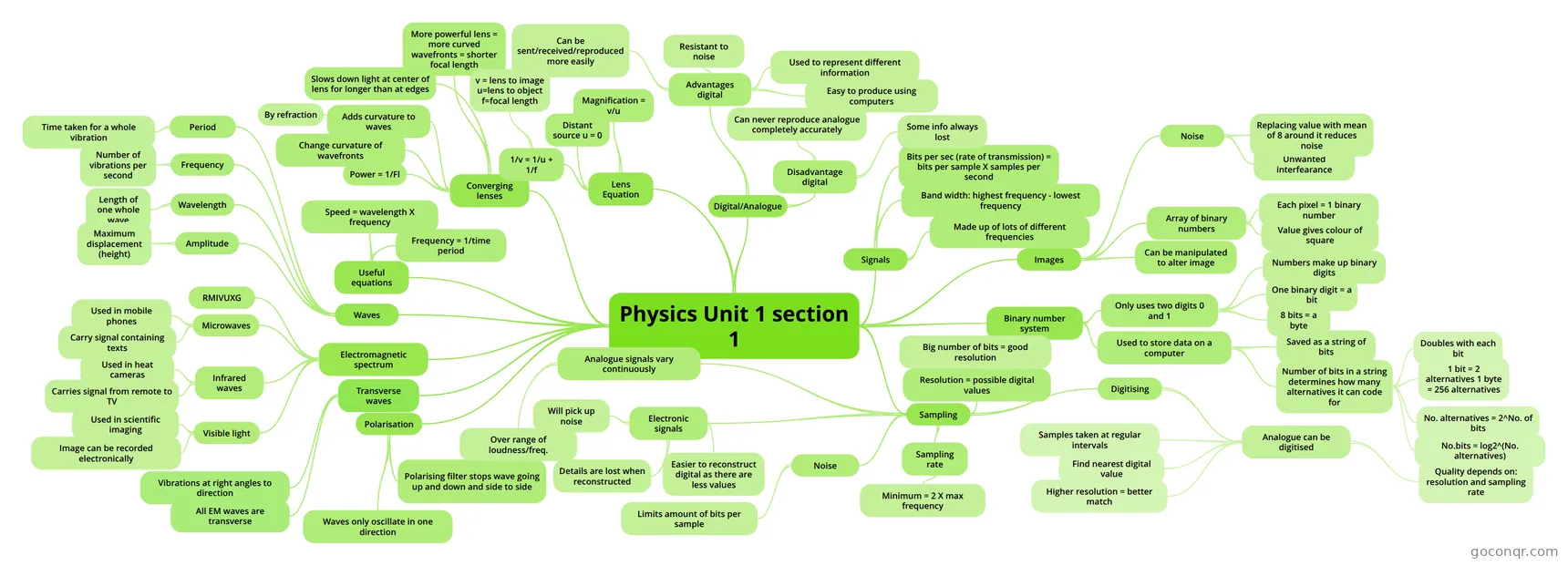
Mind map: Physics unit 1 section 1
Inhalt der Mindmap
Physics Unit 1 section 1
Waves
- Frequency
- Number of vibrations per second
- Wavelength
- Length of one whole wave
- Amplitude
- Maximum displacement (height)
- Period
- Time taken for a whole vibration
- Frequency
Electromagnetic spectrum
- RMIVUXG
- Microwaves
- Used in mobile phones
- Carry signal containing texts
- Infrared waves
- Used in heat cameras
- Carries signal from remote to TV
- Visible light
- Used in scientific imaging
- Image can be recorded electronically
Useful equations
- Frequency = 1/time period
- Speed = wavelength X frequency
Transverse waves
- Vibrations at right angles to direction
- All EM waves are transverse
Polarisation
- Waves only oscillate in one direction
- Polarising filter stops wave going up and down and side to side
Converging lenses
- Change curvature of wavefronts
- By refraction
- Adds curvature to waves
- Slows down light at center of lens for longer than at edges
- More powerful lens = more curved wavefronts = shorter focal length
- Power = 1/Fl
- Change curvature of wavefronts
Lens Equation
- 1/v = 1/u + 1/f
- v = lens to image u=lens to object f=focal length
- Distant source u = 0
- Magnification = v/u
- 1/v = 1/u + 1/f
Binary number system
- Only uses two digits 0 and 1
- Numbers make up binary digits
- One binary digit = a bit
- 8 bits = a byte
- Used to store data on a computer
- Saved as a string of bits
- Number of bits in a string determines how many alternatives it can code for
- 1 bit = 2 alternatives 1 byte = 256 alternatives
- Doubles with each bit
- No. alternatives = 2^No. of bits
- No.bits = log2^(No. alternatives)
- Only uses two digits 0 and 1
Images
- Array of binary numbers
- Each pixel = 1 binary number
- Value gives colour of square
- Noise
- Unwanted interfearance
- Replacing value with mean of 8 around it reduces noise
- Can be manipulated to alter image
- Array of binary numbers
Sampling
- Analogue signals vary continuously
- Over range of loudness/freq.
- Electronic signals
- Will pick up noise
- Details are lost when reconstructed
- Easier to reconstruct digital as there are less values
- Digitising
- Analogue can be digitised
- Samples taken at regular intervals
- Find nearest digital value
- Quality depends on: resolution and sampling rate
- Higher resolution = better match
- Analogue can be digitised
- Resolution = possible digital values
- Big number of bits = good resolution
- Noise
- Limits amount of bits per sample
- Sampling rate
- Minimum = 2 X max frequency
- Analogue signals vary continuously
Signals
- Made up of lots of different frequencies
- Band width: highest frequency - lowest frequency
- Bits per sec (rate of transmission) = bits per sample X samples per second
Digital/Analogue
- Advantages digital
- Can be sent/received/reproduced more easily
- Resistant to noise
- Used to represent different information
- Easy to produce using computers
- Disadvantage digital
- Can never reproduce analogue completely accurately
- Some info always lost
- Advantages digital
Informationen
- Beschreibung
- Mindmap am Physics Unit 1 section 1, erstellt von soniamartinelli1 am 25/01/2014.
- Erstellt von
- soniamartinelli1
- Aufrufe
- 73
- Bewertung