
Mindmap
An Inspector Calls: The Inspector (Inspector Goole)
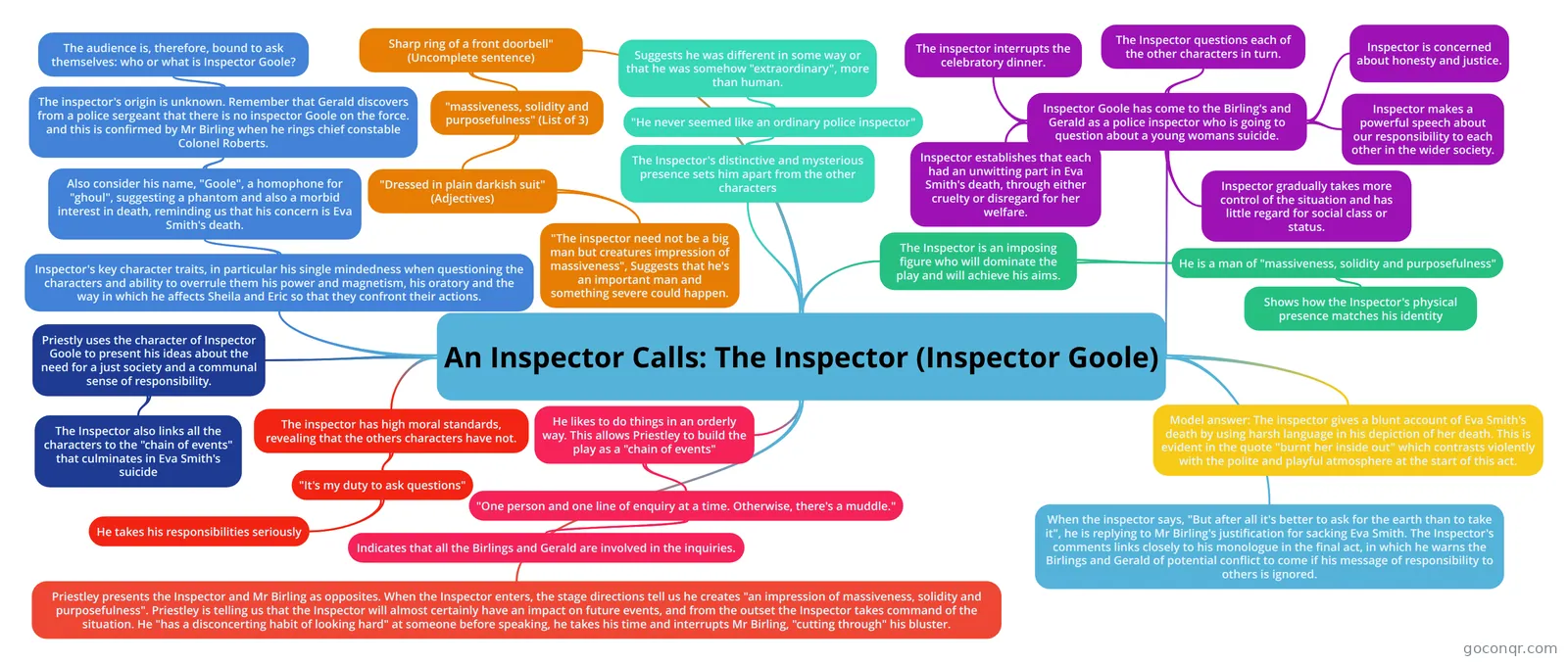
Mind map: An Inspector Calls: Inspector Goole
Inhalt der Mindmap
An Inspector Calls: The Inspector (Inspector Goole)
Inspector Goole has come to the Birling's and Gerald as a police inspector who is going to question about a young womans suicide.
- The inspector interrupts the celebratory dinner.
- The Inspector questions each of the other characters in turn.
- Inspector establishes that each had an unwitting part in Eva Smith's death, through either cruelty or disregard for her welfare.
- Inspector gradually takes more control of the situation and has little regard for social class or status.
- Inspector is concerned about honesty and justice.
- Inspector makes a powerful speech about our responsibility to each other in the wider society.
Priestly uses the character of Inspector Goole to present his ideas about the need for a just society and a communal sense of responsibility.
- The Inspector also links all the characters to the "chain of events" that culminates in Eva Smith's suicide
The Inspector is an imposing figure who will dominate the play and will achieve his aims.
- He is a man of "massiveness, solidity and purposefulness"
- Shows how the Inspector's physical presence matches his identity
- He is a man of "massiveness, solidity and purposefulness"
He likes to do things in an orderly way. This allows Priestley to build the play as a "chain of events"
- "One person and one line of enquiry at a time. Otherwise, there's a muddle."
- Indicates that all the Birlings and Gerald are involved in the inquiries.
- "One person and one line of enquiry at a time. Otherwise, there's a muddle."
The inspector has high moral standards, revealing that the others characters have not.
- "It's my duty to ask questions"
- He takes his responsibilities seriously
- "It's my duty to ask questions"
The Inspector's distinctive and mysterious presence sets him apart from the other characters
- "He never seemed like an ordinary police inspector"
- Suggests he was different in some way or that he was somehow "extraordinary", more than human.
- "He never seemed like an ordinary police inspector"
Inspector's key character traits, in particular his single mindedness when questioning the characters and ability to overrule them his power and magnetism, his oratory and the way in which he affects Sheila and Eric so that they confront their actions.
- Also consider his name, "Goole", a homophone for "ghoul", suggesting a phantom and also a morbid interest in death, reminding us that his concern is Eva Smith's death.
- The inspector's origin is unknown. Remember that Gerald discovers from a police sergeant that there is no inspector Goole on the force. and this is confirmed by Mr Birling when he rings chief constable Colonel Roberts.
- The audience is, therefore, bound to ask themselves: who or what is Inspector Goole?
- The inspector's origin is unknown. Remember that Gerald discovers from a police sergeant that there is no inspector Goole on the force. and this is confirmed by Mr Birling when he rings chief constable Colonel Roberts.
- Also consider his name, "Goole", a homophone for "ghoul", suggesting a phantom and also a morbid interest in death, reminding us that his concern is Eva Smith's death.
Sharp ring of a front doorbell" (Uncomplete sentence)
- "massiveness, solidity and purposefulness" (List of 3)
- "Dressed in plain darkish suit" (Adjectives)
- "The inspector need not be a big man but creatures impression of massiveness", Suggests that he's an important man and something severe could happen.
- "Dressed in plain darkish suit" (Adjectives)
- "massiveness, solidity and purposefulness" (List of 3)
Model answer: The inspector gives a blunt account of Eva Smith's death by using harsh language in his depiction of her death. This is evident in the quote "burnt her inside out" which contrasts violently with the polite and playful atmosphere at the start of this act.
Priestley presents the Inspector and Mr Birling as opposites. When the Inspector enters, the stage directions tell us he creates "an impression of massiveness, solidity and purposefulness". Priestley is telling us that the Inspector will almost certainly have an impact on future events, and from the outset the Inspector takes command of the situation. He "has a disconcerting habit of looking hard" at someone before speaking, he takes his time and interrupts Mr Birling, "cutting through" his bluster.
When the inspector says, "But after all it's better to ask for the earth than to take it", he is replying to Mr Birling's justification for sacking Eva Smith. The Inspector's comments links closely to his monologue in the final act, in which he warns the Birlings and Gerald of potential conflict to come if his message of responsibility to others is ignored.
Informationen
- Beschreibung
- GCSE English Mindmap am An Inspector Calls: The Inspector (Inspector Goole), erstellt von Maira Akhtar am 22/11/2016.
- Erstellt von
- Maira Akhtar
- Aufrufe
- 264
- Bewertung