
Mindmap
Changing Urban Environments
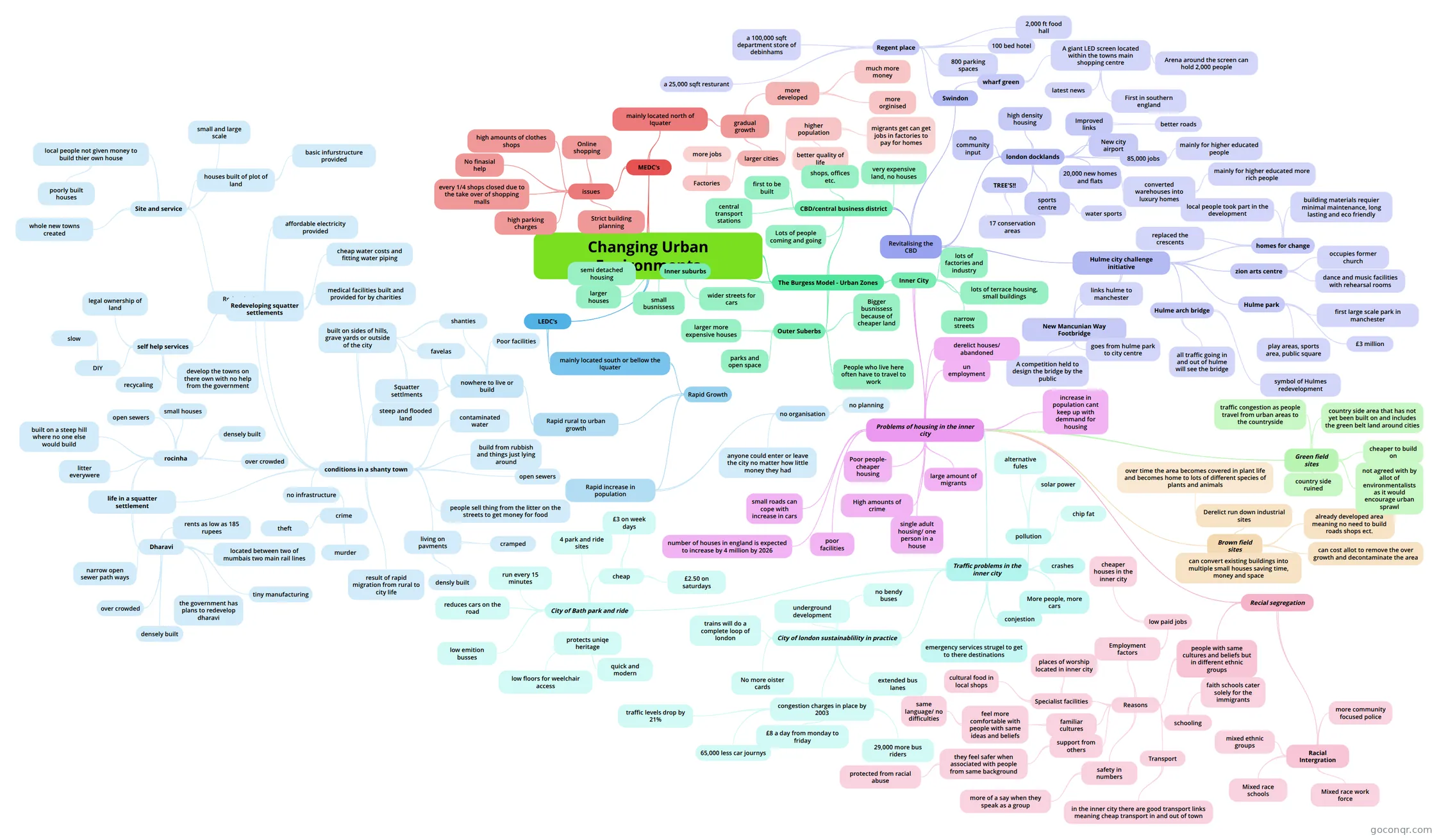
Mind map: Changing urban environments
Inhalt der Mindmap
Changing Urban Environments
MEDC's
- mainly located north of Iquater
- gradual growth
- more developed
- more orginised
- much more money
- larger cities
- higher population
- migrants get can get jobs in factories to pay for homes
- better quality of life
- Factories
- more jobs
- higher population
- more developed
- gradual growth
- issues
- high parking charges
- Strict building planning
- every 1/4 shops closed due to the take over of shopping malls
- No finasial help
- high amounts of clothes shops
- Online shopping
- mainly located north of Iquater
LEDC's
- mainly located south or bellow the Iquater
- Rapid Growth
- Rapid rural to urban growth
- nowhere to live or build
- favelas
- shanties
- built on sides of hills, grave yards or outside of the city
- conditions in a shanty town
- steep and flooded land
- contaminated water
- build from rubbish and things just lying around
- open sewers
- people sell thing from the litter on the streets to get money for food
- living on pavments
- cramped
- densly built
- result of rapid migration from rural to city life
- no infrastructure
- crime
- murder
- theft
- crime
- life in a squatter settlement
- Dharavi
- rents as low as 185 rupees
- located between two of mumbais two main rail lines
- tiny manufacturing
- the government has plans to redevelop dharavi
- densely built
- over crowded
- narrow open sewer path ways
- rocinha
- over crowded
- densely built
- small houses
- open sewers
- litter everywere
- built on a steep hill where no one else would build
- Dharavi
- Redeveloping squatter settlments
- Redeveloping squatter settlements
- self help services
- develop the towns on there own with no help from the government
- DIY
- slow
- legal ownership of land
- recycaling
- affordable electricity provided
- cheap water costs and fitting water piping
- medical facilities built and provided for by charities
- Site and service
- houses built of plot of land
- basic infurstructure provided
- small and large scale
- whole new towns created
- local people not given money to build thier own house
- poorly built houses
- houses built of plot of land
- self help services
- conditions in a shanty town
- built on sides of hills, grave yards or outside of the city
- Squatter settlments
- Poor facilities
- favelas
- nowhere to live or build
- Rapid increase in population
- no organisation
- anyone could enter or leave the city no matter how little money they had
- no planning
- no organisation
- Rapid rural to urban growth
- Rapid Growth
- mainly located south or bellow the Iquater
The Burgess Model - Urban Zones
- CBD/central business district
- first to be built
- shops, offices etc.
- Lots of people coming and going
- central transport stations
- very expensive land, no houses
- Revitalising the CBD
- Swindon
- Regent place
- a 100,000 sqft department store of debinhams
- a 25,000 sqft resturant
- 2,000 ft food hall
- 800 parking spaces
- 100 bed hotel
- wharf green
- A giant LED screen located within the towns main shopping centre
- latest news
- Arena around the screen can hold 2,000 people
- First in southern england
- A giant LED screen located within the towns main shopping centre
- Regent place
- london docklands
- Improved links
- better roads
- New city airport
- 85,000 jobs
- mainly for higher educated people
- high density housing
- 20,000 new homes and flats
- converted warehouses into luxury homes
- mainly for higher educated more rich people
- converted warehouses into luxury homes
- TREE'S!!
- 17 conservation areas
- sports centre
- water sports
- no community input
- Improved links
- Hulme city challenge initiative
- homes for change
- replaced the crescents
- local people took part in the development
- building materials requier minimal maintenance, long lasting and eco friendly
- zion arts centre
- occupies former church
- dance and music facilities with rehearsal rooms
- Hulme park
- first large scale park in manchester
- £3 million
- play areas, sports area, public square
- Hulme arch bridge
- symbol of Hulmes redevelopment
- all traffic going in and out of hulme will see the bridge
- New Mancunian Way Footbridge
- links hulme to manchester
- A competition held to design the bridge by the public
- goes from hulme park to city centre
- homes for change
- Swindon
- Inner City
- lots of factories and industry
- lots of terrace housing, small buildings
- narrow streets
- Problems of housing in the inner city
- number of houses in england is expected to increase by 4 million by 2026
- High amounts of crime
- small roads can cope with increase in cars
- Poor people- cheaper housing
- poor facilities
- single adult housing/ one person in a house
- increase in population cant keep up with demmand for housing
- un employment
- derelict houses/ abandoned
- large amount of migrants
- Green field sites
- country side area that has not yet been built on and includes the green belt land around cities
- cheaper to build on
- not agreed with by allot of environmentalists as it would encourage urban sprawl
- country side ruined
- traffic congestion as people travel from urban areas to the countryside
- Brown field sites
- Derelict run down industrial sites
- over time the area becomes covered in plant life and becomes home to lots of different species of plants and animals
- can convert existing buildings into multiple small houses saving time, money and space
- already developed area meaning no need to build roads shops ect.
- can cost allot to remove the over growth and decontaminate the area
- Derelict run down industrial sites
- Traffic problems in the inner city
- pollution
- alternative fules
- solar power
- chip fat
- More people, more cars
- emergency services strugel to get to there destinations
- crashes
- conjestion
- City of Bath park and ride
- 4 park and ride sites
- cheap
- £3 on week days
- £2.50 on saturdays
- run every 15 minutes
- low floors for weelchair access
- quick and modern
- low emition busses
- reduces cars on the road
- protects uniqe heritage
- City of london sustainablility in practice
- congestion charges in place by 2003
- £8 a day from monday to friday
- traffic levels drop by 21%
- 65,000 less car journys
- 29,000 more bus riders
- underground development
- trains will do a complete loop of london
- no bendy buses
- extended bus lanes
- No more oister cards
- congestion charges in place by 2003
- pollution
- Recial segregation
- people with same cultures and beliefs but in different ethnic groups
- Reasons
- Employment factors
- low paid jobs
- cheaper houses in the inner city
- low paid jobs
- Specialist facilities
- places of worship located in inner city
- cultural food in local shops
- schooling
- faith schools cater solely for the immigrants
- support from others
- they feel safer when associated with people from same background
- protected from racial abuse
- they feel safer when associated with people from same background
- familiar cultures
- feel more comfortable with people with same ideas and beliefs
- same language/ no difficulties
- feel more comfortable with people with same ideas and beliefs
- safety in numbers
- more of a say when they speak as a group
- Transport
- in the inner city there are good transport links meaning cheap transport in and out of town
- Employment factors
- Reasons
- Racial Intergration
- Mixed race schools
- mixed ethnic groups
- more community focused police
- Mixed race work force
- people with same cultures and beliefs but in different ethnic groups
- Inner suburbs
- semi detached housing
- larger houses
- small busnissess
- wider streets for cars
- Outer Suberbs
- larger more expensive houses
- parks and open space
- Bigger busnissess because of cheaper land
- People who live here often have to travel to work
- CBD/central business district
Informationen
- Beschreibung
- Mindmap am Changing Urban Environments, erstellt von Brutal Butt Slaps am 08/04/2014.
- Erstellt von
- Brutal Butt Slaps
- Aufrufe
- 126
- Bewertung