
Mindmap
American Lit 2
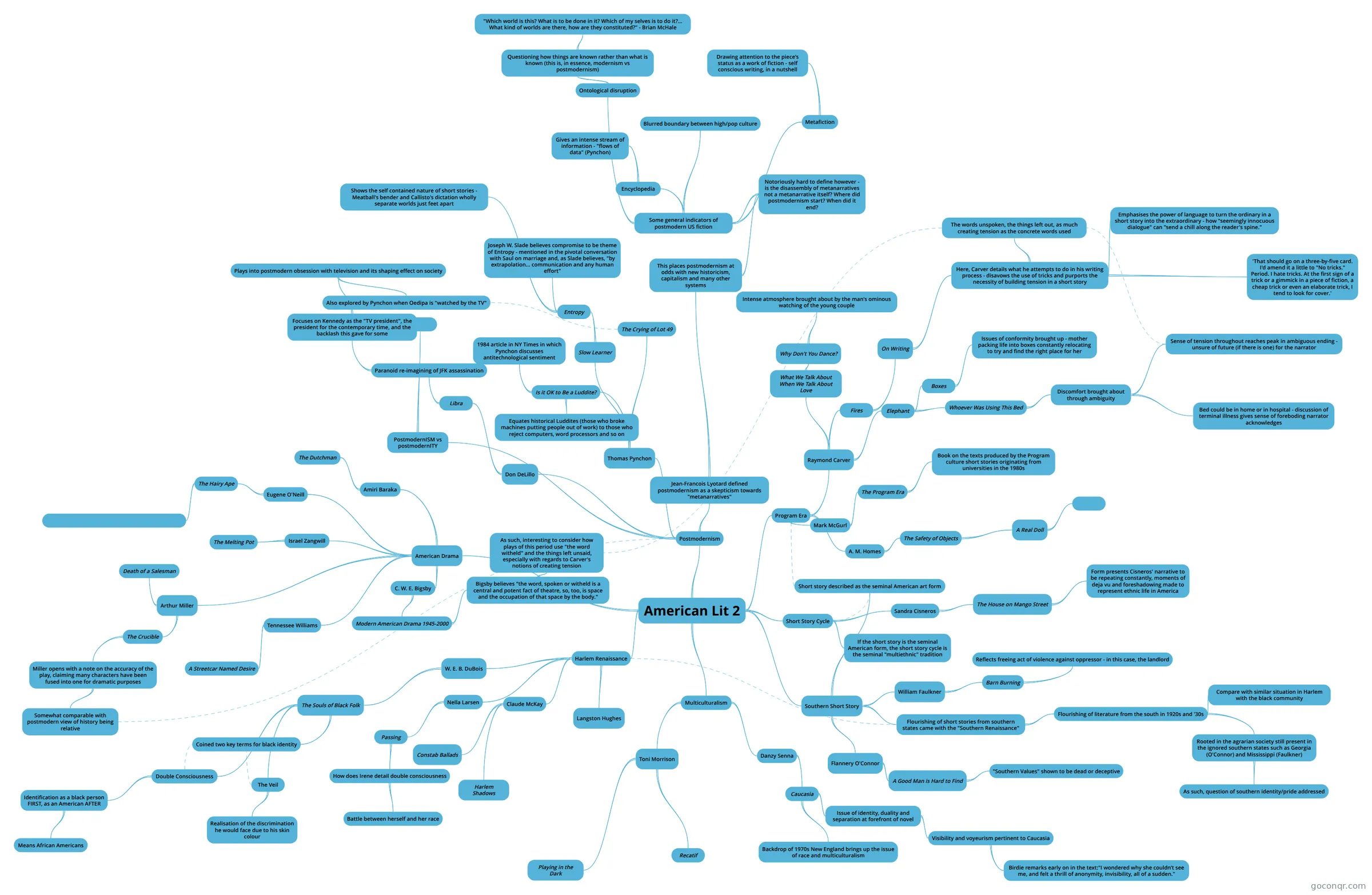
Mind map: American Lit 2
Inhalt der Mindmap
American Lit 2
Postmodernism
- Thomas Pynchon
- Slow Learner
- Entropy
- Joseph W. Slade believes compromise to be theme of Entropy - mentioned in the pivotal conversation with Saul on marriage and, as Slade believes, "by extrapolation... communication and any human effort"
- Shows the self contained nature of short stories - Meatball's bender and Callisto's dictation wholly separate worlds just feet apart
- Entropy
- The Crying of Lot 49
- Is it OK to Be a Luddite?
- 1984 article in NY Times in which Pynchon discusses antitechnological sentiment
- Equates historical Luddites (those who broke machines putting people out of work) to those who reject computers, word processors and so on
- Slow Learner
- Don DeLillo
- Libra
- Paranoid re-imagining of JFK assassination
- Focuses on Kennedy as the "TV president", the president for the contemporary time, and the backlash this gave for some
- Plays into postmodern obsession with television and its shaping effect on society
- Also explored by Pynchon when Oedipa is "watched by the TV"
- Plays into postmodern obsession with television and its shaping effect on society
- Focuses on Kennedy as the "TV president", the president for the contemporary time, and the backlash this gave for some
- Paranoid re-imagining of JFK assassination
- Libra
- PostmodernISM vs postmodernITY
- Jean-Francois Lyotard defined postmodernism as a skepticism towards "metanarratives"
- This places postmodernism at odds with new historicism, capitalism and many other systems
- Notoriously hard to define however - is the disassembly of metanarratives not a metanarrative itself? Where did postmodernism start? When did it end?
- Some general indicators of postmodern US fiction
- Ontological disruption
- Questioning how things are known rather than what is known (this is, in essence, modernism vs postmodernism)
- "Which world is this? What is to be done in it? Which of my selves is to do it?... What kind of worlds are there, how are they constituted?" - Brian McHale
- Questioning how things are known rather than what is known (this is, in essence, modernism vs postmodernism)
- Blurred boundary between high/pop culture
- Metafiction
- Drawing attention to the piece's status as a work of fiction - self conscious writing, in a nutshell
- Encyclopedia
- Gives an intense stream of information - "flows of data" (Pynchon)
- Ontological disruption
- Some general indicators of postmodern US fiction
- Notoriously hard to define however - is the disassembly of metanarratives not a metanarrative itself? Where did postmodernism start? When did it end?
- This places postmodernism at odds with new historicism, capitalism and many other systems
- Thomas Pynchon
Multiculturalism
- Toni Morrison
- Recatif
- Playing in the Dark
- Danzy Senna
- Caucasia
- Issue of identity, duality and separation at forefront of novel
- Visibility and voyeurism pertinent to Caucasia
- Birdie remarks early on in the text:"I wondered why she couldn’t see me, and felt a thrill of anonymity, invisibility, all of a sudden."
- Visibility and voyeurism pertinent to Caucasia
- Backdrop of 1970s New England brings up the issue of race and multiculturalism
- Issue of identity, duality and separation at forefront of novel
- Caucasia
- Toni Morrison
Southern Short Story
- William Faulkner
- Barn Burning
- Reflects freeing act of violence against oppressor - in this case, the landlord
- Barn Burning
- Flannery O'Connor
- A Good Man is Hard to Find
- "Southern Values" shown to be dead or deceptive
- A Good Man is Hard to Find
- Short story described as the seminal American art form
- Flourishing of short stories from southern states came with the "Southern Renaissance"
- Flourishing of literature from the south in 1920s and '30s
- Rooted in the agrarian society still present in the ignored southern states such as Georgia (O'Connor) and Mississippi (Faulkner)
- As such, question of southern identity/pride addressed
- Compare with similar situation in Harlem with the black community
- Rooted in the agrarian society still present in the ignored southern states such as Georgia (O'Connor) and Mississippi (Faulkner)
- Flourishing of literature from the south in 1920s and '30s
- William Faulkner
Harlem Renaissance
- Nella Larsen
- Passing
- How does Irene detail double consciousness
- Battle between herself and her race
- How does Irene detail double consciousness
- Passing
- W. E. B. DuBois
- The Souls of Black Folk
- Double Consciousness
- Identification as a black person FIRST, as an American AFTER
- Means African Americans
- Identification as a black person FIRST, as an American AFTER
- The Veil
- Realisation of the discrimination he would face due to his skin colour
- Coined two key terms for black identity
- Double Consciousness
- The Souls of Black Folk
- Claude McKay
- Harlem Shadows
- Constab Ballads
- Langston Hughes
- Nella Larsen
American Drama
- Israel Zangwill
- The Melting Pot
- Arthur Miller
- Death of a Salesman
- The Crucible
- Miller opens with a note on the accuracy of the play, claiming many characters have been fused into one for dramatic purposes
- Somewhat comparable with postmodern view of history being relative
- Miller opens with a note on the accuracy of the play, claiming many characters have been fused into one for dramatic purposes
- Tennessee Williams
- A Streetcar Named Desire
- Eugene O'Neill
- The Hairy Ape
- The Hairy Ape
- C. W. E. Bigsby
- Modern American Drama 1945-2000
- Bigsby believes "the word, spoken or witheld is a central and potent fact of theatre, so, too, is space and the occupation of that space by the body."
- As such, interesting to consider how plays of this period use "the word witheld" and the things left unsaid, especially with regards to Carver's notions of creating tension
- Bigsby believes "the word, spoken or witheld is a central and potent fact of theatre, so, too, is space and the occupation of that space by the body."
- Modern American Drama 1945-2000
- Amiri Baraka
- The Dutchman
- Israel Zangwill
Short Story Cycle
- Sandra Cisneros
- The House on Mango Street
- Form presents Cisneros' narrative to be repeating constantly, moments of deja vu and foreshadowing made to represent ethnic life in America
- The House on Mango Street
- If the short story is the seminal American form, the short story cycle is the seminal "multiethnic" tradition
- Sandra Cisneros
Program Era
- Raymond Carver
- Elephant
- Boxes
- Issues of conformity brought up - mother packing life into boxes constantly relocating to try and find the right place for her
- Whoever Was Using This Bed
- Discomfort brought about through ambiguity
- Sense of tension throughout reaches peak in ambiguous ending - unsure of future (if there is one) for the narrator
- Bed could be in home or in hospital - discussion of terminal illness gives sense of foreboding narrator acknowledges
- Discomfort brought about through ambiguity
- Boxes
- What We Talk About When We Talk About Love
- Why Don't You Dance?
- Intense atmosphere brought about by the man's ominous watching of the young couple
- Why Don't You Dance?
- Fires
- On Writing
- Here, Carver details what he attempts to do in his writing process - disavows the use of tricks and purports the necessity of building tension in a short story
- 'That should go on a three-by-five card. I'd amend it a little to "No tricks." Period. I hate tricks. At the first sign of a trick or a gimmick in a piece of fiction, a cheap trick or even an elaborate trick, I tend to look for cover.'
- Emphasises the power of language to turn the ordinary in a short story into the extraordinary - how "seemingly innocuous dialogue" can "send a chill along the reader's spine."
- The words unspoken, the things left out, as much creating tension as the concrete words used
- Here, Carver details what he attempts to do in his writing process - disavows the use of tricks and purports the necessity of building tension in a short story
- On Writing
- Elephant
- Mark McGurl
- The Program Era
- Book on the texts produced by the Program culture short stories originating from universities in the 1980s
- The Program Era
- A. M. Homes
- The Safety of Objects
- A Real Doll
- A Real Doll
- The Safety of Objects
- Raymond Carver
Informationen
- Beschreibung
- English Mindmap am American Lit 2, erstellt von Iwan MacBride am 11/04/2017.
- Erstellt von
- Iwan MacBride
- Aufrufe
- 3
- Bewertung
Mehr zu 20th-Century American Literature