
Mindmap
Decision Making of Juries
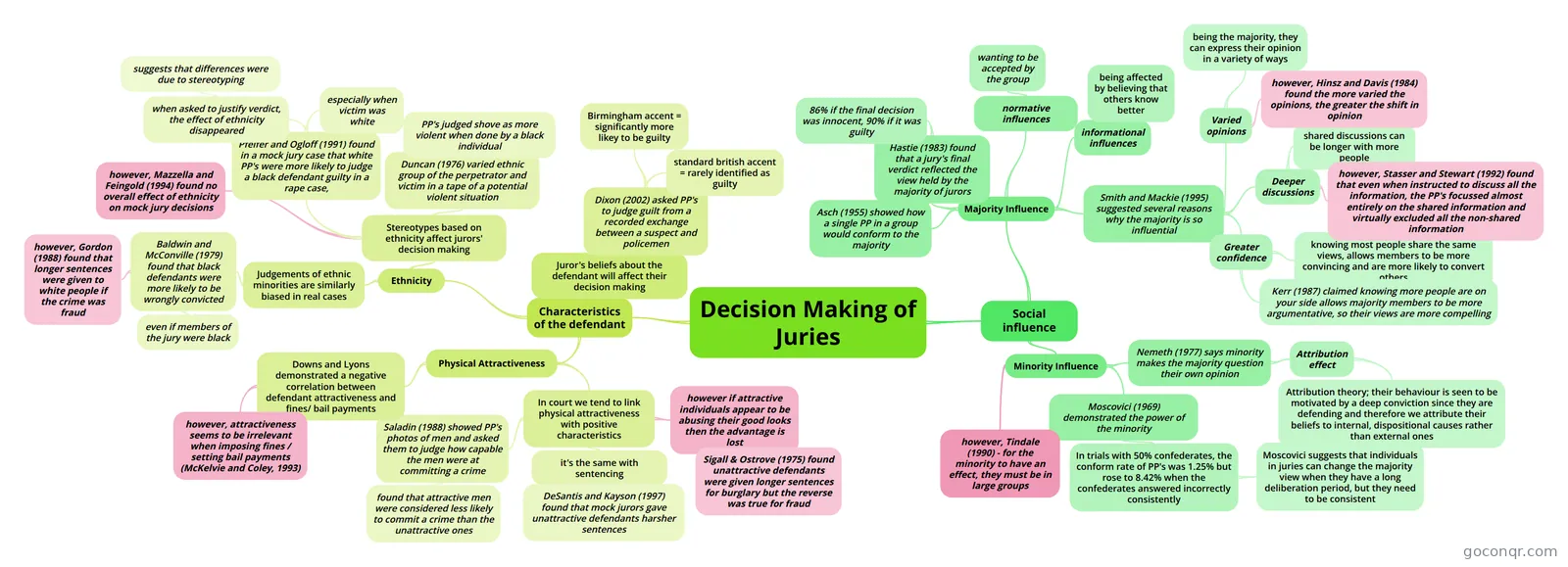
Mind map: Decision making of juries
Inhalt der Mindmap
Decision Making of Juries
Social influence
- Majority Influence
- Asch (1955) showed how a single PP in a group would conform to the majority
- Hastie (1983) found that a jury's final verdict reflected the view held by the majority of jurors
- 86% if the final decision was innocent, 90% if it was guilty
- normative influences
- wanting to be accepted by the group
- informational influences
- being affected by believing that others know better
- Smith and Mackie (1995) suggested several reasons why the majority is so influential
- Varied opinions
- being the majority, they can express their opinion in a variety of ways
- however, Hinsz and Davis (1984) found the more varied the opinions, the greater the shift in opinion
- Deeper discussions
- shared discussions can be longer with more people
- however, Stasser and Stewart (1992) found that even when instructed to discuss all the information, the PP's focussed almost entirely on the shared information and virtually excluded all the non-shared information
- Greater confidence
- knowing most people share the same views, allows members to be more convincing and are more likely to convert others
- Kerr (1987) claimed knowing more people are on your side allows majority members to be more argumentative, so their views are more compelling
- Varied opinions
- Minority Influence
- Nemeth (1977) says minority makes the majority question their own opinion
- Attribution effect
- Attribution theory; their behaviour is seen to be motivated by a deep conviction since they are defending and therefore we attribute their beliefs to internal, dispositional causes rather than external ones
- Attribution effect
- Moscovici (1969) demonstrated the power of the minority
- In trials with 50% confederates, the conform rate of PP's was 1.25% but rose to 8.42% when the confederates answered incorrectly consistently
- Moscovici suggests that individuals in juries can change the majority view when they have a long deliberation period, but they need to be consistent
- In trials with 50% confederates, the conform rate of PP's was 1.25% but rose to 8.42% when the confederates answered incorrectly consistently
- however, Tindale (1990) - for the minority to have an effect, they must be in large groups
- Nemeth (1977) says minority makes the majority question their own opinion
- Majority Influence
Characteristics of the defendant
- Juror's beliefs about the defendant will affect their decision making
- Dixon (2002) asked PP's to judge guilt from a recorded exchange between a suspect and policemen
- standard british accent = rarely identified as guilty
- Birmingham accent = significantly more likey to be guilty
- Dixon (2002) asked PP's to judge guilt from a recorded exchange between a suspect and policemen
- Ethnicity
- Stereotypes based on ethnicity affect jurors' decision making
- Duncan (1976) varied ethnic group of the perpetrator and victim in a tape of a potential violent situation
- PP's judged shove as more violent when done by a black individual
- Pfeifer and Ogloff (1991) found in a mock jury case that white PP's were more likely to judge a black defendant guilty in a rape case,
- especially when victim was white
- when asked to justify verdict, the effect of ethnicity disappeared
- suggests that differences were due to stereotyping
- however, Mazzella and Feingold (1994) found no overall effect of ethnicity on mock jury decisions
- Duncan (1976) varied ethnic group of the perpetrator and victim in a tape of a potential violent situation
- Judgements of ethnic minorities are similarly biased in real cases
- Baldwin and McConville (1979) found that black defendants were more likely to be wrongly convicted
- even if members of the jury were black
- however, Gordon (1988) found that longer sentences were given to white people if the crime was fraud
- Baldwin and McConville (1979) found that black defendants were more likely to be wrongly convicted
- Stereotypes based on ethnicity affect jurors' decision making
- Physical Attractiveness
- In court we tend to link physical attractiveness with positive characteristics
- Saladin (1988) showed PP's photos of men and asked them to judge how capable the men were at committing a crime
- found that attractive men were considered less likely to commit a crime than the unattractive ones
- it's the same with sentencing
- DeSantis and Kayson (1997) found that mock jurors gave unattractive defendants harsher sentences
- however if attractive individuals appear to be abusing their good looks then the advantage is lost
- Sigall & Ostrove (1975) found unattractive defendants were given longer sentences for burglary but the reverse was true for fraud
- Saladin (1988) showed PP's photos of men and asked them to judge how capable the men were at committing a crime
- Downs and Lyons demonstrated a negative correlation between defendant attractiveness and fines/ bail payments
- however, attractiveness seems to be irrelevant when imposing fines / setting bail payments (McKelvie and Coley, 1993)
- In court we tend to link physical attractiveness with positive characteristics
- Juror's beliefs about the defendant will affect their decision making
Informationen
- Beschreibung
- A-Levels PY4 (Forensic Psychology) Mindmap am Decision Making of Juries, erstellt von Hayd23 am 12/05/2013.
- Erstellt von
- Hayd23
- Aufrufe
- 280
- Tags
- Bewertung