
Mindmap
Theorists
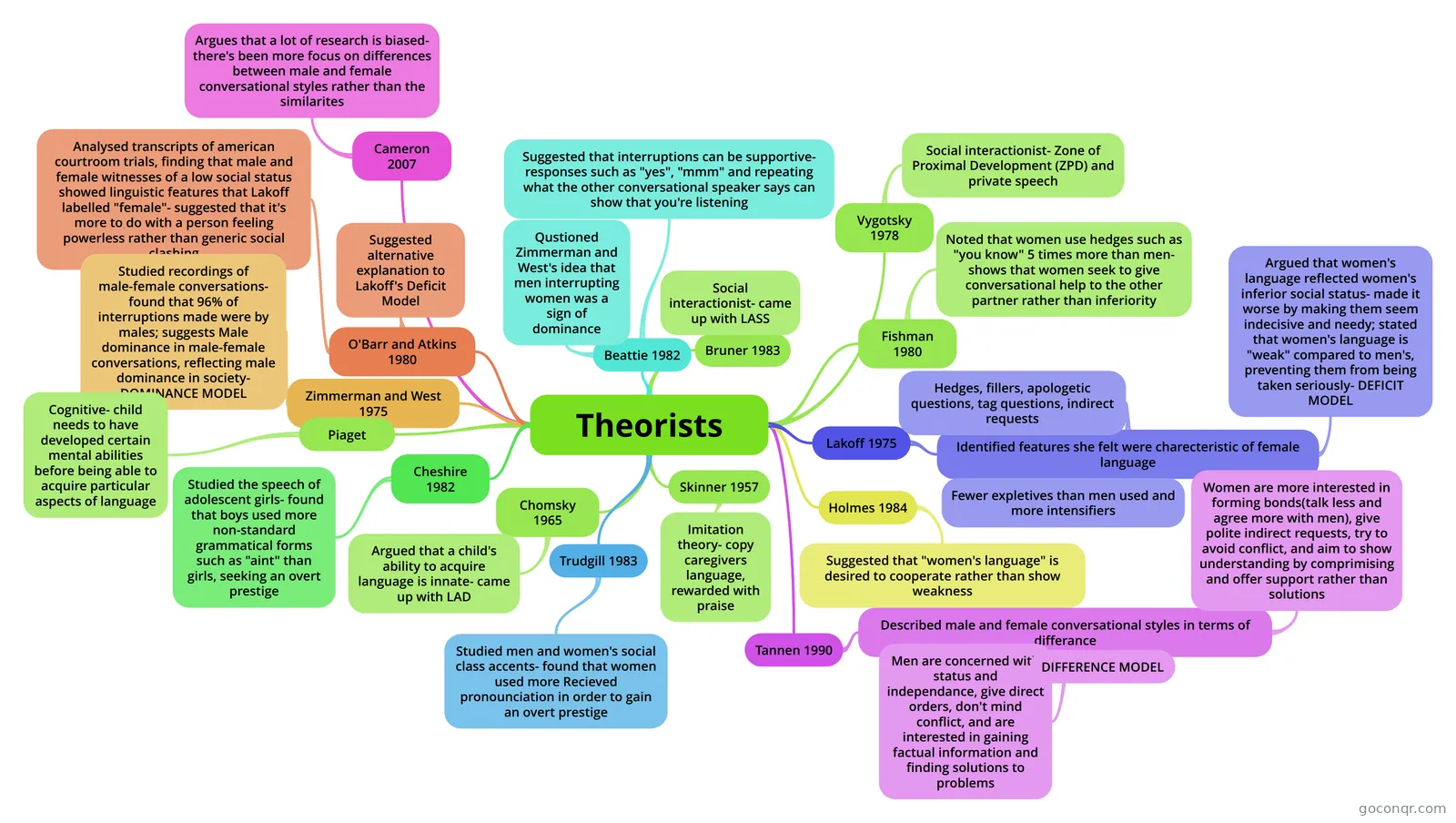
Mind map: Language and gender theorists
Inhalt der Mindmap
Theorists
Trudgill 1983
- Studied men and women's social class accents- found that women used more Recieved pronounciation in order to gain an overt prestige
Cheshire 1982
- Studied the speech of adolescent girls- found that boys used more non-standard grammatical forms such as "aint" than girls, seeking an overt prestige
Lakoff 1975
- Identified features she felt were charecteristic of female language
- Hedges, fillers, apologetic questions, tag questions, indirect requests
- Fewer expletives than men used and more intensifiers
- Argued that women's language reflected women's inferior social status- made it worse by making them seem indecisive and needy; stated that women's language is "weak" compared to men's, preventing them from being taken seriously- DEFICIT MODEL
- Identified features she felt were charecteristic of female language
O'Barr and Atkins 1980
- Suggested alternative explanation to Lakoff's Deficit Model
- Analysed transcripts of american courtroom trials, finding that male and female witnesses of a low social status showed linguistic features that Lakoff labelled "female"- suggested that it's more to do with a person feeling powerless rather than generic social clashing
Holmes 1984
- Suggested that "women's language" is desired to cooperate rather than show weakness
Zimmerman and West 1975
- Studied recordings of male-female conversations- found that 96% of interruptions made were by males; suggests Male dominance in male-female conversations, reflecting male dominance in society- DOMINANCE MODEL
Tannen 1990
- Described male and female conversational styles in terms of differance
- Men are concerned with status and independance, give direct orders, don't mind conflict, and are interested in gaining factual information and finding solutions to problems
- Women are more interested in forming bonds(talk less and agree more with men), give polite indirect requests, try to avoid conflict, and aim to show understanding by comprimising and offer support rather than solutions
- DIFFERENCE MODEL
- Described male and female conversational styles in terms of differance
Beattie 1982
- Qustioned Zimmerman and West's idea that men interrupting women was a sign of dominance
- Suggested that interruptions can be supportive- responses such as "yes", "mmm" and repeating what the other conversational speaker says can show that you're listening
Cameron 2007
- Argues that a lot of research is biased- there's been more focus on differences between male and female conversational styles rather than the similarites
Fishman 1980
- Noted that women use hedges such as "you know" 5 times more than men- shows that women seek to give conversational help to the other partner rather than inferiority
Chomsky 1965
- Argued that a child's ability to acquire language is innate- came up with LAD
Piaget
- Cognitive- child needs to have developed certain mental abilities before being able to acquire particular aspects of language
Bruner 1983
- Social interactionist- came up with LASS
Vygotsky 1978
- Social interactionist- Zone of Proximal Development (ZPD) and private speech
Skinner 1957
- Imitation theory- copy caregivers language, rewarded with praise
Informationen
- Beschreibung
- A-Levels English Mindmap am Theorists, erstellt von Jake Davey am 23/05/2013.
- Erstellt von
- Jake Davey
- Aufrufe
- 140
- Tags
- Bewertung