
Mindmap
Globalisation & Migration
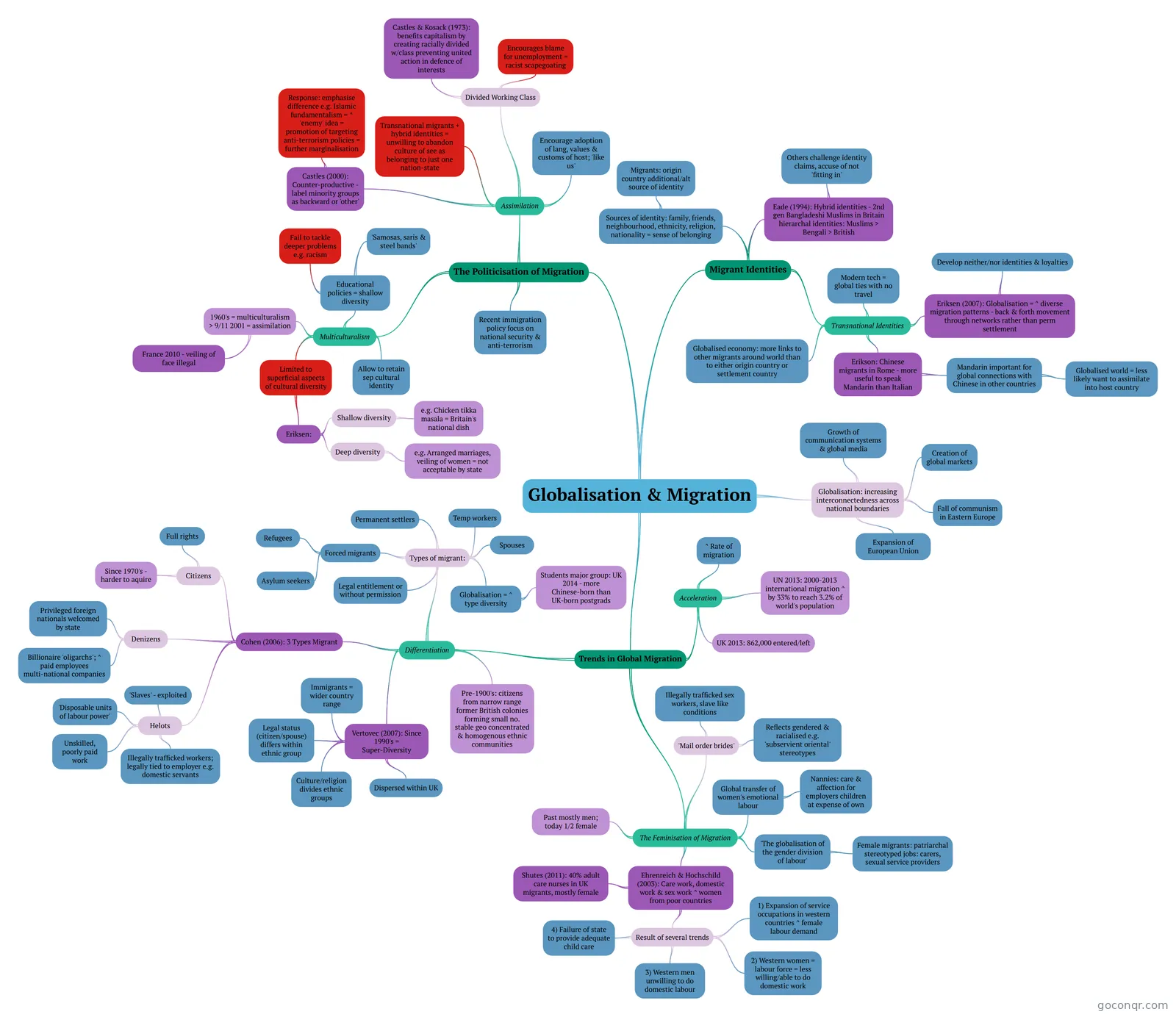
Mind map: Globalisation & migration
Inhalt der Mindmap
Globalisation & Migration
Globalisation: increasing interconnectedness across national boundaries
- Growth of communication systems & global media
- Creation of global markets
- Fall of communism in Eastern Europe
- Expansion of European Union
Trends in Global Migration
- Acceleration
- ^ Rate of migration
- UN 2013: 2000-2013 international migration ^ by 33% to reach 3.2% of world's population
- UK 2013: 862,000 entered/left
- Differentiation
- Types of migrant:
- Permanent settlers
- Temp workers
- Spouses
- Forced migrants
- Refugees
- Asylum seekers
- Legal entitlement or without permission
- Globalisation = ^ type diversity
- Students major group: UK 2014 - more Chinese-born than UK-born postgrads
- Pre-1900's: citizens from narrow range former British colonies forming small no. stable geo concentrated & homogenous ethnic communities
- Vertovec (2007): Since 1990's = Super-Diversity
- Immigrants = wider country range
- Legal status (citizen/spouse) differs within ethnic group
- Culture/religion divides ethnic groups
- Dispersed within UK
- Cohen (2006): 3 Types Migrant
- Citizens
- Full rights
- Since 1970's - harder to aquire
- Denizens
- Privileged foreign nationals welcomed by state
- Billionaire 'oligarchs'; ^ paid employees multi-national companies
- Helots
- 'Slaves' - exploited
- 'Disposable units of labour power'
- Unskilled, poorly paid work
- Illegally trafficked workers; legally tied to employer e.g. domestic servants
- Citizens
- Types of migrant:
- The Feminisation of Migration
- Past mostly men; today 1/2 female
- 'The globalisation of the gender division of labour'
- Female migrants: patriarchal stereotyped jobs: carers, sexual service providers
- Ehrenreich & Hochschild (2003): Care work, domestic work & sex work ^ women from poor countries
- Result of several trends
- 1) Expansion of service occupations in western countries ^ female labour demand
- 2) Western women = labour force = less willing/able to do domestic work
- 3) Western men unwilling to do domestic labour
- 4) Failure of state to provide adequate child care
- Shutes (2011): 40% adult care nurses in UK migrants, mostly female
- Result of several trends
- Global transfer of women's emotional labour
- Nannies: care & affection for employers children at expense of own
- 'Mail order brides'
- Reflects gendered & racialised e.g. 'subservient oriental' stereotypes
- Illegally trafficked sex workers, slave like conditions
- Acceleration
Migrant Identities
- Sources of identity: family, friends, neighbourhood, ethnicity, religion, nationality = sense of belonging
- Migrants: origin country additional/alt source of identity
- Eade (1994): Hybrid identities - 2nd gen Bangladeshi Muslims in Britain hierarchal identities: Muslims > Bengali > British
- Others challenge identity claims, accuse of not 'fitting in'
- Transnational Identities
- Eriksen (2007): Globalisation = ^ diverse migration patterns - back & forth movement through networks rather than perm settlement
- Develop neither/nor identities & loyalties
- Modern tech = global ties with no travel
- Globalised economy: more links to other migrants around world than to either origin country or settlement country
- Erikson: Chinese migrants in Rome - more useful to speak Mandarin than Italian
- Mandarin important for global connections with Chinese in other countries
- Globalised world = less likely want to assimilate into host country
- Mandarin important for global connections with Chinese in other countries
- Eriksen (2007): Globalisation = ^ diverse migration patterns - back & forth movement through networks rather than perm settlement
- Sources of identity: family, friends, neighbourhood, ethnicity, religion, nationality = sense of belonging
The Politicisation of Migration
- Recent immigration policy focus on national security & anti-terrorism
- Assimilation
- Encourage adoption of lang, values & customs of host; 'like us'
- Transnational migrants + hybrid identities = unwilling to abandon culture of see as belonging to just one nation-state
- Castles (2000): Counter-productive - label minority groups as backward or 'other'
- Response: emphasise difference e.g. Islamic fundamentalism = ^ 'enemy' idea = promotion of targeting anti-terrorism policies = further marginalisation
- Divided Working Class
- Encourages blame for unemployment = racist scapegoating
- Castles & Kosack (1973): benefits capitalism by creating racially divided w/class preventing united action in defence of interests
- Multiculturalism
- Allow to retain sep cultural identity
- Limited to superficial aspects of cultural diversity
- Eriksen:
- Shallow diversity
- e.g. Chicken tikka masala = Britain's national dish
- Deep diversity
- e.g. Arranged marriages, veiling of women = not acceptable by state
- Shallow diversity
- Eriksen:
- Educational policies = shallow diversity
- 'Samosas, saris & steel bands'
- Fail to tackle deeper problems e.g. racism
- 1960's = multiculturalism > 9/11 2001 = assimilation
- France 2010 - veiling of face illegal
Informationen
- Beschreibung
- AS level Sociology (Demography) Mindmap am Globalisation & Migration, erstellt von Beth Blake am 19/02/2018.
- Erstellt von
- Beth Blake
- Aufrufe
- 0
- Bewertung
Mehr zu Globalisation and migration