
Mindmap
6.Defamation
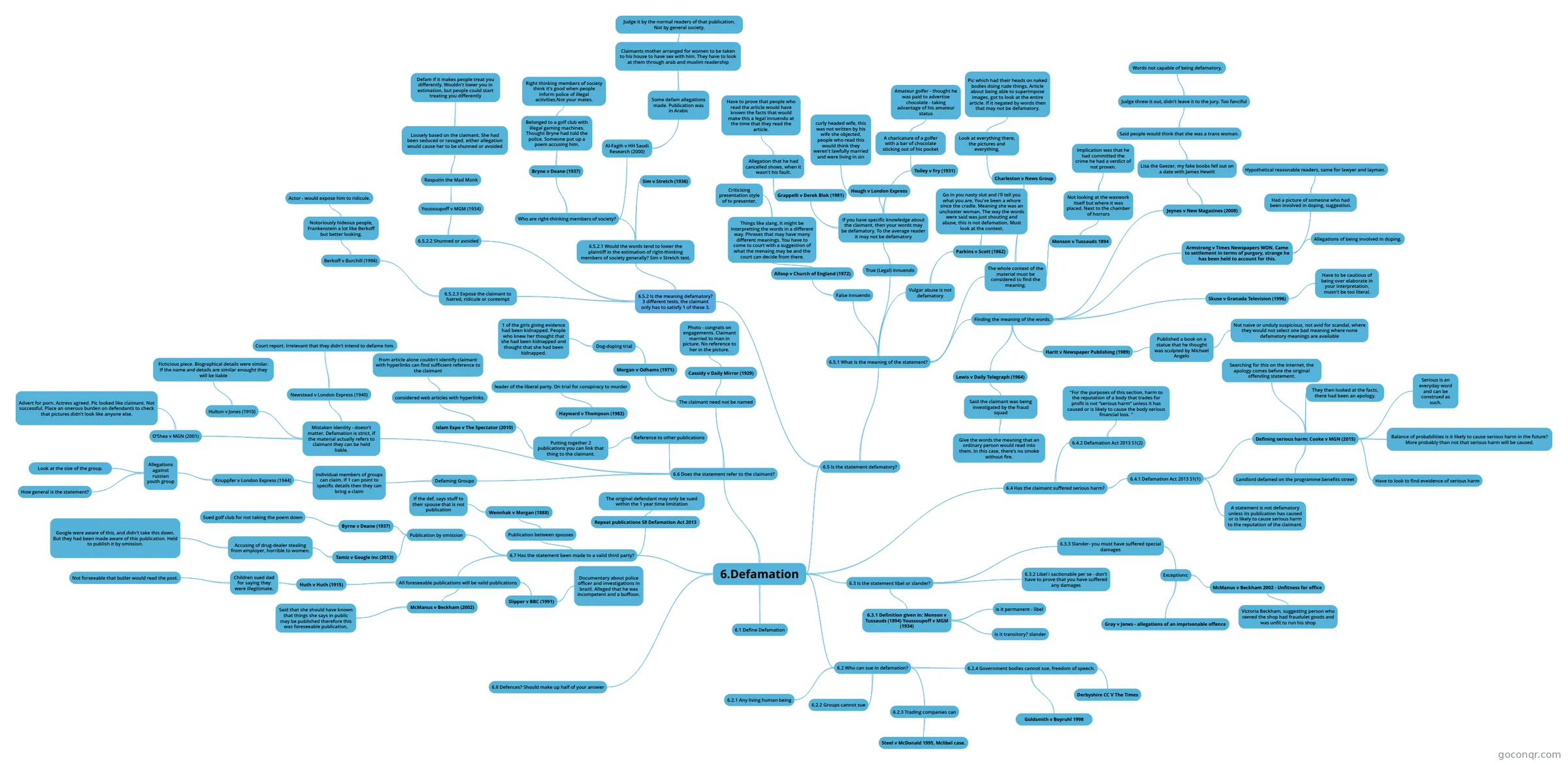
Mind map: Defamation
Inhalt der Mindmap
6.Defamation
6.2 Who can sue in defamation?
- 6.2.1 Any living human being
- 6.2.2 Groups cannot sue
- 6.2.3 Trading companies can
- Steel v McDonald 1995, Mclibel case.
- 6.2.4 Government bodies cannot sue, freedom of speech.
- Derbyshire CC V The Times
- Goldsmith v Boyruhl 1998
6.3 Is the statement libel or slander?
- 6.3.1 Definition given in: Monson v Tussauds (1894) Youssoupoff v MGM (1934)
- is it permanent - libel
- is it transitory? slander
- 6.3.2 Libel i sactionable per se - don't have to prove that you have suffered any damages
- 6.3.3 Slander- you must have suffered special damages
- Exceptions:
- Gray v Jones - allegations of an imprisonable offence
- McManus v Beckham 2002 - Unfitness for office
- Victoria Beckham, suggesting person who owned the shop had fraudulet goods and was unfit to run his shop
- Exceptions:
- 6.3.1 Definition given in: Monson v Tussauds (1894) Youssoupoff v MGM (1934)
6.4 Has the claimant suffered serious harm?
- 6.4.1 Defamation Act 2013 S1(1)
- A statement is not defamatory unless its publication has caused or is likely to cause serious harm to the reputation of the claimant.
- Defining serious harm: Cooke v MGN (2015)
- Landlord defamed on the programme benefits street
- Have to look to find eveidence of serious harm
- Balance of probabilities is it likely to cause serious harm in the future? More probably than not that serious harm will be caused.
- Serious is an everyday word and can be construed as such.
- They then looked at the facts, there had been an apology.
- Searching for this on the internet, the apology comes before the original offending statement.
- 6.4.2 Defamation Act 2013 S1(2)
- "For the purposes of this section, harm to the reputation of a body that trades for profit is not “serious harm” unless it has caused or is likely to cause the body serious financial loss. "
- 6.4.1 Defamation Act 2013 S1(1)
6.5 Is the statement defamatory?
- 6.5.1 What is the meaning of the statement?
- Finding the meaning of the words.
- Lewis v Daily Telegraph (1964)
- Said the claimant was being investigated by the fraud squad
- Give the words the meaning that an ordinary person would read into them. In this case, there's no smoke without fire.
- Said the claimant was being investigated by the fraud squad
- Hartt v Newspaper Publishing (1989)
- Published a book on a statue that he thought was sculpted by Michael Angelo
- Not naive or unduly suspicious, not avid for scandal, where they would not select one bad meaning where none defamatory meanings are available
- Published a book on a statue that he thought was sculpted by Michael Angelo
- Skuse v Granada Television (1996)
- Have to be cautious of being over elaborate in your interpretation, musn't be too literal.
- Armstrong v Times Newspapers WON. Came to settlement in terms of purgory, strange he has been held to account for this.
- Allegations of being involved in doping.
- Had a picture of someone who had been involved in doping, suggestion.
- Hypothetical reasonable readers, same for lawyer and layman.
- Jeynes v New Magazines (2008)
- Lisa the Geezer, my fake boobs fell out on a date with James Hewitt
- Said people would think that she was a trans woman.
- Judge threw it out, didn't leave it to the jury. Too fanciful
- Words not capable of being defamatory.
- Judge threw it out, didn't leave it to the jury. Too fanciful
- Said people would think that she was a trans woman.
- Lisa the Geezer, my fake boobs fell out on a date with James Hewitt
- Lewis v Daily Telegraph (1964)
- The whole context of the material must be considered to find the meaning.
- Monson v Tussauds 1894
- Not looking at the waxwork itself but where it was placed. Next to the chamber of horrors
- Implication was that he had committed the crime he had a verdict of not proven.
- Not looking at the waxwork itself but where it was placed. Next to the chamber of horrors
- Charleston v News Group
- Look at everything there, the pictures and everything.
- Pic which had their heads on naked bodies doing rude things. Article about being able to superimpose images, got to look at the entire article. If it negated by words then that may not be defamatory.
- Look at everything there, the pictures and everything.
- Monson v Tussauds 1894
- Vulgar abuse is not defamatory
- Parkins v Scott (1862)
- Go in you nasty slut and i'll tell you what you are. You've been a whore since the cradle. Meaning she was an unchaster woman. The way the words were said was just shouting and abuse, this is not defamation. Must look at the context.
- Parkins v Scott (1862)
- True (Legal) innuendo
- If you have specific knowledge about the claimant, then your words may be defamatory. To the average reader it may not be defamatory
- Hough v London Express
- curly headed wife, this was not written by his wife she objected, people who read this would think they weren't lawfully married and were living in sin
- Tolley v Fry (1931)
- A charicature of a golfer with a bar of chocolate sticking out of his pocket
- Amateur golfer - thought he was paid to advertise chocolate - taking advantage of his amateur status
- A charicature of a golfer with a bar of chocolate sticking out of his pocket
- Grappelli v Derek Blok (1981)
- Allegation that he had cancelled shows, when it wasn't his fault.
- Have to prove that people who read the article would have known the facts that would make this a legal innuendo at the time that they read the article.
- Allegation that he had cancelled shows, when it wasn't his fault.
- Hough v London Express
- If you have specific knowledge about the claimant, then your words may be defamatory. To the average reader it may not be defamatory
- False Innuendo
- Allsop v Church of England (1972)
- Things like slang, it might be interpretting the words in a different way. Phrases that may have many different meanings. You have to come to court with a suggestion of what the menaing may be and the court can decide from there.
- Criticising presentation style of tv presenter.
- Things like slang, it might be interpretting the words in a different way. Phrases that may have many different meanings. You have to come to court with a suggestion of what the menaing may be and the court can decide from there.
- Allsop v Church of England (1972)
- Finding the meaning of the words.
- 6.5.2 Is the meaning defamatory? 3 different tests, the claimant only has to satisfy 1 of these 3.
- 6.5.2.1 Would the words tend to lower the plaintiff in the estimation of right-thinking members of society generally? Sim v Stretch test.
- Who are right-thinking members of society?
- Bryne v Deane (1937)
- Belonged to a golf club with illegal gaming machines. Thought Bryne had told the police. Someone put up a poem accusing him.
- Right thinking members of society think it's good when people inform police of illegal activities.Not your mates.
- Belonged to a golf club with illegal gaming machines. Thought Bryne had told the police. Someone put up a poem accusing him.
- Al-Fagih v HH Saudi Research (2000)
- Some defam allegations made. Publication was in Arabic
- Claimants mother arranged for women to be taken to his house to have sex with him. They have to look at them through arab and muslim readership
- Judge it by the normal readers of that publication. Not by general society.
- Claimants mother arranged for women to be taken to his house to have sex with him. They have to look at them through arab and muslim readership
- Some defam allegations made. Publication was in Arabic
- Bryne v Deane (1937)
- Sim v Stretch (1936)
- Who are right-thinking members of society?
- 6.5.2.2 Shunned or avoided
- Youssoupoff v MGM (1934)
- Rasputin the Mad Monk
- Loosely based on the claimant. She had been seduced or ravaged, either allegation would cause her to be shunned or avoided
- Defam if it makes people treat you differently. Wouldn't lower you in estimation, but people could start treating you differently
- Loosely based on the claimant. She had been seduced or ravaged, either allegation would cause her to be shunned or avoided
- Rasputin the Mad Monk
- Youssoupoff v MGM (1934)
- 6.5.2.3 Expose the claimant to hatred, ridicule or contempt
- Berkoff v Burchill (1996)
- Notoriously hideous people, Frankenstein a lot like Berkoff but better looking.
- Actor - would expose him to ridicule.
- Notoriously hideous people, Frankenstein a lot like Berkoff but better looking.
- Berkoff v Burchill (1996)
- 6.5.2.1 Would the words tend to lower the plaintiff in the estimation of right-thinking members of society generally? Sim v Stretch test.
- 6.5.1 What is the meaning of the statement?
6.6 Does the statement refer to the claimant?
- The claimant need not be named
- Cassidy v Daily Mirror (1929)
- Photo - congrats on engagements. Claimant married to man in picture. No reference to her in the picture.
- Morgan v Odhams (1971)
- Dog-doping trial
- 1 of the girls giving evidence had been kidnapped. People who knew her thought that she had been kidnapped and thought that she had been kidnapped.
- Dog-doping trial
- Cassidy v Daily Mirror (1929)
- Reference to other publications
- Putting together 2 publications you can link that thing to the claimant.
- Hayward v Thompson (1982)
- leader of the liberal party. On trial for conspiracy to murder
- Islam Expo v The Spectator (2010)
- considered web articles with hyperlinks.
- from article alone couldn't identify claimant with hyperlinks can find sufficient reference to the claimant
- considered web articles with hyperlinks.
- Hayward v Thompson (1982)
- Putting together 2 publications you can link that thing to the claimant.
- Mistaken Identity - doesn't matter. Defamation is strict, if the material actually refers to claimant they can be held liable.
- Newstead v London Express (1940)
- Court report. Irrelevant that they didn't intend to defame him.
- Hulton v Jones (1910)
- Ficticious piece. Biographical details were similar. If the name and details are similar enought they will be liable
- O’Shea v MGN (2001)
- Advert for porn. Actress agreed. Pic looked like claimant. Not successful. Place an onerous burden on defendants to check that pictures didn't look like anyone else.
- Newstead v London Express (1940)
- Defaming Groups
- Individual members of groups can claim. If 1 can point to specific details then they can bring a claim
- Knuppfer v London Express (1944)
- Allegations against russian youth group
- Look at the size of the group.
- How general is the statement?
- Allegations against russian youth group
- Knuppfer v London Express (1944)
- Individual members of groups can claim. If 1 can point to specific details then they can bring a claim
- The claimant need not be named
6.1 Define Defamation
6.7 Has the statement been made to a valid third party?
- Repeat publications S8 Defamation Act 2013
- The original defendant may only be sued within the 1 year time limitation
- Publication between spouses
- Wennhak v Morgan (1888)
- If the def, says stuff to their spouse that is not publication
- Wennhak v Morgan (1888)
- Publication by omission
- Byrne v Deane (1937)
- Sued golf club for not taking the poem down
- Tamiz v Google Inc (2013)
- Accusing of drug-dealer stealing from employer, horrible to women.
- Google were aware of this, and didn't take this down. But they had been made aware of this publication. Held to publish it by omission.
- Accusing of drug-dealer stealing from employer, horrible to women.
- Byrne v Deane (1937)
- All foreseeable publications will be valid publications
- Huth v Huth (1915)
- Children sued dad for saying they were illegitimate.
- Not forseeable that butler would read the post.
- Children sued dad for saying they were illegitimate.
- McManus v Beckham (2002)
- Said that she should have known that things she says in public may be published therefore this was foreseeable publication,
- Slipper v BBC (1991)
- Documentary about police officer and investigations in brazil. Alleged that he was incompetent and a buffoon.
- Huth v Huth (1915)
- Repeat publications S8 Defamation Act 2013
6.8 Defences? Should make up half of your answer
Informationen
- Beschreibung
- Law (Tort Law) Mindmap am 6.Defamation, erstellt von Emma Atherton am 20/02/2018.
- Erstellt von
- Emma Atherton
- Aufrufe
- 1
- Bewertung