
Mindmap
Utilitarianism
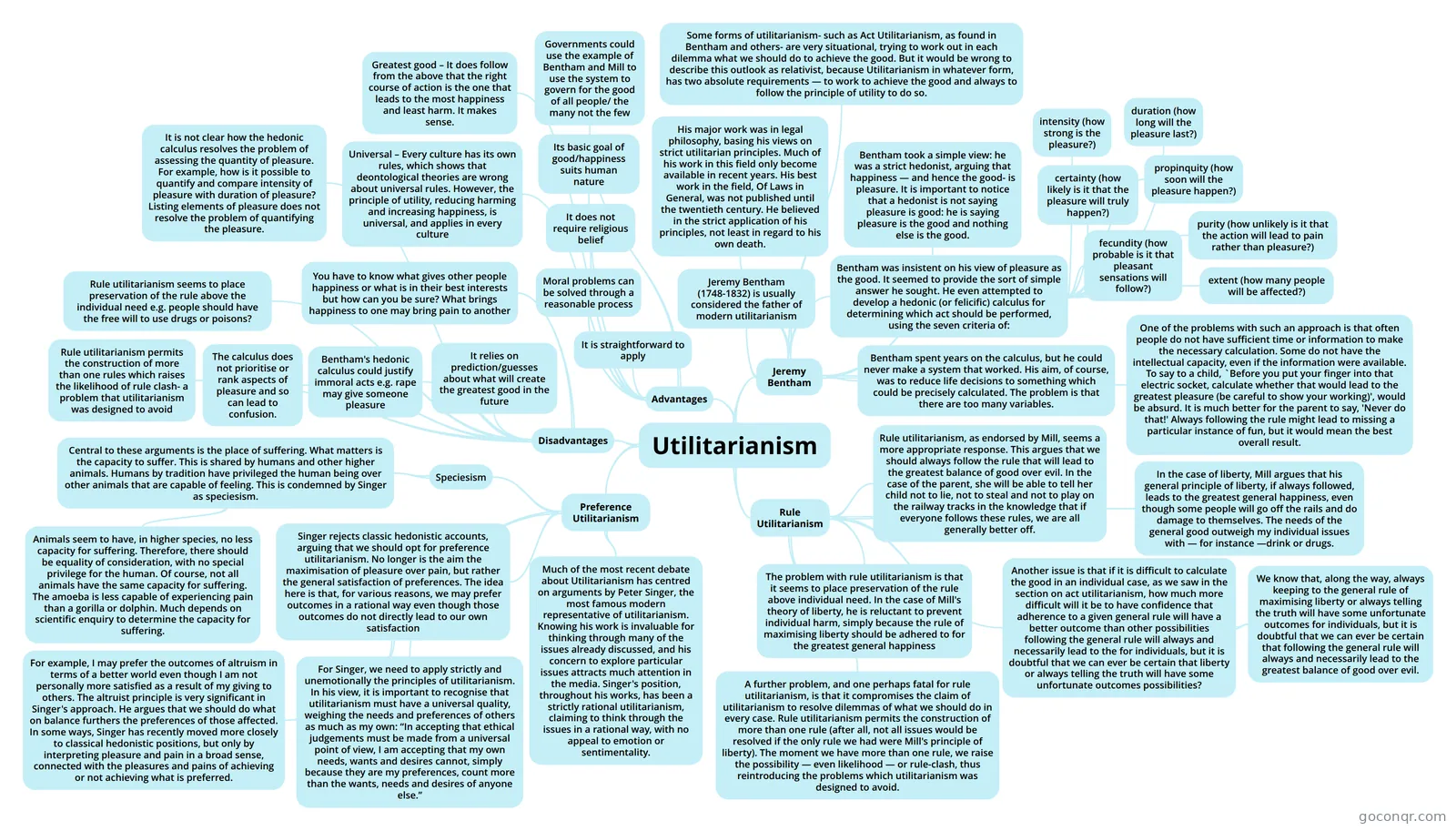
Mind map: Utilitarianism
Inhalt der Mindmap
Utilitarianism
Jeremy Bentham
- Jeremy Bentham (1748-1832) is usually considered the father of modern utilitarianism
- His major work was in legal philosophy, basing his views on strict utilitarian principles. Much of his work in this field only become available in recent years. His best work in the field, Of Laws in General, was not published until the twentieth century. He believed in the strict application of his principles, not least in regard to his own death.
- Some forms of utilitarianism- such as Act Utilitarianism, as found in Bentham and others- are very situational, trying to work out in each dilemma what we should do to achieve the good. But it would be wrong to describe this outlook as relativist, because Utilitarianism in whatever form, has two absolute requirements — to work to achieve the good and always to follow the principle of utility to do so.
- Bentham took a simple view: he was a strict hedonist, arguing that happiness — and hence the good- is pleasure. It is important to notice that a hedonist is not saying pleasure is good: he is saying pleasure is the good and nothing else is the good.
- Bentham was insistent on his view of pleasure as the good. It seemed to provide the sort of simple answer he sought. He even attempted to develop a hedonic (or felicific) calculus for determining which act should be performed, using the seven criteria of:
- intensity (how strong is the pleasure?)
- duration (how long will the pleasure last?)
- certainty (how likely is it that the pleasure will truly happen?)
- propinquity (how soon will the pleasure happen?)
- fecundity (how probable is it that pleasant sensations will follow?)
- purity (how unlikely is it that the action will lead to pain rather than pleasure?)
- extent (how many people will be affected?)
- Bentham spent years on the calculus, but he could never make a system that worked. His aim, of course, was to reduce life decisions to something which could be precisely calculated. The problem is that there are too many variables.
- One of the problems with such an approach is that often people do not have sufficient time or information to make the necessary calculation. Some do not have the intellectual capacity, even if the information were available. To say to a child, `Before you put your finger into that electric socket, calculate whether that would lead to the greatest pleasure (be careful to show your working)', would be absurd. It is much better for the parent to say, 'Never do that!' Always following the rule might lead to missing a particular instance of fun, but it would mean the best overall result.
Rule Utilitarianism
- Rule utilitarianism, as endorsed by Mill, seems a more appropriate response. This argues that we should always follow the rule that will lead to the greatest balance of good over evil. In the case of the parent, she will be able to tell her child not to lie, not to steal and not to play on the railway tracks in the knowledge that if everyone follows these rules, we are all generally better off.
- In the case of liberty, Mill argues that his general principle of liberty, if always followed, leads to the greatest general happiness, even though some people will go off the rails and do damage to themselves. The needs of the general good outweigh my individual issues with — for instance —drink or drugs.
- The problem with rule utilitarianism is that it seems to place preservation of the rule above individual need. In the case of Mill's theory of liberty, he is reluctant to prevent individual harm, simply because the rule of maximising liberty should be adhered to for the greatest general happiness
- Another issue is that if it is difficult to calculate the good in an individual case, as we saw in the section on act utilitarianism, how much more difficult will it be to have confidence that adherence to a given general rule will have a better outcome than other possibilities following the general rule will always and necessarily lead to the for individuals, but it is doubtful that we can ever be certain that liberty or always telling the truth will have some unfortunate outcomes possibilities?
- We know that, along the way, always keeping to the general rule of maximising liberty or always telling the truth will have some unfortunate outcomes for individuals, but it is doubtful that we can ever be certain that following the general rule will always and necessarily lead to the greatest balance of good over evil.
- A further problem, and one perhaps fatal for rule utilitarianism, is that it compromises the claim of utilitarianism to resolve dilemmas of what we should do in every case. Rule utilitarianism permits the construction of more than one rule (after all, not all issues would be resolved if the only rule we had were Mill's principle of liberty). The moment we have more than one rule, we raise the possibility — even likelihood — or rule-clash, thus reintroducing the problems which utilitarianism was designed to avoid.
Preference Utilitarianism
- Much of the most recent debate about Utilitarianism has centred on arguments by Peter Singer, the most famous modern representative of utilitarianism. Knowing his work is invaluable for thinking through many of the issues already discussed, and his concern to explore particular issues attracts much attention in the media. Singer's position, throughout his works, has been a strictly rational utilitarianism, claiming to think through the issues in a rational way, with no appeal to emotion or sentimentality.
- For Singer, we need to apply strictly and unemotionally the principles of utilitarianism. In his view, it is important to recognise that utilitarianism must have a universal quality, weighing the needs and preferences of others as much as my own: “In accepting that ethical judgements must be made from a universal point of view, I am accepting that my own needs, wants and desires cannot, simply because they are my preferences, count more than the wants, needs and desires of anyone else.”
- Singer rejects classic hedonistic accounts, arguing that we should opt for preference utilitarianism. No longer is the aim the maximisation of pleasure over pain, but rather the general satisfaction of preferences. The idea here is that, for various reasons, we may prefer outcomes in a rational way even though those outcomes do not directly lead to our own satisfaction
- For example, I may prefer the outcomes of altruism in terms of a better world even though I am not personally more satisfied as a result of my giving to others. The altruist principle is very significant in Singer's approach. He argues that we should do what on balance furthers the preferences of those affected. In some ways, Singer has recently moved more closely to classical hedonistic positions, but only by interpreting pleasure and pain in a broad sense, connected with the pleasures and pains of achieving or not achieving what is preferred.
- Speciesism
- Central to these arguments is the place of suffering. What matters is the capacity to suffer. This is shared by humans and other higher animals. Humans by tradition have privileged the human being over other animals that are capable of feeling. This is condemned by Singer as speciesism.
- Animals seem to have, in higher species, no less capacity for suffering. Therefore, there should be equality of consideration, with no special privilege for the human. Of course, not all animals have the same capacity for suffering. The amoeba is less capable of experiencing pain than a gorilla or dolphin. Much depends on scientific enquiry to determine the capacity for suffering.
- Central to these arguments is the place of suffering. What matters is the capacity to suffer. This is shared by humans and other higher animals. Humans by tradition have privileged the human being over other animals that are capable of feeling. This is condemned by Singer as speciesism.
Advantages
- It does not require religious belief
- Its basic goal of good/happiness suits human nature
- Moral problems can be solved through a reasonable process
- It is straightforward to apply
- Governments could use the example of Bentham and Mill to use the system to govern for the good of all people/ the many not the few
- Universal – Every culture has its own rules, which shows that deontological theories are wrong about universal rules. However, the principle of utility, reducing harming and increasing happiness, is universal, and applies in every culture
- Greatest good – It does follow from the above that the right course of action is the one that leads to the most happiness and least harm. It makes sense.
Disadvantages
- It relies on prediction/guesses about what will create the greatest good in the future
- You have to know what gives other people happiness or what is in their best interests but how can you be sure? What brings happiness to one may bring pain to another
- Rule utilitarianism seems to place preservation of the rule above the individual need e.g. people should have the free will to use drugs or poisons?
- Rule utilitarianism permits the construction of more than one rules which raises the likelihood of rule clash- a problem that utilitarianism was designed to avoid
- It is not clear how the hedonic calculus resolves the problem of assessing the quantity of pleasure. For example, how is it possible to quantify and compare intensity of pleasure with duration of pleasure? Listing elements of pleasure does not resolve the problem of quantifying the pleasure.
- The calculus does not prioritise or rank aspects of pleasure and so can lead to confusion.
- Bentham's hedonic calculus could justify immoral acts e.g. rape may give someone pleasure
Informationen
- Beschreibung
- AS level Philosophy ethics and theology (Ethics) Mindmap am Utilitarianism, erstellt von Lily Duffy am 22/03/2018.
- Erstellt von
- Lily Duffy
- Aufrufe
- 0
- Bewertung