
Mindmap
Tort - Defamation
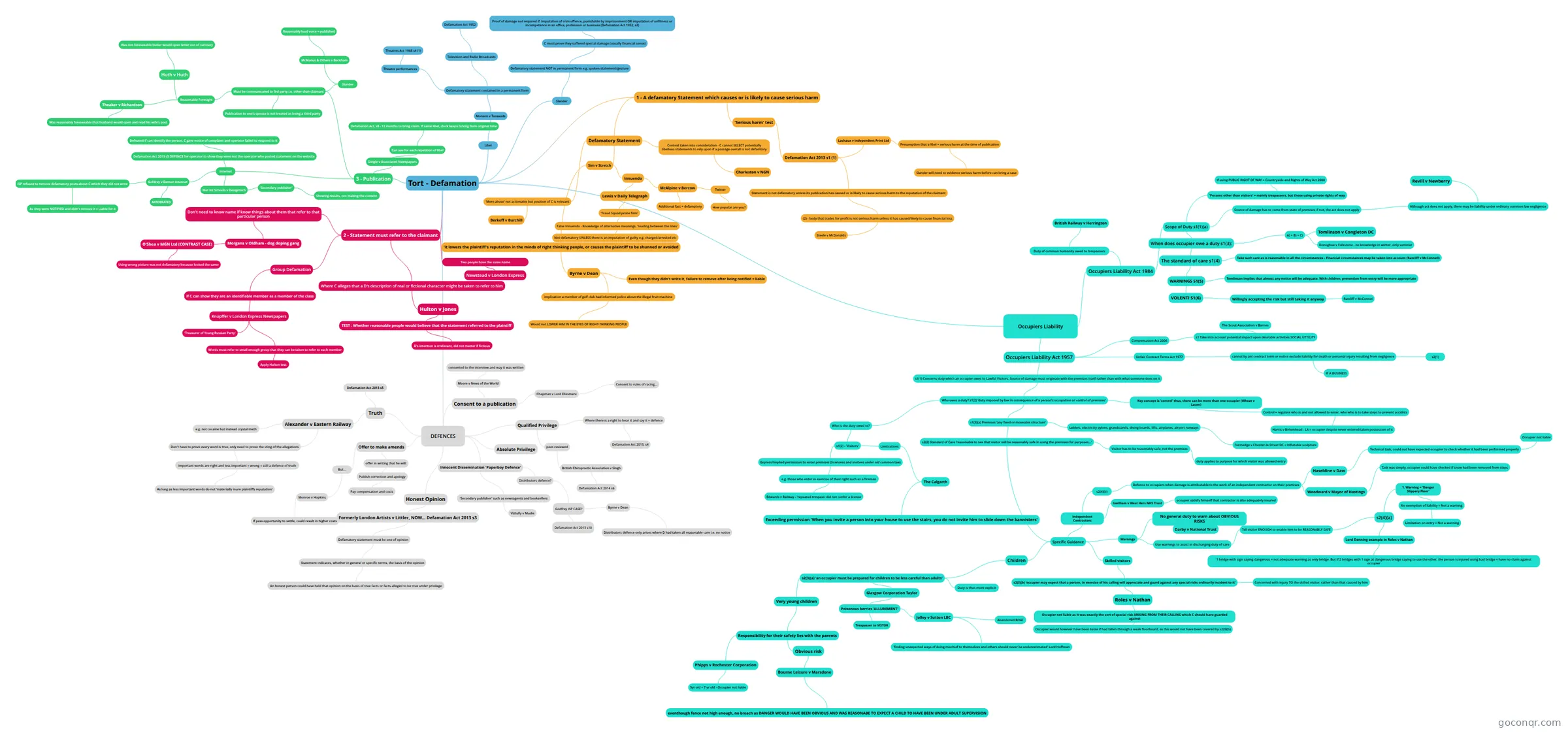
Mind map: Tort defamation
Inhalt der Mindmap
Tort - Defamation
Libel
- Monson v Tussauds
- Defamatory statement contained in a permanent form
- Theatre performances
- Theatres Act 1968 s4 (1)
- Television and Radio Broadcasts
- Defamation Act 1952
- Theatre performances
- Defamatory statement contained in a permanent form
- Monson v Tussauds
Slander
- Defamatory statement NOT in permanent form e.g. spoken statement/gesture
- C must prove they suffered special damage (usually financial sense)
- Proof of damage not required if: Imputation of crim offence, punishable by imprisonment OR imputation of unfitness or incompetence in an office, profession or business (Defamation Act 1952, s2)
- C must prove they suffered special damage (usually financial sense)
- Defamatory statement NOT in permanent form e.g. spoken statement/gesture
1 - A defamatory Statement which causes or is likely to cause serious harm
- Defamatory Statement
- Sim v Stretch
- 'it lowers the plaintiff's reputation in the minds of right thinking people, or causes the plaintiff to be shunned or avoided
- Byrne v Dean
- implication a member of golf club had informed police about the illegal fruit machine
- Would not LOWER HIM IN THE EYES OF RIGHT-THINKING PEOPLE
- Even though they didn't write it, failure to remove after being notified = liable
- implication a member of golf club had informed police about the illegal fruit machine
- Byrne v Dean
- Innuendo
- Lewis v Daily Telegraph
- 'Fraud Squad probe firm'
- False Innuendo - Knowledge of alternative meanings, 'reading between the lines'
- Not defamatory UNLESS there is an imputation of guilty e.g. charged/arrested etc
- False Innuendo - Knowledge of alternative meanings, 'reading between the lines'
- 'Fraud Squad probe firm'
- McAlpine v Bercow
- Additional fact = defamatory
- Twitter
- How popular are you?
- Lewis v Daily Telegraph
- 'it lowers the plaintiff's reputation in the minds of right thinking people, or causes the plaintiff to be shunned or avoided
- 'Mere abuse' not actionable but position of C is relevant
- Berkoff v Burchill
- Context taken into consideration - C cannot SELECT potentially libellous statements to rely upon if a passage overall is not defamtory
- Charleston v NGN
- Sim v Stretch
- 'Serious harm' test
- Defamation Act 2013 s1 (1)
- Statement is not defamatory unless its publication has caused or is likely to cause serious harm to the reputation of the claimant
- (2) - body that trades for profit is not serious harm unless it has caused/likely to cause financial loss
- Steele v McDonalds
- (2) - body that trades for profit is not serious harm unless it has caused/likely to cause financial loss
- Lachaux v Independent Print Ltd
- Presumption that a libel = serious harm at the time of publication
- Slander will need to evidence serious harm before can bring a case
- Presumption that a libel = serious harm at the time of publication
- Statement is not defamatory unless its publication has caused or is likely to cause serious harm to the reputation of the claimant
- Defamation Act 2013 s1 (1)
- Defamatory Statement
2 - Statement must refer to the claimant
- Where C alleges that a D's description of real or fictional character might be taken to refer to him
- Hulton v Jones
- TEST : Whether reasonable people would believe that the statement referred to the plaintiff
- D's intention is irrelevant, did not matter if fictious
- TEST : Whether reasonable people would believe that the statement referred to the plaintiff
- Hulton v Jones
- Two people have the same name
- Newstead v London Express
- Don't need to know name if know things about them that refer to that particular person
- Morgans v Oldham - dog doping gang
- O'Shea v MGN Ltd (CONTRAST CASE)
- Using wrong picture was not defamatory because looked the same
- O'Shea v MGN Ltd (CONTRAST CASE)
- Morgans v Oldham - dog doping gang
- Group Defamation
- If C can show they are an identifiable member as a member of the class
- Knupffer v London Express Newspapers
- 'Treasurer of Young Russian Party'
- Words must refer to small enough group that they can be taken to refer to each member
- Apply Hulton test
- Knupffer v London Express Newspapers
- If C can show they are an identifiable member as a member of the class
- Where C alleges that a D's description of real or fictional character might be taken to refer to him
3 - Publication
- Must be communicated to 3rd party i.e. other than claimant
- Publication to one's spouse is not treated as being a third party
- Reasonable Foresight
- Huth v Huth
- Was not foreseeable butler would open letter out of curiosity
- Theaker v Richardson
- Was reasonably foreseeable that husband would open and read his wife's post
- Huth v Huth
- Slander
- McManus & Others v Beckham
- Reasonably loud voice = published
- McManus & Others v Beckham
- Internet
- Gofdrey v Demon Internet
- ISP refused to remove defamatory posts about C which they did not write
- As they were NOTIFIED and didn't remove it = Liable for it
- MODERATED
- ISP refused to remove defamatory posts about C which they did not write
- Met Int Schools v Designtech
- 'Secondary publisher'
- Showing results, not making the content.
- 'Secondary publisher'
- Defamation Act 2013 s5 DEFENCE for operator to show they were not the operator who posted statement on the website
- Defeated if can identify the person, C gave notice of complaint and operator failed to respond to it
- Gofdrey v Demon Internet
- Dingle v Associated Newspapers
- Can sue for each repetition of libel
- Defamation Act, s8 - 12 months to bring claim. If same libel, clock keeps ticking from original time
- Can sue for each repetition of libel
- Must be communicated to 3rd party i.e. other than claimant
DEFENCES
- Truth
- Alexander v Eastern Railway
- e.g. not cocaine but instead crystal meth
- Don't have to prove every word is true, only need to prove the sting of the allegations
- Important words are right and less important = wrong = still a defence of truth
- As long as less important words do not 'materially inure plaintiffs reputation'
- Important words are right and less important = wrong = still a defence of truth
- Defamation Act 2013 s5
- Alexander v Eastern Railway
- Honest Opinion
- Formerly London Artists v Littler, NOW... Defamation Act 2013 s3
- Defamatory statement must be one of opinion
- Statement indicates, whether in general or specific terms, the basis of the opinion
- An honest person could have held that opinion on the basis of true facts or facts alleged to be true under privilege
- Statement indicates, whether in general or specific terms, the basis of the opinion
- Defamatory statement must be one of opinion
- Formerly London Artists v Littler, NOW... Defamation Act 2013 s3
- Qualified Privilege
- Where there is a right to hear it and say it = defence
- Defamation Act 2013, s4
- peer-reviewed
- British Chiropractic Association v Singh
- Defamation Act 2014 s6
- British Chiropractic Association v Singh
- Where there is a right to hear it and say it = defence
- Absolute Privilege
- Innocent Dissemination 'Paperboy Defence'
- 'Secondary publisher' such as newsagents and booksellers
- Viztully v Mudie
- Distributors defence?
- Godfrey ISP CASE?
- Defamation Act 2013 s10
- Byrne v Dean
- Distributors defence only arises where D had taken all reasonable care i.e. no notice
- Godfrey ISP CASE?
- 'Secondary publisher' such as newsagents and booksellers
- Consent to a publication
- Chapman v Lord Ellesmere
- Consent to rules of racing...
- Moore v News of the World
- consented to the interview and way it was written
- Chapman v Lord Ellesmere
- Offer to make amends
- But...
- Monroe v Hopkins
- If pass opportunity to settle, could result in higher costs
- Monroe v Hopkins
- offer in writing that he will:
- Publish correction and apology
- Pay compensation and costs
- Publish correction and apology
- But...
- Truth
Occupiers Liability
- Occupiers Liability Act 1957
- s1(1) Concerns duty which an occupier owes to Lawful Visitors. Source of damage must originate with the premises itself rather than with what someone does on it
- Who owes a duty? s1(2) 'duty imposed by law in consequence of a person's occupation or control of premises'
- Key concept is 'control' thus, there can be more than one occupier (Wheat v Lacon)
- Control = regulate who is and not allowed to enter, who who is to take steps to prevent accidnts
- Harris v Birkenhead - LA = occupier despite never entered/taken possession of it
- Control = regulate who is and not allowed to enter, who who is to take steps to prevent accidnts
- s1(3)(a) Premises 'any fixed or moveable structure'
- ladders, electricity pylons, grandstands, diving boards, lifts, airplanes, airport runways
- Furmedge v Chester-le-Street DC = Inflatable sculpture
- s2(2) Standard of Care 'reasonable to see that visitor will be reasonably safe in using the premises for purposes...'
- Visitor has to be reasonably safe, not the premises
- duty applies to purpose for which visitor was allowed entry
- Specific Guidance
- Children
- s2(3)(a) 'an occupier must be prepared for children to be less careful than adults'
- Duty is thus more explicit
- Glasgow Corporation Taylor
- Poisonous berries 'ALLUREMENT'
- Trespasser to VISTOR
- Jolley v Sutton LBC
- 'finding unexpected ways of doing mischief to themselves and others should never be underestimated' Lord Hoffman
- Abandoned BOAT
- Poisonous berries 'ALLUREMENT'
- Very young children
- Responsibility for their safety lies with the parents
- Phipps v Rochester Corporation
- 5yr old + 7 yr old - Occupier not liable
- Obvious risk
- Bourne Leisure v Marsdone
- eventhough fence not high enough, no breach as DANGER WOULD HAVE BEEN OBVIOUS AND WAS REASONABE TO EXPECT A CHILD TO HAVE BEEN UNDER ADULT SUPERVISION
- Bourne Leisure v Marsdone
- Phipps v Rochester Corporation
- Responsibility for their safety lies with the parents
- s2(3)(a) 'an occupier must be prepared for children to be less careful than adults'
- Skilled visitors
- s2(3)(b) 'occupier may expect that a person, in exercise of his calling will appreciate and guard against any special risks ordinarily incident to it'
- Concerned with injury TO the skilled visitor, rather than that caused by him
- Roles v Nathan
- Occupier not liable as it was exactly the sort of special risk ARISING FROM THEIR CALLING which C should have guarded against
- Occupier would however have been liable if had fallen through a weak floorboard, as this would not have been covered by s2(3)(b)
- Occupier not liable as it was exactly the sort of special risk ARISING FROM THEIR CALLING which C should have guarded against
- s2(3)(b) 'occupier may expect that a person, in exercise of his calling will appreciate and guard against any special risks ordinarily incident to it'
- Warnings
- Use warnings to assist in discharging duty of care
- Tell visitor ENOUGH to enable him to be REASONABLY SAFE
- s2(4)(a)
- Lord Denning example in Roles v Nathan
- 1 bridge with sign saying dangerous = not adequate warning as only bridge. But if 2 bridges with 1 sign at dangerous bridge saying to use the other, the person is injured using bad bridge = have no claim against occupier
- 1. Warning = 'Danger Slippery Floor'
- An exemption of liability = Not a warning
- Limitation on entry = Not a warning
- An exemption of liability = Not a warning
- Lord Denning example in Roles v Nathan
- s2(4)(a)
- Tell visitor ENOUGH to enable him to be REASONABLY SAFE
- No general duty to warn about OBVIOUS RISKS
- Darby v National Trust
- Use warnings to assist in discharging duty of care
- Independent Contractors
- s2(4)(b)
- Defence to occupiers when damage is attributable to the work of an independent contractor on their premises
- Haseldine v Daw
- Technical task, could not have expected occupier to check whether it had been performed properly
- Occupier not liable
- Technical task, could not have expected occupier to check whether it had been performed properly
- Woodward v Mayor of Hastings
- Task was simply, occupier could have checked if snow had been removed from steps
- Haseldine v Daw
- Defence to occupiers when damage is attributable to the work of an independent contractor on their premises
- Gwilliam v West Hers NHS Trust
- occupier satisfy himself that contractor is also adequately insured
- s2(4)(b)
- Children
- Visitor has to be reasonably safe, not the premises
- ladders, electricity pylons, grandstands, diving boards, lifts, airplanes, airport runways
- Who is the duty owed to?
- s1(2) - 'Visitors'
- Express/Implied permission to enter premises (licensees and invitees under old common law)
- e.g. those who enter in exercise of their right such as a fireman
- Edwards v Railway - 'repeated trespass' did not confer a license
- e.g. those who enter in exercise of their right such as a fireman
- Limitrations
- The Calgarth
- Exceeding permission 'When you invite a person into your house to use the stairs, you do not invite him to slide down the bannisters'
- The Calgarth
- Express/Implied permission to enter premises (licensees and invitees under old common law)
- s1(2) - 'Visitors'
- Key concept is 'control' thus, there can be more than one occupier (Wheat v Lacon)
- Who owes a duty? s1(2) 'duty imposed by law in consequence of a person's occupation or control of premises'
- Compensation Act 2006
- s1 Take into account potential impact upon desirable activities SOCIAL UTTILITY
- The Scout Association v Barnes
- s1 Take into account potential impact upon desirable activities SOCIAL UTTILITY
- Unfair Contract Terms Act 1977
- cannot by ant contract term or notice exclude liability for death or personal injury resulting from negligence
- IF A BUSINESS
- s2(1)
- cannot by ant contract term or notice exclude liability for death or personal injury resulting from negligence
- s1(1) Concerns duty which an occupier owes to Lawful Visitors. Source of damage must originate with the premises itself rather than with what someone does on it
- Occupiers Liability Act 1984
- Duty of common humanity owed to trespassers
- British Railway v Herrington
- Scope of Duty s1(1)(a)
- 'Persons other than visitors' = mainly trespassers, but those using private rights of way
- If using PUBLIC RIGHT OF WAY = Countryside and Rights of Way Act 2000
- Source of damage has to come from state of premises if not, the act does not apply
- Although act does not apply, there may be liability under ordinary common law negligence
- Revill v Newberry
- Although act does not apply, there may be liability under ordinary common law negligence
- When does occupier owe a duty s1(3):
- A) + B) + C)
- Tomlinson v Congleton DC
- Donoghue v Folkstone - no knowledge in winter, only summer
- The standard of care s1(4)
- Take such care as is reasonable in all the circumstances - Financial circumstances may be taken into account (Ratcliff v McConnell)
- WARNINGS S1(5)
- Tomlinson implies that almost any notice will be adequate. With children, prevention from entry will be more appropriate
- VOLENTI S1(6)
- Willingly accepting the risk but still taking it anyway
- Ratcliff v McConnel
- Willingly accepting the risk but still taking it anyway
- A) + B) + C)
- 'Persons other than visitors' = mainly trespassers, but those using private rights of way
- Duty of common humanity owed to trespassers
- Occupiers Liability Act 1957
Informationen
- Beschreibung
- Law Mindmap am Tort - Defamation, erstellt von Cameron Tinkler am 27/03/2018.
- Erstellt von
- Cameron Tinkler
- Aufrufe
- 1
- Bewertung