
Mindmap
"Macbeth": Macbeth Analysis
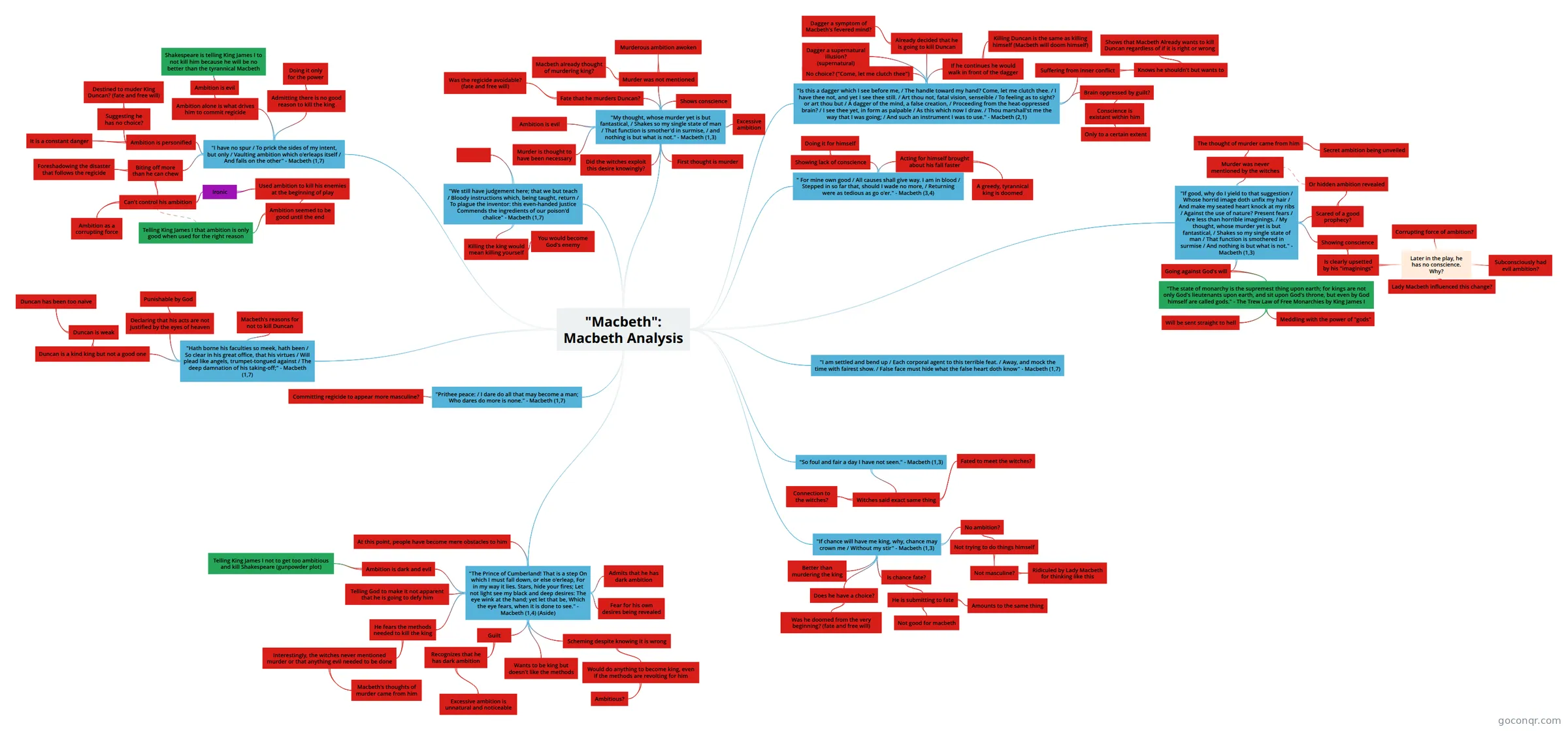
Mind map: Macbeth analysis
Inhalt der Mindmap
"Macbeth": Macbeth Analysis
"If chance will have me king, why, chance may crown me / Without my stir" - Macbeth (1,3)
- Is chance fate?
- He is submitting to fate
- Amounts to the same thing
- Not good for macbeth
- He is submitting to fate
- Better than murdering the king
- Does he have a choice?
- Was he doomed from the very beginning? (fate and free will)
- No ambition?
- Not trying to do things himself
- Not masculine?
- Ridiculed by Lady Macbeth for thinking like this
- Not masculine?
- Not trying to do things himself
- Is chance fate?
"The Prince of Cumberland! That is a step On which I must fall down, or else o'erleap, For in my way it lies. Stars, hide your fires; Let not light see my black and deep desires: The eye wink at the hand; yet let that be, Which the eye fears, when it is done to see." - Macbeth (1,4) (Aside)
- Guilt
- Recognizes that he has dark ambition
- Excessive ambition is unnatural and noticeable
- Recognizes that he has dark ambition
- Scheming despite knowing it is wrong
- Would do anything to become king, even if the methods are revolting for him
- Ambitious?
- Would do anything to become king, even if the methods are revolting for him
- Fear for his own desires being revealed
- Wants to be king but doesn't like the methods
- Telling God to make it not apparent that he is going to defy him
- He fears the methods needed to kill the king
- Interestingly, the witches never mentioned murder or that anything evil needed to be done
- Macbeth's thoughts of murder came from him
- Interestingly, the witches never mentioned murder or that anything evil needed to be done
- Ambition is dark and evil
- Telling King James I not to get too ambitious and kill Shakespeare (gunpowder plot)
- Admits that he has dark ambition
- At this point, people have become mere obstacles to him
- Guilt
"Prithee peace: / I dare do all that may become a man; Who dares do more is none." - Macbeth (1,7)
- Committing regicide to appear more masculine?
"Is this a dagger which I see before me, / The handle toward my hand? Come, let me clutch thee. / I have thee not, and yet I see thee still. / Art thou not, fatal vision, senseible / To feeling as to sight? or art thou but / A dagger of the mind, a false creation, / Proceeding from the heat-oppressed brain? / I see thee yet, in form as palpable / As this which now I draw. / Thou marshall'st me the way that I was going; / And such an instrument I was to use." - Macbeth (2,1)
- No choice? ("Come, let me clutch thee")
- Dagger a supernatural illusion? (supernatural)
- Already decided that he is going to kill Duncan
- Dagger a symptom of Macbeth's fevered mind?
- If he continues he would walk in front of the dagger
- Killing Duncan is the same as killing himself (Macbeth will doom himself)
- Brain oppressed by guilt?
- Conscience is existant within him
- Only to a certain extent
- Conscience is existant within him
- Suffering from inner conflict
- Knows he shouldn't but wants to
- Shows that Macbeth Already wants to kill Duncan regardless of if it is right or wrong
- Knows he shouldn't but wants to
"Hath borne his faculties so meek, hath been / So clear in his great office, that his virtues / Will plead like angels, trumpet-tongued against / The deep damnation of his taking-off;" - Macbeth (1,7)
- Macbeth's reasons for not to kill Duncan
- Duncan is a kind king but not a good one
- Duncan is weak
- Duncan has been too naive
- Duncan is weak
- Declaring that his acts are not justified by the eyes of heaven
- Punishable by God
"We still have judgement here; that we but teach / Bloody instructions which, being taught, return / To plague the inventor: this even-handed justice Commends the ingredients of our poison'd chalice" - Macbeth (1,7)
- Killing the king would mean killing yourself
- You would become God's enemy
- Killing the king would mean killing yourself
"My thought, whose murder yet is but fantastical, / Shakes so my single state of man / That function is smother'd in surmise, / and nothing is but what is not." - Macbeth (1,3)
- Murder was not mentioned
- Murderous ambition awoken
- Macbeth already thought of murdering king?
- Ambition is evil
- Murder is thought to have been necessary
- Fate that he murders Duncan?
- Was the regicide avoidable? (fate and free will)
- Shows conscience
- First thought is murder
- Did the witches exploit this desire knowingly?
- Excessive ambition
- Murder was not mentioned
"I have no spur / To prick the sides of my intent, but only / Vaulting ambition which o'erleaps itself / And falls on the other" - Macbeth (1,7)
- Admitting there is no good reason to kill the king
- Doing it only for the power
- Ambition alone is what drives him to commit regicide
- Ambition is evil
- Shakespeare is telling King James I to not kill him because he will be no better than the tyrannical Macbeth
- Ambition is evil
- Ambition is personified
- Suggesting he has no choice?
- Destined to muder King Duncan? (fate and free will)
- It is a constant danger
- Suggesting he has no choice?
- Biting off more than he can chew
- Foreshadowing the disaster that follows the regicide
- Can't control his ambition
- Ambition as a corrupting force
- Ironic
- Used ambition to kill his enemies at the beginning of play
- Ambition seemed to be good until the end
- Telling King James I that ambition is only good when used for the right reason
- Ambition seemed to be good until the end
- Used ambition to kill his enemies at the beginning of play
- Admitting there is no good reason to kill the king
" For mine own good / All causes shall give way. I am in blood / Stepped in so far that, should I wade no more, / Returning were as tedious as go o'er." - Macbeth (3,4)
- Showing lack of conscience
- Doing it for himself
- Acting for himself brought about his fall faster
- A greedy, tyrannical king is doomed
- Showing lack of conscience
"If good, why do I yield to that suggestion / Whose horrid image doth unfix my hair / And make my seated heart knock at my ribs / Against the use of nature? Present fears / Are less than horrible imaginings. / My thought, whose murder yet is but fantastical, / Shakes so my single state of man / That function is smothered in surmise / And nothing is but what is not." - Macbeth (1,3)
- Going against God's will
- "The state of monarchy is the supremest thing upon earth; for kings are not only God's lieutenants upon earth, and sit upon God's throne, but even by God himself are called gods." - The Trew Law of Free Monarchies by King James I
- Will be sent straight to hell
- Meddling with the power of "gods"
- "The state of monarchy is the supremest thing upon earth; for kings are not only God's lieutenants upon earth, and sit upon God's throne, but even by God himself are called gods." - The Trew Law of Free Monarchies by King James I
- Scared of a good prophecy?
- Or hidden ambition revealed
- Murder was never mentioned by the witches
- The thought of murder came from him
- Secret ambition being unveiled
- The thought of murder came from him
- Showing conscience
- Is clearly upsetted by his "imaginings"
- Later in the play, he has no conscience. Why?
- Corrupting force of ambition?
- Subconsciously had evil ambition?
- Lady Macbeth influenced this change?
- Later in the play, he has no conscience. Why?
- Is clearly upsetted by his "imaginings"
- Going against God's will
"So foul and fair a day I have not seen." - Macbeth (1,3)
- Witches said exact same thing
- Connection to the witches?
- Fated to meet the witches?
- Witches said exact same thing
"I am settled and bend up / Each corporal agent to this terrible feat. / Away, and mock the time with fairest show. / False face must hide what the false heart doth know" - Macbeth (1,7)
Informationen
- Beschreibung
- GCSE English (Macbeth) Mindmap am "Macbeth": Macbeth Analysis, erstellt von blah blah am 15/04/2018.
- Erstellt von
- blah blah
- Aufrufe
- 29
- Bewertung