
Mindmap
AQA 9-1 B2 Cell Division
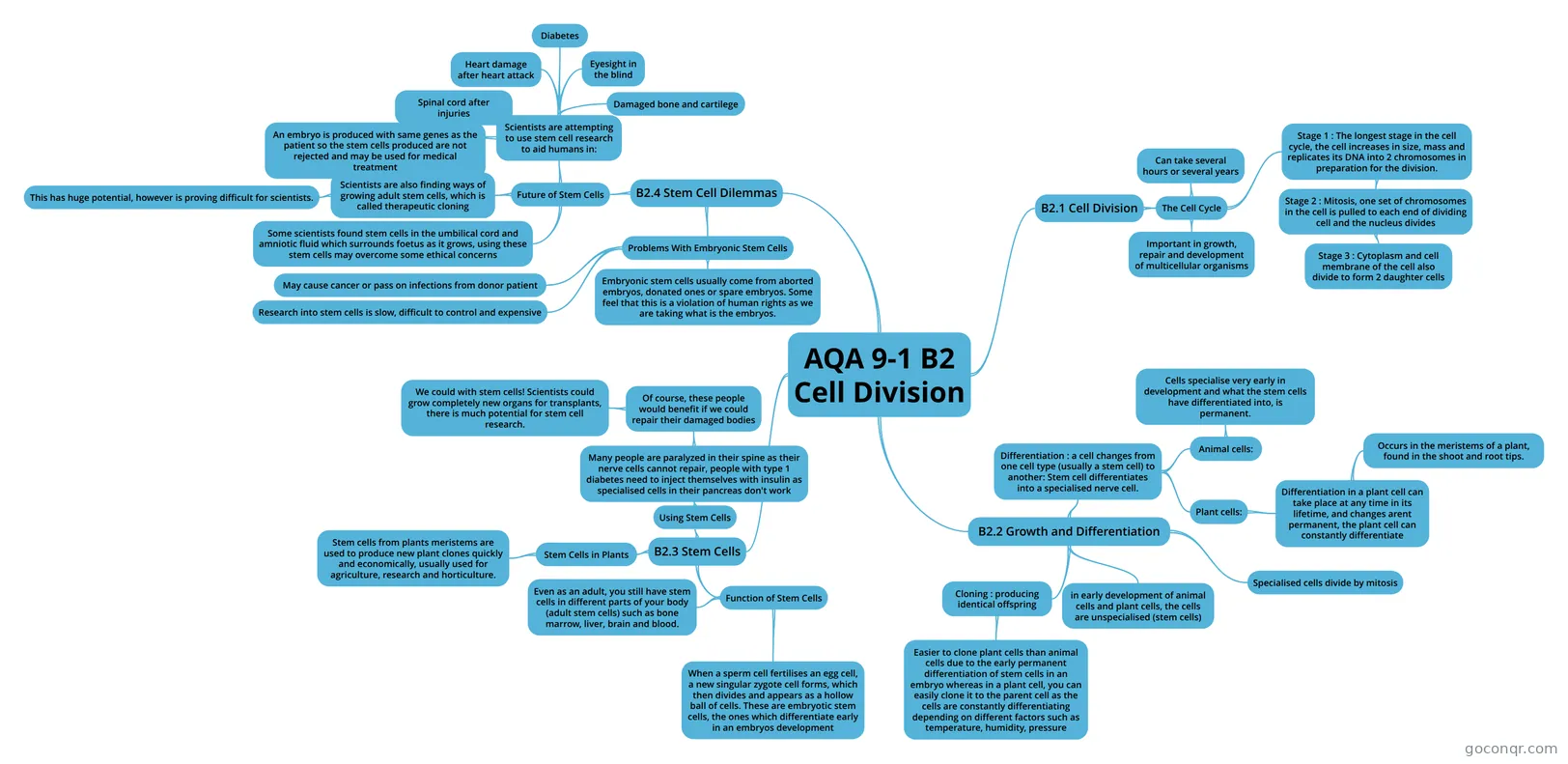
Mind map: AQA B2 cell division
Inhalt der Mindmap
AQA 9-1 B2 Cell Division
B2.1 Cell Division
- The Cell Cycle
- Stage 1 : The longest stage in the cell cycle, the cell increases in size, mass and replicates its DNA into 2 chromosomes in preparation for the division.
- Stage 2 : Mitosis, one set of chromosomes in the cell is pulled to each end of dividing cell and the nucleus divides
- Stage 3 : Cytoplasm and cell membrane of the cell also divide to form 2 daughter cells
- Stage 2 : Mitosis, one set of chromosomes in the cell is pulled to each end of dividing cell and the nucleus divides
- Can take several hours or several years
- Important in growth, repair and development of multicellular organisms
- Stage 1 : The longest stage in the cell cycle, the cell increases in size, mass and replicates its DNA into 2 chromosomes in preparation for the division.
- The Cell Cycle
B2.2 Growth and Differentiation
- Differentiation : a cell changes from one cell type (usually a stem cell) to another: Stem cell differentiates into a specialised nerve cell.
- Animal cells:
- Cells specialise very early in development and what the stem cells have differentiated into, is permanent.
- Plant cells:
- Differentiation in a plant cell can take place at any time in its lifetime, and changes arent permanent, the plant cell can constantly differentiate
- Occurs in the meristems of a plant, found in the shoot and root tips.
- Differentiation in a plant cell can take place at any time in its lifetime, and changes arent permanent, the plant cell can constantly differentiate
- Animal cells:
- in early development of animal cells and plant cells, the cells are unspecialised (stem cells)
- Specialised cells divide by mitosis
- Cloning : producing identical offspring
- Easier to clone plant cells than animal cells due to the early permanent differentiation of stem cells in an embryo whereas in a plant cell, you can easily clone it to the parent cell as the cells are constantly differentiating depending on different factors such as temperature, humidity, pressure
- Differentiation : a cell changes from one cell type (usually a stem cell) to another: Stem cell differentiates into a specialised nerve cell.
B2.3 Stem Cells
- Function of Stem Cells
- When a sperm cell fertilises an egg cell, a new singular zygote cell forms, which then divides and appears as a hollow ball of cells. These are embryotic stem cells, the ones which differentiate early in an embryos development
- Even as an adult, you still have stem cells in different parts of your body (adult stem cells) such as bone marrow, liver, brain and blood.
- Using Stem Cells
- Many people are paralyzed in their spine as their nerve cells cannot repair, people with type 1 diabetes need to inject themselves with insulin as specialised cells in their pancreas don't work
- Of course, these people would benefit if we could repair their damaged bodies
- We could with stem cells! Scientists could grow completely new organs for transplants, there is much potential for stem cell research.
- Of course, these people would benefit if we could repair their damaged bodies
- Many people are paralyzed in their spine as their nerve cells cannot repair, people with type 1 diabetes need to inject themselves with insulin as specialised cells in their pancreas don't work
- Stem Cells in Plants
- Stem cells from plants meristems are used to produce new plant clones quickly and economically, usually used for agriculture, research and horticulture.
- Function of Stem Cells
B2.4 Stem Cell Dilemmas
- Problems With Embryonic Stem Cells
- Embryonic stem cells usually come from aborted embryos, donated ones or spare embryos. Some feel that this is a violation of human rights as we are taking what is the embryos.
- Research into stem cells is slow, difficult to control and expensive
- May cause cancer or pass on infections from donor patient
- Future of Stem Cells
- Some scientists found stem cells in the umbilical cord and amniotic fluid which surrounds foetus as it grows, using these stem cells may overcome some ethical concerns
- Scientists are also finding ways of growing adult stem cells, which is called therapeutic cloning
- This has huge potential, however is proving difficult for scientists.
- An embryo is produced with same genes as the patient so the stem cells produced are not rejected and may be used for medical treatment
- Scientists are attempting to use stem cell research to aid humans in:
- Spinal cord after injuries
- Heart damage after heart attack
- Diabetes
- Eyesight in the blind
- Damaged bone and cartilege
- Problems With Embryonic Stem Cells
Informationen
- Beschreibung
- Mind Map on AQA 9-1 B2 Cell Division, created by joshua hopkins on 23/05/2018.
- Erstellt von
- joshua hopkins
- Aufrufe
- 11
- Bewertung