
Mindmap
An Analysis of The Help
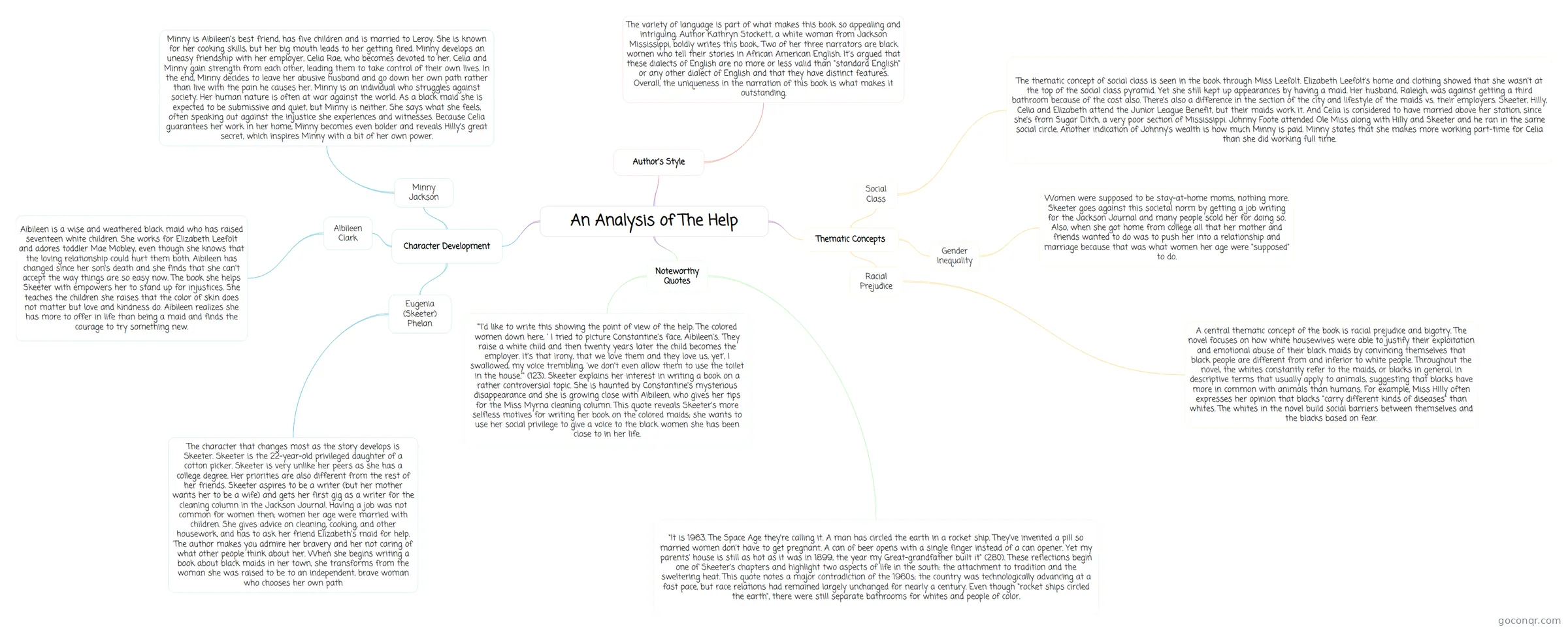
Mind map: An analysis of The Help
Inhalt der Mindmap
An Analysis of The Help
Character Development
- Minny Jackson
- Minny is Aibileen's best friend, has five children and is married to Leroy. She is known for her cooking skills, but her big mouth leads to her getting fired. Minny develops an uneasy friendship with her employer, Celia Rae, who becomes devoted to her. Celia and Minny gain strength from each other, leading them to take control of their own lives. In the end, Minny decides to leave her abusive husband and go down her own path rather than live with the pain he causes her. Minny is an individual who struggles against society. Her human nature is often at war against the world. As a black maid she is expected to be submissive and quiet, but Minny is neither. She says what she feels, often speaking out against the injustice she experiences and witnesses. Because Celia guarantees her work in her home, Minny becomes even bolder and reveals Hilly's great secret, which inspires Minny with a bit of her own power.
- Eugenia (Skeeter) Phelan
- The character that changes most as the story develops is Skeeter. Skeeter is the 22-year-old privileged daughter of a cotton picker. Skeeter is very unlike her peers as she has a college degree. Her priorities are also different from the rest of her friends. Skeeter aspires to be a writer (but her mother wants her to be a wife) and gets her first gig as a writer for the cleaning column in the Jackson Journal. Having a job was not common for women then; women her age were married with children. She gives advice on cleaning, cooking, and other housework, and has to ask her friend Elizabeth's maid for help. The author makes you admire her bravery and her not caring of what other people think about her. When she begins writing a book about black maids in her town, she transforms from the woman she was raised to be to an independent, brave woman who chooses her own path
- AIbileen Clark
- Aibileen is a wise and weathered black maid who has raised seventeen white children. She works for Elizabeth Leefolt and adores toddler Mae Mobley, even though she knows that the loving relationship could hurt them both. Aibileen has changed since her son's death and she finds that she can't accept the way things are so easy now. The book she helps Skeeter with empowers her to stand up for injustices. She teaches the children she raises that the color of skin does not matter but love and kindness do. Aibileen realizes she has more to offer in life than being a maid and finds the courage to try something new.
- Minny Jackson
Thematic Concepts
- Racial Prejudice
- A central thematic concept of the book is racial prejudice and bigotry. The novel focuses on how white housewives were able to justify their exploitation and emotional abuse of their black maids by convincing themselves that black people are different from and inferior to white people. Throughout the novel, the whites constantly refer to the maids, or blacks in general, in descriptive terms that usually apply to animals, suggesting that blacks have more in common with animals than humans. For example, Miss HIlly often expresses her opinion that blacks "carry different kinds of diseases" than whites. The whites in the novel build social barriers between themselves and the blacks based on fear.
- Social Class
- The thematic concept of social class is seen in the book through Miss Leefolt. Elizabeth Leefolt’s home and clothing showed that she wasn't at the top of the social class pyramid. Yet she still kept up appearances by having a maid. Her husband, Raleigh, was against getting a third bathroom because of the cost also. There’s also a difference in the section of the city and lifestyle of the maids vs. their employers. Skeeter, Hilly, Celia and Elizabeth attend the Junior League Benefit, but their maids work it. And Celia is considered to have married above her station, since she’s from Sugar Ditch, a very poor section of Mississippi. Johnny Foote attended Ole Miss along with Hilly and Skeeter and he ran in the same social circle. Another indication of Johnny’s wealth is how much Minny is paid. Minny states that she makes more working part-time for Celia than she did working full time.
- Gender Inequality
- Women were supposed to be stay-at-home moms, nothing more. Skeeter goes against this societal norm by getting a job writing for the Jackson Journal and many people scold her for doing so. Also, when she got home from college all that her mother and friends wanted to do was to push her into a relationship and marriage because that was what women her age were "supposed" to do.
- Racial Prejudice
Author's Style
- The variety of language is part of what makes this book so appealing and intriguing. Author Kathryn Stockett, a white woman from Jackson Mississippi, boldly writes this book.. Two of her three narrators are black women who tell their stories in African American English. It's argued that these dialects of English are no more or less valid than "standard English" or any other dialect of English and that they have distinct features. Overall, the uniqueness in the narration of this book is what makes it outstanding.
Noteworthy Quotes
- "'I'd like to write this showing the point of view of the help. The colored women down here, ' I tried to picture Constantine's face, Aibileen's. 'They raise a white child and then twenty years later the child becomes the employer. It's that irony, that we love them and they love us, yet', I swallowed, my voice trembling, 'we don't even allow them to use the toilet in the house.'" (123). Skeeter explains her interest in writing a book on a rather controversial topic. She is haunted by Constantine's mysterious disappearance and she is growing close with Aibileen, who gives her tips for the Miss Myrna cleaning column. This quote reveals Skeeter's more selfless motives for writing her book on the colored maids; she wants to use her social privilege to give a voice to the black women she has been close to in her life.
- “It is 1963. The Space Age they're calling it. A man has circled the earth in a rocket ship. They've invented a pill so married women don't have to get pregnant. A can of beer opens with a single finger instead of a can opener. Yet my parents' house is still as hot as it was in 1899, the year my Great-grandfather built it" (280). These reflections begin one of Skeeter's chapters and highlight two aspects of life in the south: the attachment to tradition and the sweltering heat. This quote notes a major contradiction of the 1960s; the country was technologically advancing at a fast pace, but race relations had remained largely unchanged for nearly a century. Even though "rocket ships circled the earth", there were still separate bathrooms for whites and people of color.
Informationen
- Beschreibung
- 12th grade English Mindmap am An Analysis of The Help, erstellt von Lauren Murray am 24/05/2018.
- Erstellt von
- Lauren Murray
- Aufrufe
- 2
- Verlauf
-
- Erstellt von Lauren Murray · 23 Mai 2018
- Kopiert von Lauren Murray · 24 Mai 2018
- Bewertung