
Mindmap
B4 - The Processes of Life
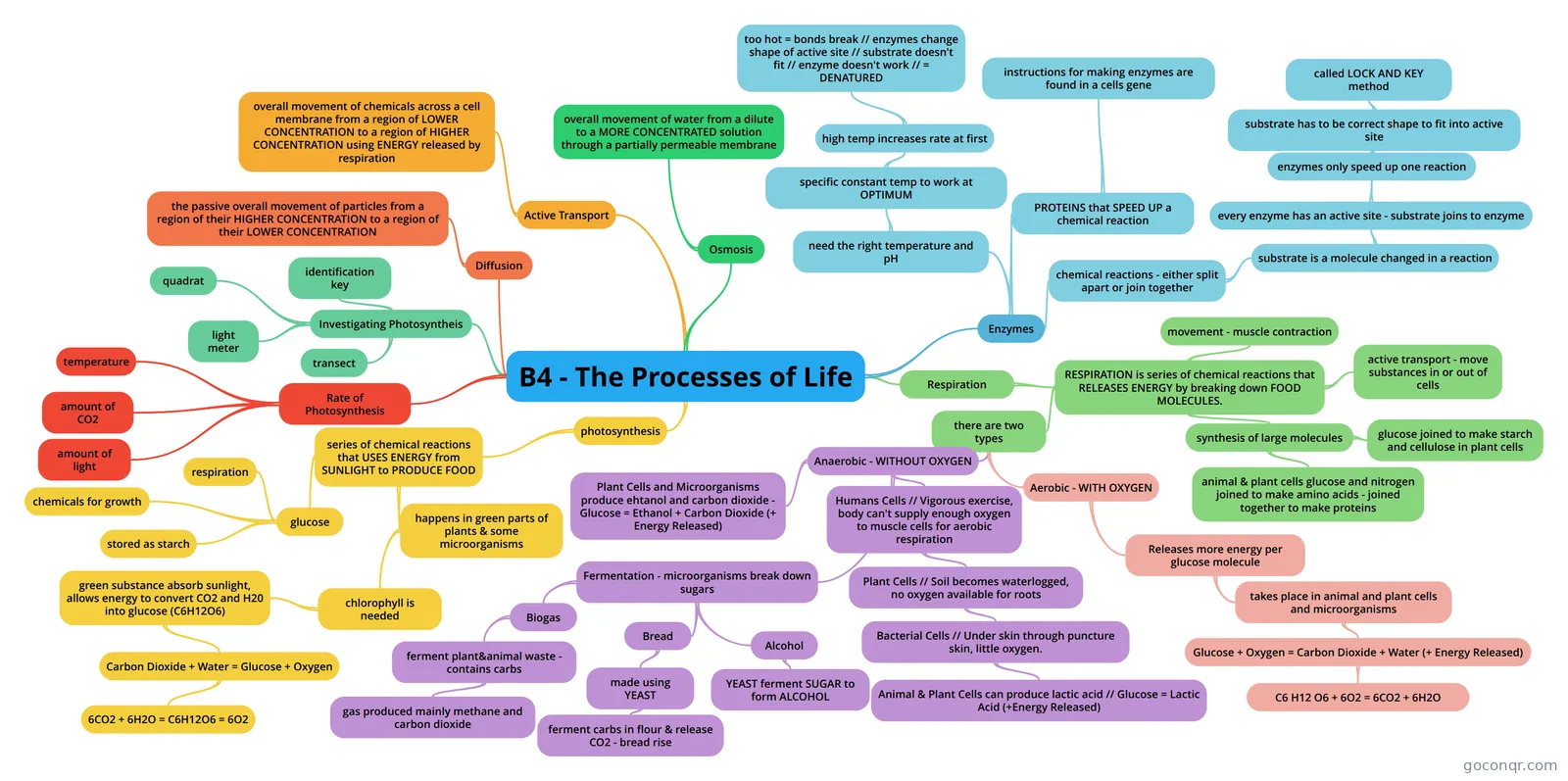
Mind map: B4 the processes of life
Inhalt der Mindmap
B4 - The Processes of Life
Enzymes
- PROTEINS that SPEED UP a chemical reaction
- instructions for making enzymes are found in a cells gene
- chemical reactions - either split apart or join together
- substrate is a molecule changed in a reaction
- every enzyme has an active site - substrate joins to enzyme
- enzymes only speed up one reaction
- substrate has to be correct shape to fit into active site
- called LOCK AND KEY method
- substrate has to be correct shape to fit into active site
- enzymes only speed up one reaction
- every enzyme has an active site - substrate joins to enzyme
- substrate is a molecule changed in a reaction
- need the right temperature and pH
- specific constant temp to work at OPTIMUM
- high temp increases rate at first
- too hot = bonds break // enzymes change shape of active site // substrate doesn't fit // enzyme doesn't work // = DENATURED
- high temp increases rate at first
- specific constant temp to work at OPTIMUM
- PROTEINS that SPEED UP a chemical reaction
Respiration
- RESPIRATION is series of chemical reactions that RELEASES ENERGY by breaking down FOOD MOLECULES.
- movement - muscle contraction
- active transport - move substances in or out of cells
- synthesis of large molecules
- glucose joined to make starch and cellulose in plant cells
- animal & plant cells glucose and nitrogen joined to make amino acids - joined together to make proteins
- there are two types
- Aerobic - WITH OXYGEN
- Releases more energy per glucose molecule
- takes place in animal and plant cells and microorganisms
- Glucose + Oxygen = Carbon Dioxide + Water (+ Energy Released)
- C6 H12 O6 + 6O2 = 6CO2 + 6H2O
- Glucose + Oxygen = Carbon Dioxide + Water (+ Energy Released)
- takes place in animal and plant cells and microorganisms
- Releases more energy per glucose molecule
- Anaerobic - WITHOUT OXYGEN
- Humans Cells // Vigorous exercise, body can't supply enough oxygen to muscle cells for aerobic respiration
- Plant Cells // Soil becomes waterlogged, no oxygen available for roots
- Bacterial Cells // Under skin through puncture skin, little oxygen.
- Animal & Plant Cells can produce lactic acid // Glucose = Lactic Acid (+Energy Released)
- Bacterial Cells // Under skin through puncture skin, little oxygen.
- Plant Cells // Soil becomes waterlogged, no oxygen available for roots
- Plant Cells and Microorganisms produce ehtanol and carbon dioxide - Glucose = Ethanol + Carbon Dioxide (+ Energy Released)
- Fermentation - microorganisms break down sugars
- Biogas
- ferment plant&animal waste - contains carbs
- gas produced mainly methane and carbon dioxide
- ferment plant&animal waste - contains carbs
- Bread
- made using YEAST
- ferment carbs in flour & release CO2 - bread rise
- made using YEAST
- Alcohol
- YEAST ferment SUGAR to form ALCOHOL
- Biogas
- Humans Cells // Vigorous exercise, body can't supply enough oxygen to muscle cells for aerobic respiration
- Aerobic - WITH OXYGEN
- RESPIRATION is series of chemical reactions that RELEASES ENERGY by breaking down FOOD MOLECULES.
photosynthesis
- series of chemical reactions that USES ENERGY from SUNLIGHT to PRODUCE FOOD
- happens in green parts of plants & some microorganisms
- chlorophyll is needed
- green substance absorb sunlight, allows energy to convert CO2 and H20 into glucose (C6H12O6)
- Carbon Dioxide + Water = Glucose + Oxygen
- 6CO2 + 6H2O = C6H12O6 = 6O2
- Carbon Dioxide + Water = Glucose + Oxygen
- green substance absorb sunlight, allows energy to convert CO2 and H20 into glucose (C6H12O6)
- chlorophyll is needed
- glucose
- respiration
- chemicals for growth
- stored as starch
- happens in green parts of plants & some microorganisms
- series of chemical reactions that USES ENERGY from SUNLIGHT to PRODUCE FOOD
Rate of Photosynthesis
- amount of light
- amount of CO2
- temperature
Investigating Photosyntheis
- transect
- light meter
- quadrat
- identification key
Diffusion
- the passive overall movement of particles from a region of their HIGHER CONCENTRATION to a region of their LOWER CONCENTRATION
Osmosis
- overall movement of water from a dilute to a MORE CONCENTRATED solution through a partially permeable membrane
Active Transport
- overall movement of chemicals across a cell membrane from a region of LOWER CONCENTRATION to a region of HIGHER CONCENTRATION using ENERGY released by respiration
Informationen
- Beschreibung
- Mindmap am B4 - The Processes of Life, erstellt von Lauren Healey am 11/11/2014.
- Erstellt von
- Lauren Healey
- Aufrufe
- 106
- Tags
- Bewertung