
Mindmap
Problem solving etc 2
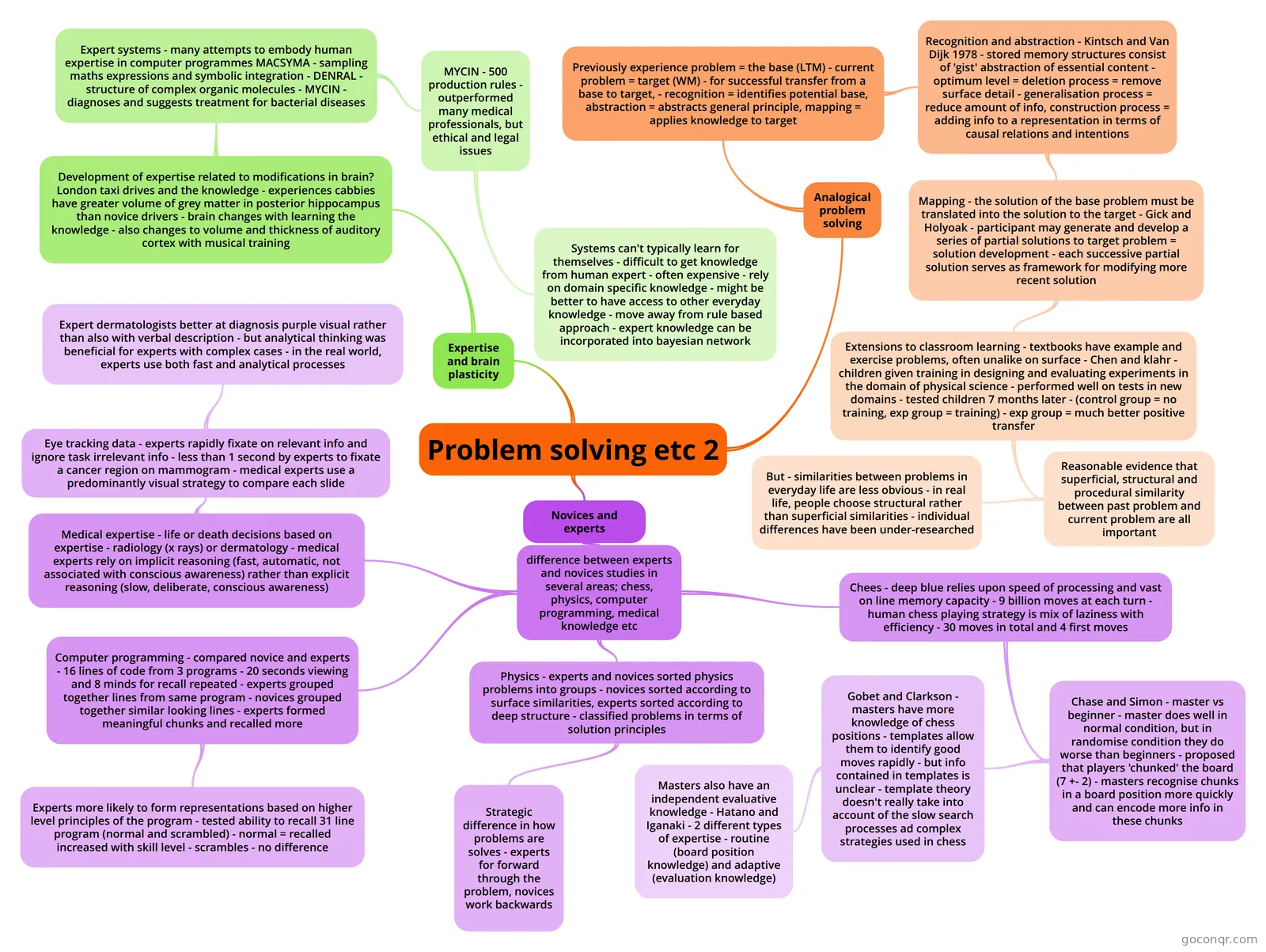
Mind map: Problem solving etc 2
Inhalt der Mindmap
Problem solving etc 2
Analogical problem solving
- Previously experience problem = the base (LTM) - current problem = target (WM) - for successful transfer from a base to target, - recognition = identifies potential base, abstraction = abstracts general principle, mapping = applies knowledge to target
- Recognition and abstraction - Kintsch and Van Dijk 1978 - stored memory structures consist of 'gist' abstraction of essential content - optimum level = deletion process = remove surface detail - generalisation process = reduce amount of info, construction process = adding info to a representation in terms of causal relations and intentions
- Mapping - the solution of the base problem must be translated into the solution to the target - Gick and Holyoak - participant may generate and develop a series of partial solutions to target problem = solution development - each successive partial solution serves as framework for modifying more recent solution
- Extensions to classroom learning - textbooks have example and exercise problems, often unalike on surface - Chen and klahr - children given training in designing and evaluating experiments in the domain of physical science - performed well on tests in new domains - tested children 7 months later - (control group = no training, exp group = training) - exp group = much better positive transfer
- Reasonable evidence that superficial, structural and procedural similarity between past problem and current problem are all important
- But - similarities between problems in everyday life are less obvious - in real life, people choose structural rather than superficial similarities - individual differences have been under-researched
- Reasonable evidence that superficial, structural and procedural similarity between past problem and current problem are all important
- Extensions to classroom learning - textbooks have example and exercise problems, often unalike on surface - Chen and klahr - children given training in designing and evaluating experiments in the domain of physical science - performed well on tests in new domains - tested children 7 months later - (control group = no training, exp group = training) - exp group = much better positive transfer
- Mapping - the solution of the base problem must be translated into the solution to the target - Gick and Holyoak - participant may generate and develop a series of partial solutions to target problem = solution development - each successive partial solution serves as framework for modifying more recent solution
- Recognition and abstraction - Kintsch and Van Dijk 1978 - stored memory structures consist of 'gist' abstraction of essential content - optimum level = deletion process = remove surface detail - generalisation process = reduce amount of info, construction process = adding info to a representation in terms of causal relations and intentions
- Previously experience problem = the base (LTM) - current problem = target (WM) - for successful transfer from a base to target, - recognition = identifies potential base, abstraction = abstracts general principle, mapping = applies knowledge to target
Novices and experts
- difference between experts and novices studies in several areas; chess, physics, computer programming, medical knowledge etc
- Chees - deep blue relies upon speed of processing and vast on line memory capacity - 9 billion moves at each turn - human chess playing strategy is mix of laziness with efficiency - 30 moves in total and 4 first moves
- Chase and Simon - master vs beginner - master does well in normal condition, but in randomise condition they do worse than beginners - proposed that players 'chunked' the board (7 +- 2) - masters recognise chunks in a board position more quickly and can encode more info in these chunks
- Gobet and Clarkson - masters have more knowledge of chess positions - templates allow them to identify good moves rapidly - but info contained in templates is unclear - template theory doesn't really take into account of the slow search processes ad complex strategies used in chess
- Masters also have an independent evaluative knowledge - Hatano and Iganaki - 2 different types of expertise - routine (board position knowledge) and adaptive (evaluation knowledge)
- Gobet and Clarkson - masters have more knowledge of chess positions - templates allow them to identify good moves rapidly - but info contained in templates is unclear - template theory doesn't really take into account of the slow search processes ad complex strategies used in chess
- Chase and Simon - master vs beginner - master does well in normal condition, but in randomise condition they do worse than beginners - proposed that players 'chunked' the board (7 +- 2) - masters recognise chunks in a board position more quickly and can encode more info in these chunks
- Physics - experts and novices sorted physics problems into groups - novices sorted according to surface similarities, experts sorted according to deep structure - classified problems in terms of solution principles
- Strategic difference in how problems are solves - experts for forward through the problem, novices work backwards
- Computer programming - compared novice and experts - 16 lines of code from 3 programs - 20 seconds viewing and 8 minds for recall repeated - experts grouped together lines from same program - novices grouped together similar looking lines - experts formed meaningful chunks and recalled more
- Experts more likely to form representations based on higher level principles of the program - tested ability to recall 31 line program (normal and scrambled) - normal = recalled increased with skill level - scrambles - no difference
- Medical expertise - life or death decisions based on expertise - radiology (x rays) or dermatology - medical experts rely on implicit reasoning (fast, automatic, not associated with conscious awareness) rather than explicit reasoning (slow, deliberate, conscious awareness)
- Eye tracking data - experts rapidly fixate on relevant info and ignore task irrelevant info - less than 1 second by experts to fixate a cancer region on mammogram - medical experts use a predominantly visual strategy to compare each slide
- Expert dermatologists better at diagnosis purple visual rather than also with verbal description - but analytical thinking was beneficial for experts with complex cases - in the real world, experts use both fast and analytical processes
- Eye tracking data - experts rapidly fixate on relevant info and ignore task irrelevant info - less than 1 second by experts to fixate a cancer region on mammogram - medical experts use a predominantly visual strategy to compare each slide
- Chees - deep blue relies upon speed of processing and vast on line memory capacity - 9 billion moves at each turn - human chess playing strategy is mix of laziness with efficiency - 30 moves in total and 4 first moves
- difference between experts and novices studies in several areas; chess, physics, computer programming, medical knowledge etc
Expertise and brain plasticity
- Development of expertise related to modifications in brain? London taxi drives and the knowledge - experiences cabbies have greater volume of grey matter in posterior hippocampus than novice drivers - brain changes with learning the knowledge - also changes to volume and thickness of auditory cortex with musical training
- Expert systems - many attempts to embody human expertise in computer programmes MACSYMA - sampling maths expressions and symbolic integration - DENRAL - structure of complex organic molecules - MYCIN - diagnoses and suggests treatment for bacterial diseases
- MYCIN - 500 production rules - outperformed many medical professionals, but ethical and legal issues
- Systems can't typically learn for themselves - difficult to get knowledge from human expert - often expensive - rely on domain specific knowledge - might be better to have access to other everyday knowledge - move away from rule based approach - expert knowledge can be incorporated into bayesian network
- MYCIN - 500 production rules - outperformed many medical professionals, but ethical and legal issues
- Expert systems - many attempts to embody human expertise in computer programmes MACSYMA - sampling maths expressions and symbolic integration - DENRAL - structure of complex organic molecules - MYCIN - diagnoses and suggests treatment for bacterial diseases
- Development of expertise related to modifications in brain? London taxi drives and the knowledge - experiences cabbies have greater volume of grey matter in posterior hippocampus than novice drivers - brain changes with learning the knowledge - also changes to volume and thickness of auditory cortex with musical training
Informationen
- Beschreibung
- Degree Cognitive Psychology Mindmap am Problem solving etc 2, erstellt von Abbey Wrigley am 15/01/2019.
- Erstellt von
- Abbey Wrigley
- Aufrufe
- 0
- Bewertung
Mehr zu Problem Solving and Creativity