
Mindmap
Economics:01
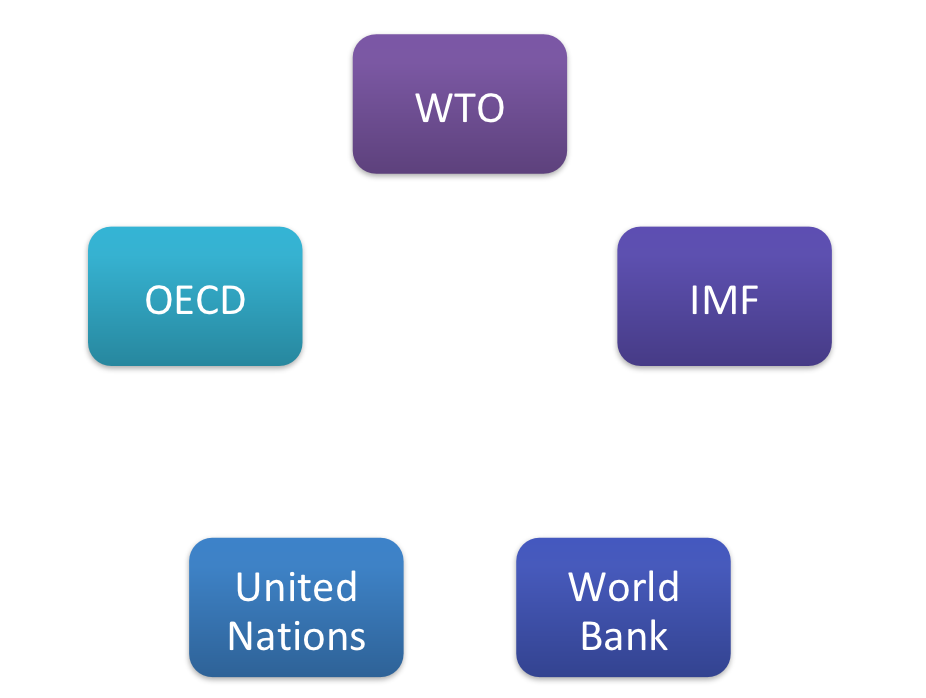
Inhalt der Mindmap
Economics:01
International Economic Integration:
- The Global Economy:
- The contagen effect has both positive and negative outcomes
- Eg; The widespread negative effect of the GFC was due to the fact that the US got affected by the events of it such harshly. However, China had passed through the GFC with ease which also meant that Australia passed through the GFC with little difficulty due to Australia's close tie with the Chinese economy.
- The contagen effect has both positive and negative outcomes
- Gross World Product:
- GWP (Gross World Product) is the aggregate value of all goods and services produced world wide each year.
- Globalisation:
- Globalisation is the increased integration between economies of the world to have an increased impact of international influences on all aspects of life and economic activity.
- The removal of barriers allows for greater movement and trade of goods, services, finance, labour, information and technology between countries.
- +VE: Ideas are constantly being shared around the world on how to make economies more efficient as well as keeping up to date with current affairs and news. Wealth is often bought to foreign countries (somtimes not the countries that need them the most). The cost of transportation is less.
- -VE: The vast majority of the time, only the wealthier countries benefit from the outcomes of Globalisation. With globalisation comes Westernisation which is seen as a threat to the worlds cultural diversity. Globalisation will cause a dependance of any and all economies on the global economy as a whole. This can be effected by the contagion effect.
- TNC's bring wealth and foreign currencies to local economies when they buy local resources, products, and services. The extra money can be spent on health, education, and allowing the economy to be better off.
- A.) TRADE IN GOODS AND SERVICES: Trade in goods and services has grown rapidly (GWP is 9 times the 1950 level and the volume of world trade is 33 times the 1950 level.) Annual trade is double the world economic growth. The vast quantity of the word trades items instead of producing them. (E.g. John Green's video where the t-shirt is made in one country, printed on in another, marketed in another and sold in another). The USA, Euro, and Japan are the parent countries to 85% of all TNC's. The number of TNC's has grown from 37,000 to 82,000+ since 1990's.Major trading agreements have encouraged the expansion in the volume of trade. (E.g. NAFTA [North America FTA], APEC [Asia-Pacific Economic Co-operation], WTO, EU [European Union].)
- B.) FINANCIAL FLOWS: Financial flows are the main determinants of the value of most nations exchange rates. Trade on G+S has little impact on the value of exchange rates. Financial flows have increased 10 times the rate of GDP. Foreign exchange is now 100 times the value of world trade.
- C.) INVESTMENT IN TNC'S : FDI (Foreign Direct Investment) flows have risen from $44 US Billion in 1985 to over $1940 US Billion in 2008. Areas of investment have been markets in Asia and South America. Global FDI fell by 15% as a result of the GFC. FDI fluctuates in advanced economies whereas it stays more constant in developing countries.
- D.) TECHNOLOGY, TRANSPORT AND COMMUNICATION: Technology, transport and communication are being made easier, faster and cheaper everyday which are drivers of Globalisation. Internet use has increased 340% between 2000 and 2008 and it's use is dominated by the richest 20% of nations.
- E.) INTERNATIONAL DIVISION OF LABOUR AND MIGRATION: People are migration larger distances and more frequently to work and earn money and take advantages of work opportunities. 3% of the worlds nation has travelled internationally tin order to find work. Highly skilled workers are attracted to the richest economies in the USA and Europe. This acounts for the "Brain Drain" from Aust. and NZ. Low skilled labourers are attracted to countries where there is a shortage of locals willing to work in low paid, basic skilled jobs. Although, barriers still exist to the movement of labour such as immigration restrictions, language barriers, cultural factors, incompatible education and professional qualifications as well as the attractions of staying at home.
- The International and regional Business Cycle:
- Definitoin: Fluctuations in the level of economic growth or activity due to domestic or international factors. The contagion effect comes into play and cam make the downswings and trough's that the economy experiences far worse than what it would have been without the factors of globalisation. Likewise, when an economy has an upswing or boom in economic growth/activity, it is ever-present throughout the global economy due to the factors of globalisation.
- The Global Economy:
Trade, Financial Flows and Foreign Investment:
- Free trade occurs when there are no artifical barriers put in place to restrict the flow of goods and services being traded between nations.
- A surplus of resources comes a trade of that surplus to other nations around the globe. The money made from this is used to purchase other G+S from overseas economies or can also be used to better an economy. When trade barriers are put in place (such as tariffs and quotas), they are there to protect domestic producers from international competition.
- ADVANTAGES: 1.) Increased Production: A specialisation in production allow for a comparative advantage and an increased efficiency and an increased output. 2.) Production Efficiencies: Improved efficiency of resource allocation allows for a higher productivity and increasing total domestic output of all G+S. Competition promotes innovative production methods through use of technology, marketing, and distribution methods. 3.) Benefits To Consumers: This leads to a lower average cost for the consumer as well as having a larger variety of goods and services to choose from. It can also increase the quality of the G+S. 4.) Foreign Exchange Rates: When an economy sells exports, it creates hard currency (injection) from the countries that purchase the G+S. This money is used to pay for imports that are produced more efficiently and cheaper overseas. 5.) Employment: Employment will increase, particularly in manufacturing and service industries. There will be structural unemployment (d
- There will be structural unemployment (displacement of workers) as import competing industries close down. (E.g. Holden, Toyota) 6.) Economic Growth: Rising living standards, increased incomes, higher rates of economic growth. This is all due to competitive industries increasing productivity and efficiency.
- DISADVANTAGES: 1.) Short-Term Structural Unemployment: (12 months unemployed = hard to find work). 2.) Decreased domestic economic instability, contagion effect as economies become dependant on the global market. 3.) International markets are not an even playing field: Countries with a surplus of G+S may dump them on the world market at below average cost. Some efficient industries may find it difficult to compete in these conditions for long periods of time. 4.) Developing industries may find it difficult difficult to become established in a compeditive environment with no short-term protection policies. 5.) Environmental Efficiency: Companies fail to include compensation for environmental damage in the cost of their product unless the Govt. places an environmental legislation to decrease the effect on the environment. 6.) Pressure to increase protection during the GFC (-ve externality).
- ADVANTAGES: 1.) Increased Production: A specialisation in production allow for a comparative advantage and an increased efficiency and an increased output. 2.) Production Efficiencies: Improved efficiency of resource allocation allows for a higher productivity and increasing total domestic output of all G+S. Competition promotes innovative production methods through use of technology, marketing, and distribution methods. 3.) Benefits To Consumers: This leads to a lower average cost for the consumer as well as having a larger variety of goods and services to choose from. It can also increase the quality of the G+S. 4.) Foreign Exchange Rates: When an economy sells exports, it creates hard currency (injection) from the countries that purchase the G+S. This money is used to pay for imports that are produced more efficiently and cheaper overseas. 5.) Employment: Employment will increase, particularly in manufacturing and service industries. There will be structural unemployment (d
- A surplus of resources comes a trade of that surplus to other nations around the globe. The money made from this is used to purchase other G+S from overseas economies or can also be used to better an economy. When trade barriers are put in place (such as tariffs and quotas), they are there to protect domestic producers from international competition.
- Free trade occurs when there are no artifical barriers put in place to restrict the flow of goods and services being traded between nations.
Bilder und Dateien der Mindmap
Informationen
- Beschreibung
- Mindmap am Economics:01, erstellt von Maxinee am 27/11/2014.
- Erstellt von
- Maxinee
- Aufrufe
- 6
- Tags
- Bewertung