
Mindmap
Purification Methods (Making Pure Substances)
Inhalt der Mindmap
Purification Methods (Making Pure Substances)
Pure Substances
- Melts at a fixed temperature
- Boils at a fixed temperature
- Forms one spot on chromatogram
Impure Substances (MIxtures)
- Melts at a lower temperature than the correct melting point of the pure substance and melts over a range of temperatures
- Boils over a range of temperatures
- Forms two or more spots on a chromatogram
A solution of a solid in a solvent (e.g. aqueous copper(II) sulphate)
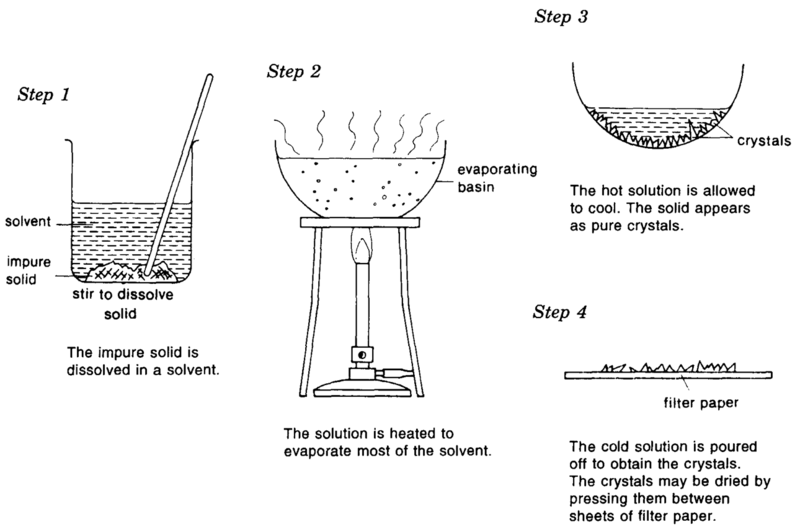
- Crystallisation (Copper(II) sulfate and water)
- Physical property
- Solubility of solids (Solubility of copper(II) sulfate in water changes with temperature)
- Brief Description of Method
- !. Pour the copper(II) sulfate solution into the evaporating dish
- 2. Heat the mixture gently until a saturated solution is obtained (When a thin crust is observed above the liquid surface)
- 3. Leave the saturated solution to cool for crystals to form
- 4. Filter the mixture to obtain the crystals (pure solids) as a residue
- 5. Wash and dry the crystals (pure solids) between fillter papers
- For common salt (NaCl), the solution needs to be evaporated to dryness
- Special tecniques/ Precautions
- Best to leave the solution to cools for days
- Saturated means there is no more space left for the solid to dissolve; thoroughly soaked
- Diagram
- Must label: Solution containing a solid dissolved in a liquid, evaportaing dish, crystals and heat
- Physical property
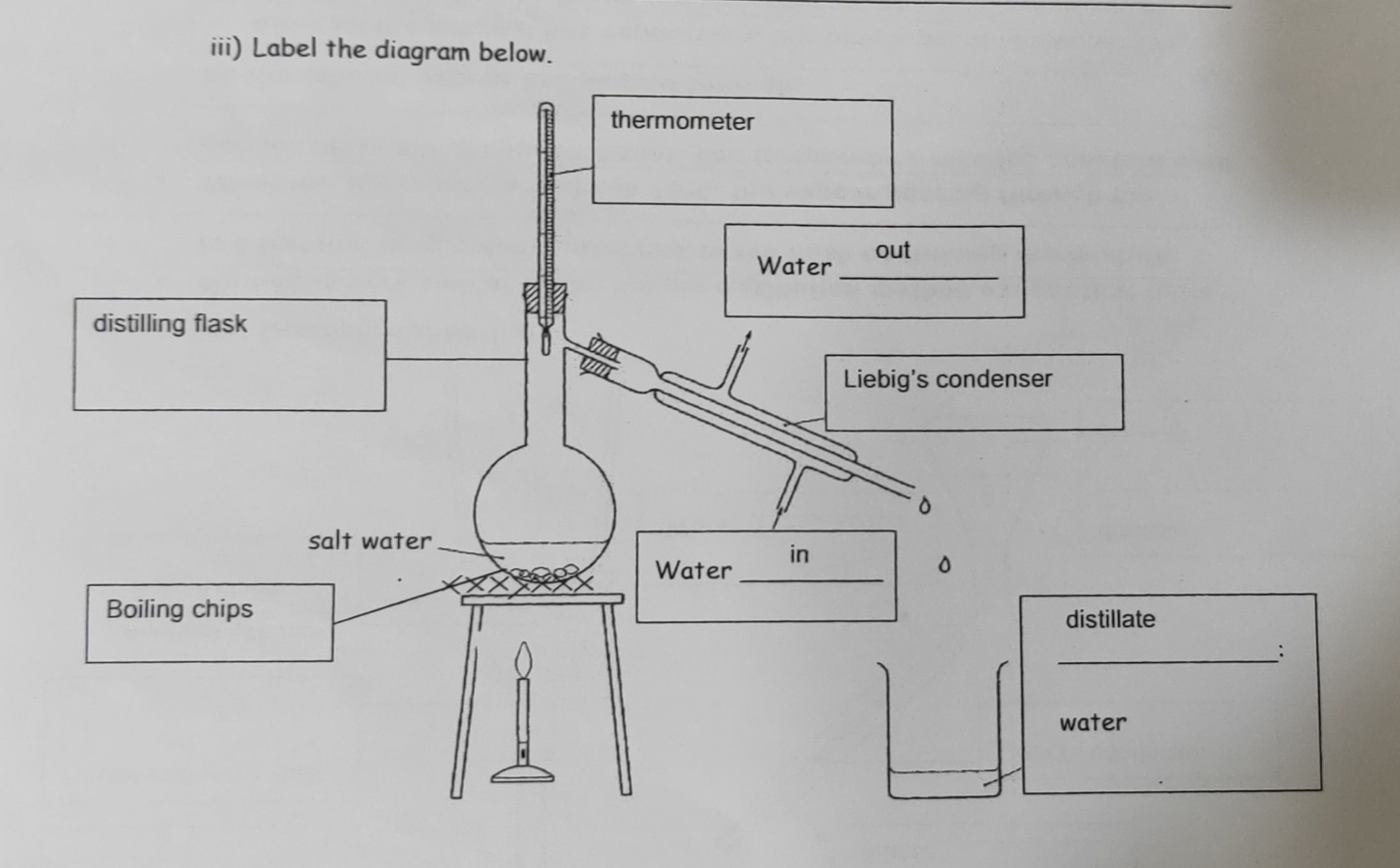
- Simple Distillation (Salt water, sea water)
- Physical property
- Boiling point (salt has a boiling point that is much higher than that of water)
- Brief Decription of Method
- 1. Pour the whole solution into the distilling flask, add boiling chips and place the clamped flask on a tripod stand
- 2. Fix a condenser to the side arm of the flask and insert a thermometer into the flask such that the bulb is at the side arm of the flask
- 3. Fill the condenser with running water
- 4. Heat the solution in the flask gently. When the temperature of the thermometer remains constant at the boiling point of water(100°C), collect the water coming through the condenser with a beaker
- 5. Continue collecting until no more water comes through the condenser
- Supporting theories/ Scientific knowledge
- When the salt water is heated, the vapour formed contains only pure water
- Water vapour will condense to form water when it is cooled to room temperature. As the water vapour passes through the inner tube of the condenser, heat is taken away by the cooler water running through the jacket of the condenser. Finally the water vapour condenses
- Special techniques/precautions
- Boiling chips are added to the mixture to ensure smooth boiling
- Tap water enters the condenser at the lower end and leaves through the higher end. This is to ensure that the jacket of the condenser is always completely filled with tap water and that the condenser is coldest at the part where the distillate leaves the condenser
- The bulb of the thermometer has to be at the side arm of the distilling flask so that it can record the temperature of the vapour (also the boiling point) passing into the condenser
- Diagram
- Physical property
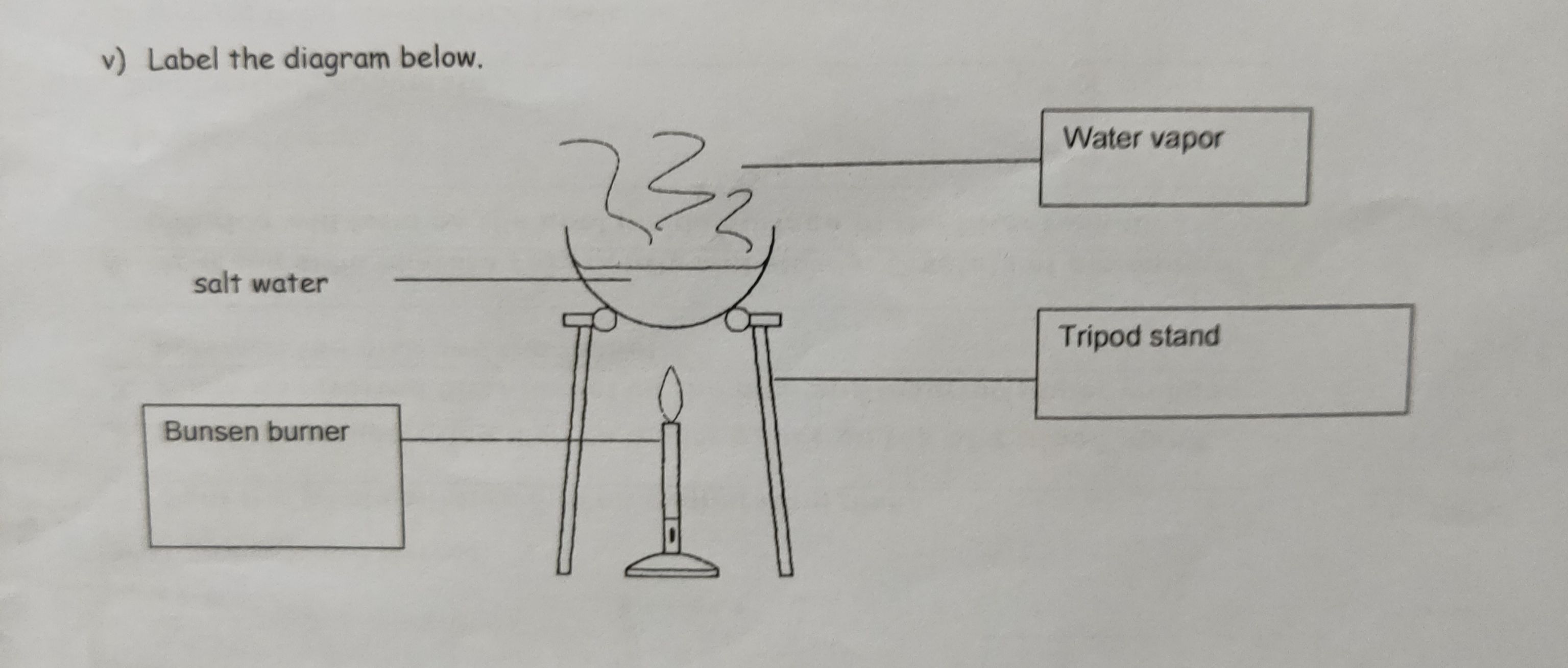
- Evaporation to dryness (Salt water/salt solution/aqueous salt)
- Physical Property
- Boiling point (salt has a higher boiling point than water, so when the mixture is heated, only water vapourises)
- Brief Description of the Method
- 1. Pour the whole mixture into an evaporating dish
- 2. Heat the mixture gently until no more water remains
- 3. The residue is salt
- Additional Notes
- The problem with this method is that if any impurities are present, the impurities will remain in the sodium chloride. For other substances, Crystallization is the preferred method
- This method is to obtain the salt not the water. If the purpose is to obtain the water, simple distillation is preferred
- Salt melts at 800°C so to change salt to its vapour state, a very high temperature is needed
- Salt dissolves to form a homogenous mixture (equal proportions of its component throughout the given sample). When left to settle, there is only one layer (salt does not separate out)
- Only for Sodium Chloride/Salt (NaCl)
- Diagram
- Physical Property
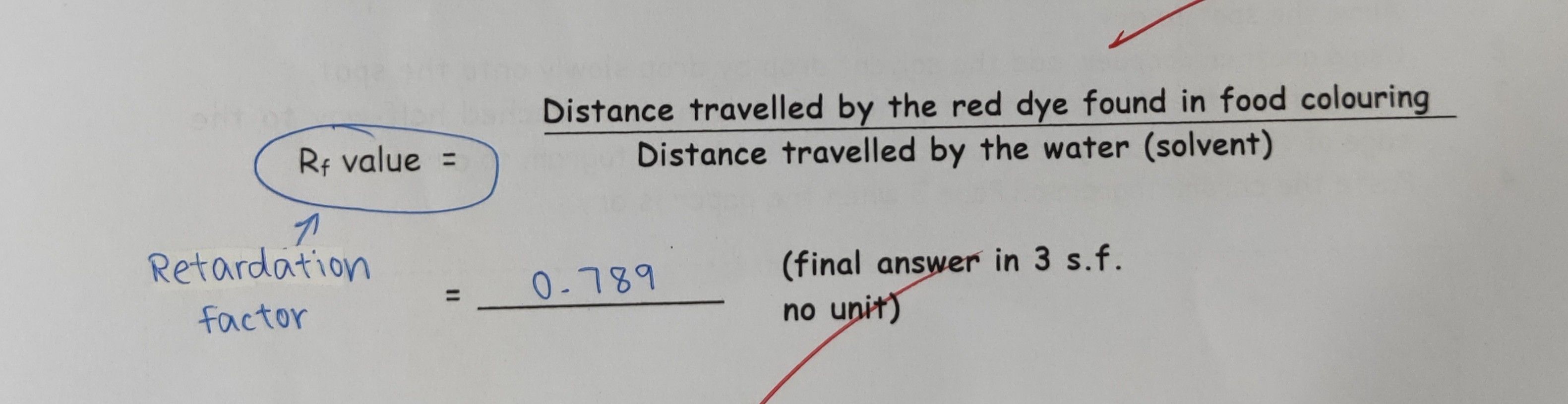
- Chromatogram (Dyes in ink)
- Only for very small quantities of solutes dissolved in solvents
- Physical Property
- Solubility of the dyes (Dyes have different solubilities in a chosen solvent/absorption to the paper)
- Brief Desription of Method
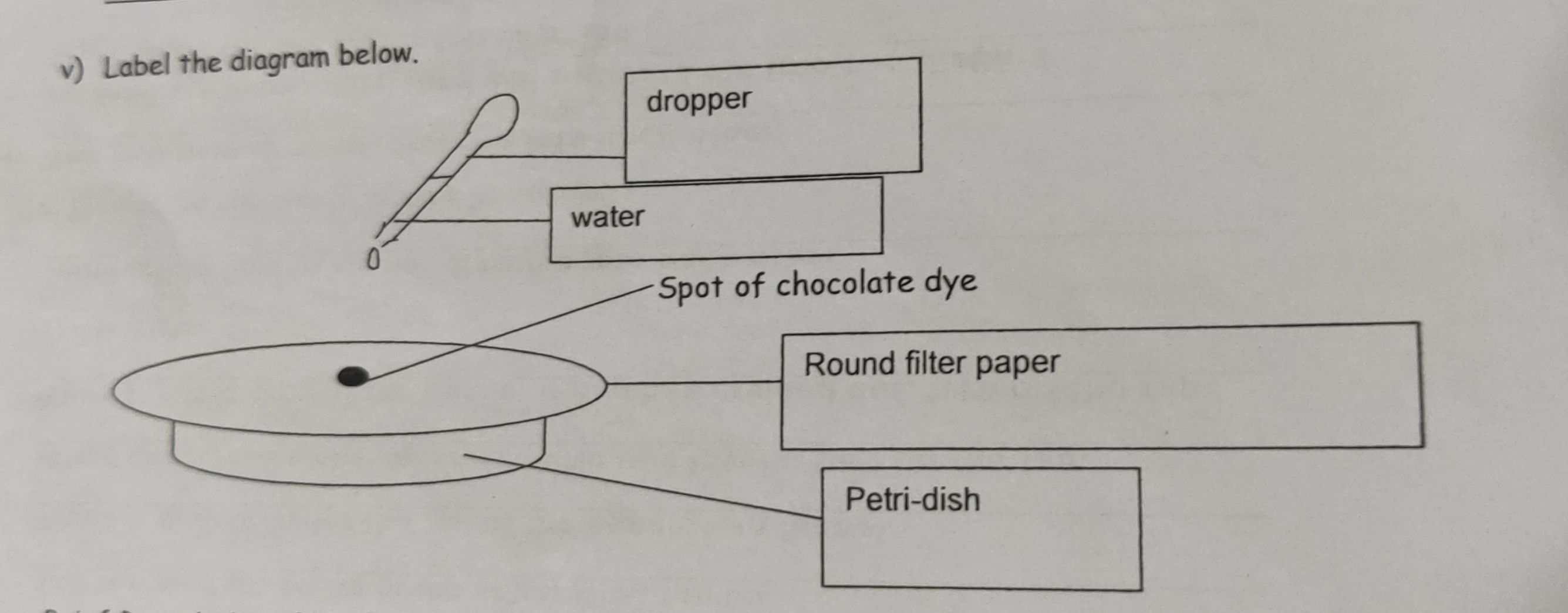
- 1. Place a small drop of chocolate dye onto the centre of the filter paper and leave the spot to dry
- 2. Place the paper on the centre of a petri dish
- 3. Add drops of water on the chocolate dye spot very slowly, waiting for the ink to stop spreading before adding the next drop
- Special techniques/precautions
- The addition of water should be done slowly
- The spot of the mixture has to be small to allow for more effective separation
- Supporting Theories/Scientific knowledge
- Dyes are coloured substances
- Dyes which are more soluble in the solvent used will move further away together with the solvent from the original spot
- The chromatogram obtained would be different if the separation is done at a higher temperature or using a different solvent
- The separation can only be done if all the dyes can be soluble in the chosen solvent
- Diagram
- Crystallisation (Copper(II) sulfate and water)
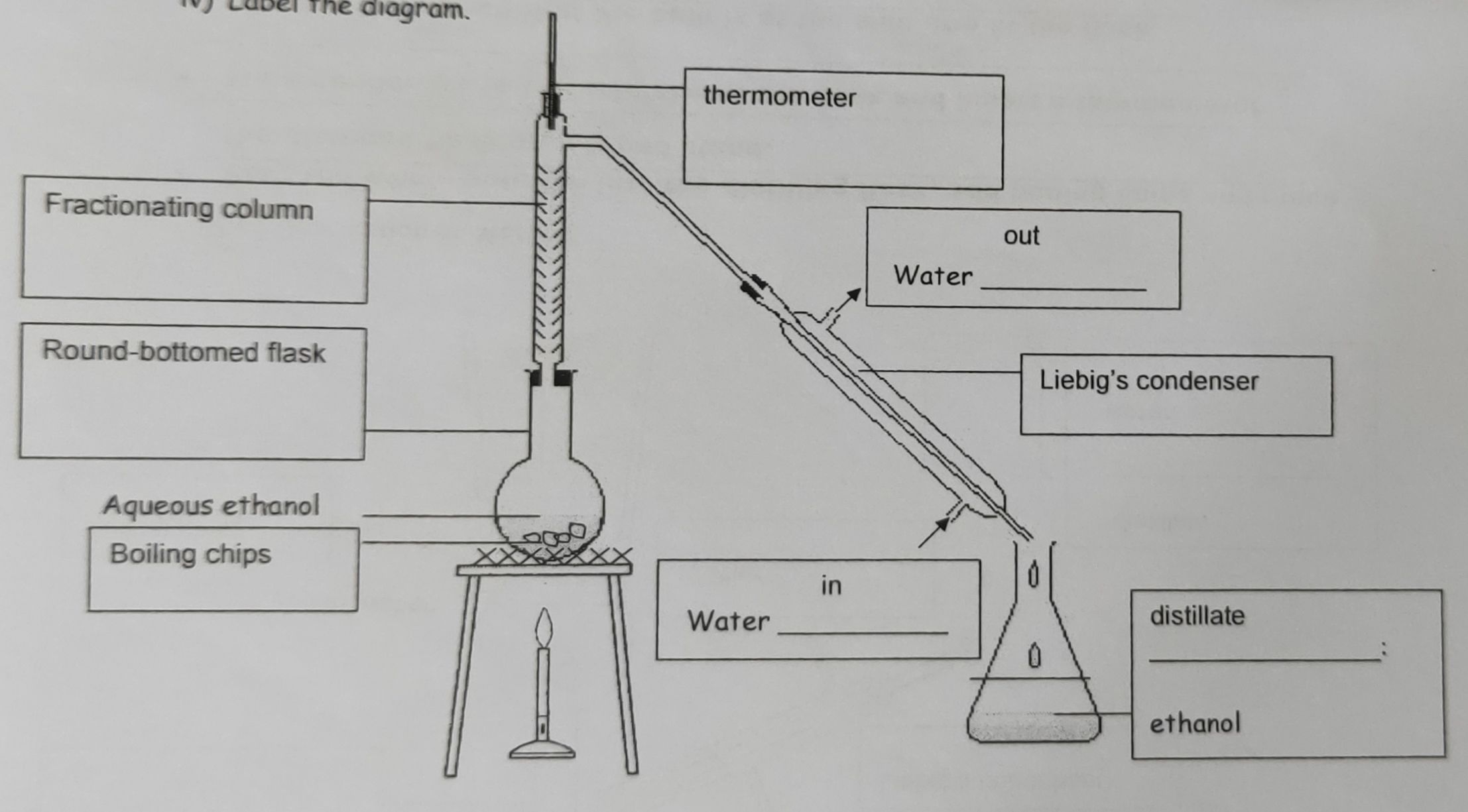
Fractional Distillation
- Physical Property
- Boiling point (Boiling point of ethanol (78°C), lower than the boiling point of water (100°C))
- Brief Description of the Method
- In the fractionating column, the liquid is repeatedly boiled and condensed. Each time it boils, the percentage of the lower boiling point liquid increases until it becomes almost pure upon reaching the top of the column
- Method is very similar to simple distillation except that there is a fractionating column attached to the flask containing the mixture
- When the temperature reaches 78°C, the vapour passing through the condenser is almost pure ethanol. The temperature remains constant until all the ethanol vapour has passed through
- After all the ethanol has vapourised, the temperature shown on the thermometer will rise and then remain constant at 100°C when water vapour starts to pass through the condenser
- Supporting theories/scientific knowledge
- The longer the fractionating column, the higher the chance of getting 100% of the lower b.p. liquid (pure)
- A mixture of miscible liquids is formed when the liquids dissolve in each other. When left to stand, only one layer is observed since the liquids do not separate out
- Ethanol has a lower boiling point than water so it is more volatile than water
- A volatile liquid is one which has a boiling point which is very close (higher than) to room temperature and so evaporates very easily at room temperature
- On warming the mixture, the vapour formed is a mixture of ethanol and water still but it is richer in the volatile ethanol than the original mixture
- Diagram
- Physical Property
Two or more Miscible Liquids (e.g. Ethanol and water)
Two Immiscible liquids (Water and cooking oil)
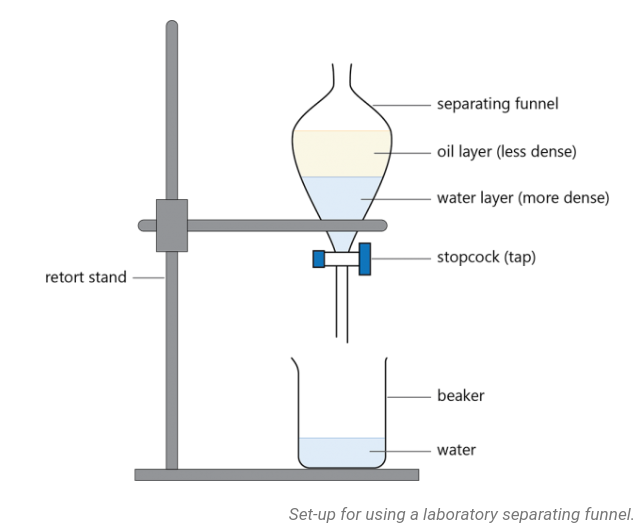
- Separating Funnel
- Physical Property
- Solubility of the liquids (Oil and water do not dissolve into each other thus they are known as immiscible liquids)
- Brief Description of Method
- 1. Remove the cover and close the tap of the separating funnel
- 2. Pour the mixture of oil and water into the separating funnel
- 3. Let the mixture settle in the separating funnel
- 4. Place a beaker under the tap of the separating funnel
- 5. When the mixture has separated into two layers, turn on the tap
- 6. When the last drop of the denser liquid has drained out, turn off the tap
- Supporting theories/scientific knowledge
- The two liquids do not dissolve into each other
- The less dense liquid will move to occupy the top layer while the denser liquid will be at the bottom of the two layers
- Diagram
- Physical Property
- Separating Funnel
Mixture of two solids
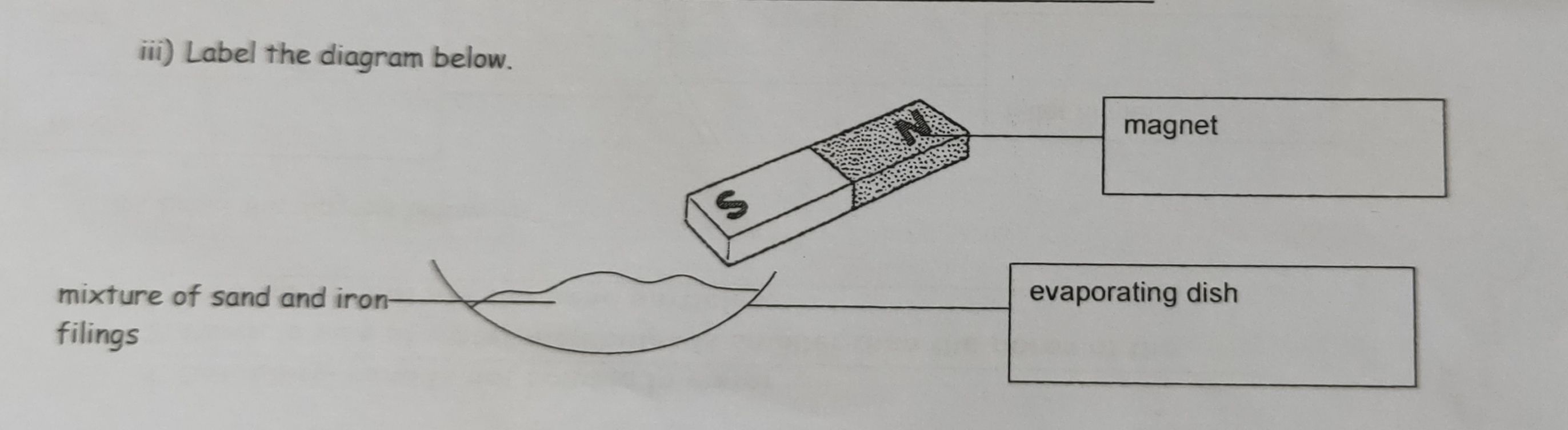
- Magnetic Separation (Sand and Iron fillings)
- Physical Property
- Magnetism (Sand is not attracted to magnet but iron is)
- Brief Description of Method
- 1. Wrap the magnet with a piece of paer
- 2. Move the wrapped magnet just above the mixture
- 3. When all the iron fillings have been attracted, hold the wrapped magnet above another evaporating dish. Remove the paper carefully so that the iron fillings drop into the evaporating dish
- Supporting theories/scientific knowledge
- Magnetic materials (COINS)
- Cobalt
- Iron
- Nickel
- Steel
- Magnetic materials (COINS)
- Diagram
- Physical Property
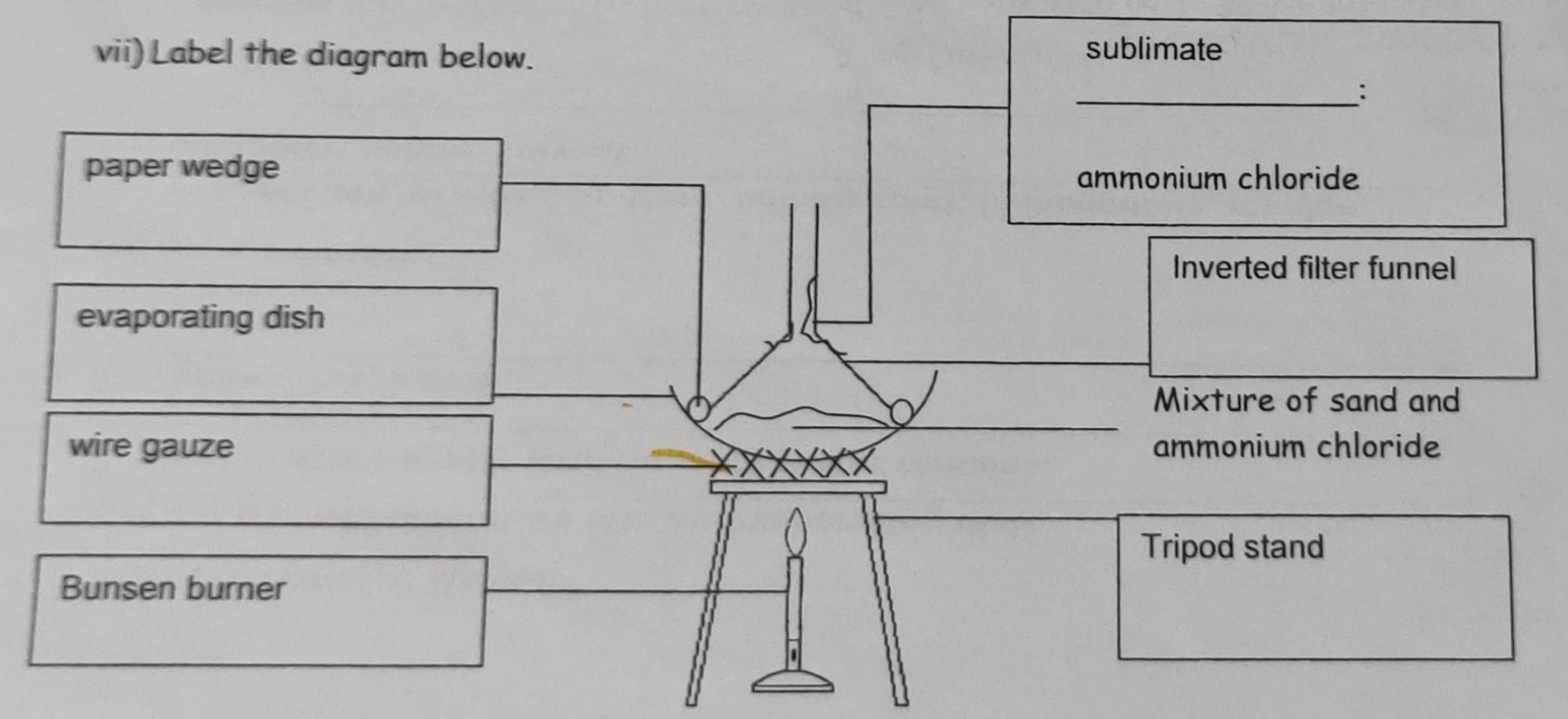
- Sublimation (Sand and ammonium chloride)
- Physical Property
- Effect of heat on solid (Ammonium chloride sublimes but sand does not sublime and does not decompose on heating)
- Diagram
- Brief Desription of Method
- 1. Pour the whole mixture into the evaporating dish
- 2. Place the evaporating dish on a wire gauze on top of a tripod stand
- 3. Place an inverted filter funnel on the dish and insert paper wedges between the dish and the funnel
- 4. Heat the solid mixture very gently and slowly. Crystals of ammonium chloride will form on the cool inside surface of the filter funnel
- Supporting theories/scientific knowledge
- A process in which a substance changes from the solid state to the gaseous state without melting
- Ammonium chloride, dry ice (solid carbon dioxide), naphthalene and iodine sublimes
- Heating must be done slowly and gently so that the inverted filter funnel remains cool while the evaporating dish is being heated. This is to allow the ammonium chloride crystals to form on the filter funnel
- Ammonium chloride, iodine and naphthalene are solids at room temperature
- Iodine is dark grey in the solid state and forms violet iodine vapour when heated (crystals are purple)
- Physical Property
- Magnetic Separation (Sand and Iron fillings)
Mixture of solid and liquid
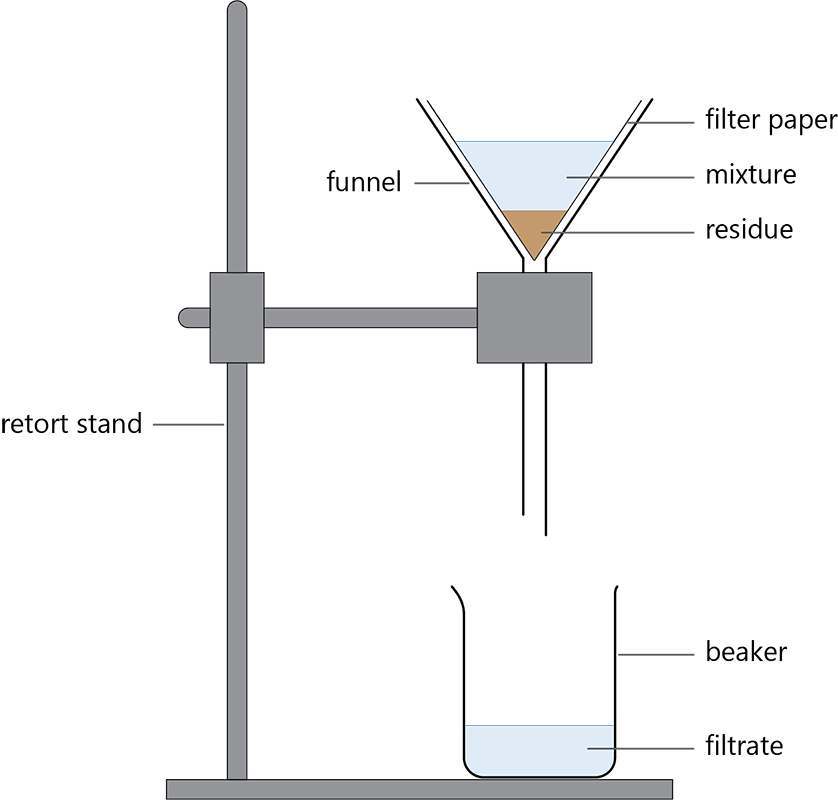
- Filtration (Sand and water)
- Physical Property
- Solubility (Sand is not soluble in water)
- Particle size of water molecules is smaller than the pores of the filter paper but not the sand particles
- Diagram
- Brief Description of Method
- 1. Line the filter funnel with filter paper and clamp it with a retort stand over a beaker
- 2. Pour the mixture onto the filter funnel
- 3. The sand is collected as residue on the filter paper while the water is collected as filtrate in the beaker
- 4. Place the sand between 2 pieces of filter papers and press them together to dry the sand and let it air dry for 15 minutes
- Supporting theories/scientific knowledge
- A mixture is which a solid does not dissolve in the liquid is heterogenous (its physical properties are not the same throughout the mixture)
- Filter paper contains very small holes. Solid particles are too big to pass through the holes and so stay on the paper. Liquid particles are smaller so they can pass through the holes
- Physical Property
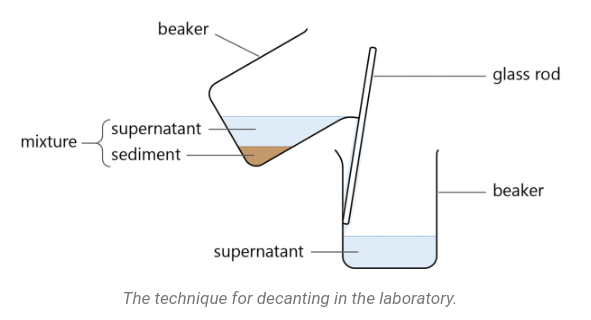
- Decanting (sand and water)
- Diagram
- Filtration (Sand and water)
Bilder und Dateien der Mindmap
Informationen
- Beschreibung
- International Baccalaureate Chemistry Mindmap am Purification Methods (Making Pure Substances), erstellt von ONG SHENG HUI RACHEL 1G am 29/09/2019.
- Erstellt von
- ONG SHENG HUI RACHEL 1G
- Aufrufe
- 2
- Bewertung