
Mindmap
Biomes
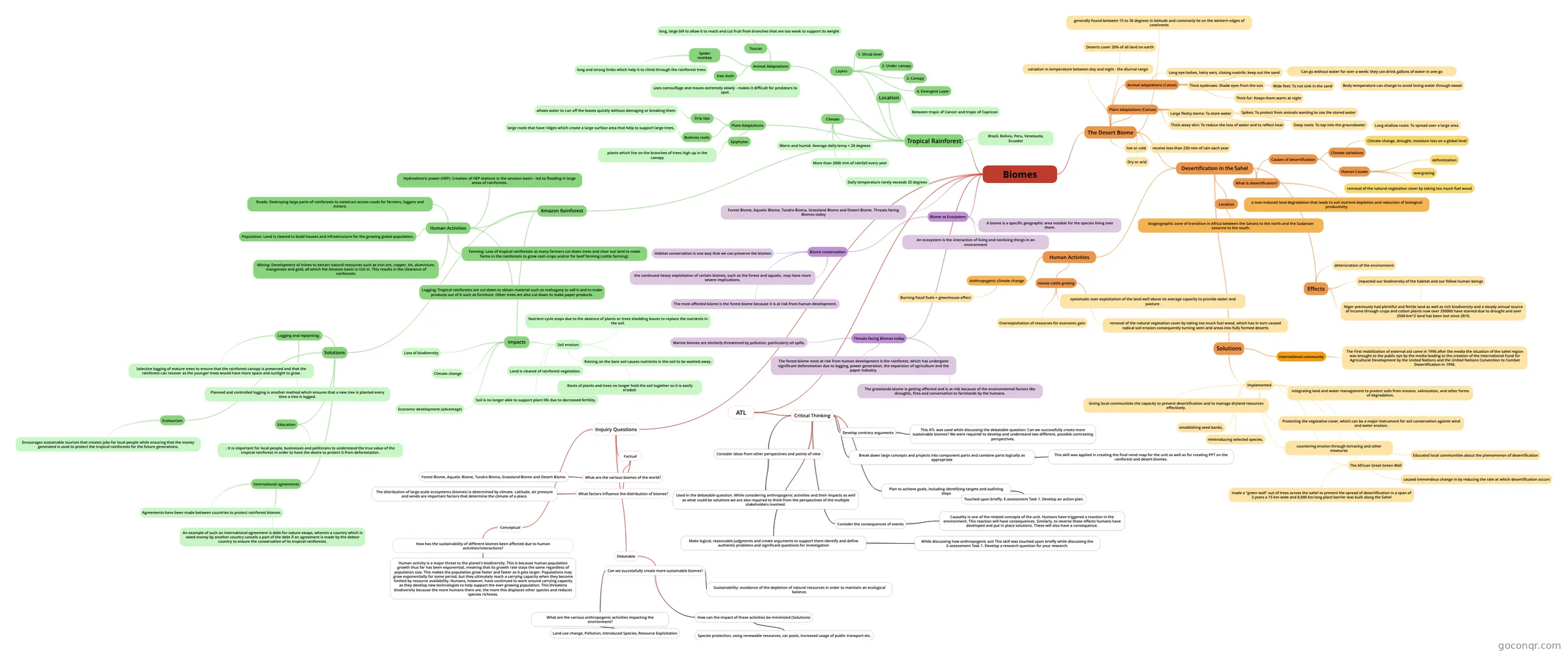
Mind map: Biomes
Inhalt der Mindmap
Biomes
The Desert Biome
- Desertification in the Sahel
- What is desertification?
- a man induced land degradation that leads to soil nutrient depletion and reduction of biological productivity.
- Causes of desertification
- Climate variations
- Climate change, drought, moisture loss on a global level
- Human Causes
- overgrazing
- removal of the natural vegetation cover by taking too much fuel wood
- deforestation
- Climate variations
- Location
- biogeographic zone of transition in Africa between the Sahara to the north and the Sudanian savanna to the south.
- Human Activities
- Anthropogenic climate change
- Burning fossil fuels = greenhouse effect
- excess cattle grazing
- systematic over-exploitation of the land well above its average capacity to provide water and pasture.
- Overexploitation of resources for economic gain
- removal of the natural vegetation cover by taking too much fuel wood, which has in turn caused radical soil erosion consequently turning semi arid areas into fully formed deserts
- Anthropogenic climate change
- Effects
- deterioration of the environment
- impacted our biodiversity of the habitat and our fellow human beings
- Niger previously had plentiful and fertile land as well as rich biodiversity and a steady annual source of income through crops and cotton plants now over 350000 have starved due to drought and over 2500 km^2 land has been lost since 2010.
- Solutions
- International community
- The First mobilization of external aid came in 1996 after the media the situation of the sahel region was brought to the public eye by the media leading to the creation of the International Fund for Agricultural Development by the United Nations and the United Nations Convention to Combat Desertification in 1996.
- Implemented
- integrating land and water management to protect soils from erosion, salinization, and other forms of degradation.
- Protecting the vegetative cover, which can be a major instrument for soil conservation against wind and water erosion.
- Giving local communities the capacity to prevent desertification and to manage dryland resources effectively.
- establishing seed banks,
- reintroducing selected species,
- countering erosion through terracing and other measures
- The African Great Green Wall
- made a “green wall” out of trees across the sahel to prevent the spread of desertification in a span of 3 years a 15 km wide and 8,000 km long plant barrier was built along the Sahel
- Educated local communities about the phenomenon of desertification
- caused tremendous change in by reducing the rate at which desertification occurs
- International community
- What is desertification?
- Dry or arid
- receive less than 250 mm of rain each year
- hot or cold
- Plant adaptations (Cactus)
- Thick waxy skin: To reduce the loss of water and to reflect heat
- Large fleshy stems: To store water
- Spikes: To protect from animals wanting to use the stored water
- Deep roots: To tap into the groundwater
- Long shallow roots: To spread over a large area
- Animal adaptations (Camel)
- Long eye-lashes, hairy ears, closing nostrils: keep out the sand
- Thick eyebrows: Shade eyes from the sun
- Wide feet: To not sink in the sand
- Can go without water for over a week: they can drink gallons of water in one go
- Body temperature can change to avoid losing water through sweat
- Thick fur: Keeps them warm at night
- variation in temperature between day and night - the diurnal range
- Deserts cover 20% of all land on earth
- generally found between 15 to 30 degrees in latitude and commonly lie on the western edges of continents
- Desertification in the Sahel
ATL
- Critical Thinking
- Consider ideas from other perspectives and points of view
- Used in the debatable question. While considering anthropogenic activities and their impacts as well as what could be solutions we are also required to think from the perspectives of the multiple stakeholders involved.
- Develop contrary arguments
- This ATL was used while discussing the debatable question: Can we successfully create more sustainable biomes? We were required to develop and understand two different, possible contrasting perspectives.
- Break down large concepts and projects into component parts and combine parts logically as appropriate
- This skill was applied in creating the final mind map for the unit as well as for creating PPT on the rainforest and desert biomes.
- Plan to achieve goals, including identifying targets and outlining steps
- Touched upon briefly. E-assessment Task 1. Develop an action plan.
- Consider the consequences of events
- Causality is one of the related concepts of the unit. Humans have triggered a reaction in the environment. This reaction will have consequences. Similarly, to reverse these effects humans have developed and put in place solutions. These will also have a consequence.
- Make logical, reasonable judgments and create arguments to support them Identify and define authentic problems and significant questions for investigation
- While discussing how anthropogenic acti This skill was touched upon briefly while discussing the E-assessment Task 1. Develop a research question for your research.
- Consider ideas from other perspectives and points of view
- Critical Thinking
Tropical Rainforest
- Location
- Between tropic of Cancer and tropic of Capricon
- Climate
- Warm and humid. Average daily temp = 28 degrees
- More than 2000 mm of rainfall every year
- Daily temperature rarely exceeds 35 degrees
- Layers
- 1. Shrub level
- 2. Under canopy
- 3. Canopy
- 4. Emergent Layer
- Brazil, Bolivia, Peru, Venezuela, Ecuador
- Animal Adaptations
- tree sloth
- uses camouflage and moves extremely slowly - makes it difficult for predators to spot.
- Spider monkey
- long and strong limbs which help it to climb through the rainforest trees
- Toucan
- long, large bill to allow it to reach and cut fruit from branches that are too weak to support its weight
- tree sloth
- Plant Adaptations
- Drip tips
- allows water to run off the leaves quickly without damaging or breaking them
- Buttress roots
- large roots that have ridges which create a large surface area that help to support large trees.
- Epiphytes
- plants which live on the branches of trees high up in the canopy
- Drip tips
- Amazon Rainforest
- Human Activities
- Farming: Loss of tropical rainforests as many farmers cut down trees and clear out land to make farms in the rainforests to grow cash crops and/or for beef farming (cattle farming).
- Logging: Tropical rainforests are cut down to obtain material such as mahogany to sell it and to make products out of it such as furniture. Other trees are also cut down to make paper products.
- Mining: Development of mines to extract natural resources such as iron ore, copper, tin, aluminium, manganese and gold, all which the Amazon basin is rich in. This results in the clearance of rainforests.
- Roads: Destroying large parts of rainforests to construct access roads for farmers, loggers and miners.
- Hydroelectric power (HEP): Creation of HEP stations in the amazon basin - led to flooding in large areas of rainforests.
- Population: Land is cleared to build houses and infrastructure for the growing global population.
- Impacts
- Soil erosion:
- Land is cleared of rainforest vegetation.
- Raining on the bare soil causes nutrients in the soil to be washed away.
- Nutrient cycle stops due to the absence of plants or trees shedding leaves to replace the nutrients in the soil.
- Soil is no longer able to support plant life due to decreased fertility.
- Roots of plants and trees no longer hold the soil together so it is easily eroded.
- Loss of biodiversity
- Climate change
- Economic development (advantage)
- Soil erosion:
- Solutions
- Logging and replanting:
- Selective logging of mature trees to ensure that the rainforest canopy is preserved and that the rainforest can recover as the younger trees would have more space and sunlight to grow.
- Planned and controlled logging is another method which ensures that a new tree is planted every time a tree is logged.
- Education
- : It is important for local people, businesses and politicians to understand the true value of the tropical rainforest in order to have the desire to protect it from deforestation.
- Ecotourism
- Encourages sustainable tourism that creates jobs for local people while ensuring that the money generated is used to protect the tropical rainforests for the future generations.
- International agreements
- Agreements have been made between countries to protect rainforest biomes.
- An example of such an international agreement is debt-for-nature swaps, wherein a country which is owed money by another country cancels a part of the debt if an agreement is made by the debtor country to ensure the conservation of its tropical rainforests.
- Logging and replanting:
- Human Activities
- Location
Forest Biome, Aquatic Biome, Tundra Bioma, Grassland Biome and Desert Biome. Threats facing Biomes today
Biome vs Ecosystem
- A biome is a specific geographic area notable for the species living over there.
- An ecosystem is the interaction of living and nonliving things in an environment
- Biome conservation
- the continued heavy exploitation of certain biomes, such as the forest and aquatic, may have more severe implications.
- Habitat conservation is one way that we can preserve the biomes
- The most affected biome is the forest biome because it is at risk from human development.
Threats facing Biomes today
- Marine biomes are similarly threatened by pollution, particularly oil spills.
- The forest biome most at risk from human development is the rainforest, which has undergone significant deforestation due to logging, power generation, the expansion of agriculture and the paper industry.
- The grasslands biome is getting affected and is at risk because of the environmental factors like droughts, fires and conversation to farmlands by the humans.
Inquiry Questions
- Factual
- What are the various biomes of the world?
- Forest Biome, Aquatic Biome, Tundra Bioma, Grassland Biome and Desert Biome.
- What factors influence the distribution of biomes?
- The distribution of large-scale ecosystems (biomes) is determined by climate. Latitude, air pressure and winds are important factors that determine the climate of a place.
- What are the various biomes of the world?
- Conceptual
- How has the sustainability of different biomes been affected due to human activities/interactions?
- Human activity is a major threat to the planet's biodiversity. This is because human population growth thus far has been exponential, meaning that its growth rate stays the same regardless of population size. This makes the population grow faster and faster as it gets larger. Populations may grow exponentially for some period, but they ultimately reach a carrying capacity when they become limited by resource availability. Humans, however, have continued to work around carrying capacity as they develop new technologies to help support the ever-growing population. This threatens biodiversity because the more humans there are, the more this displaces other species and reduces species richness.
- How has the sustainability of different biomes been affected due to human activities/interactions?
- Debatable
- Can we successfully create more sustainable biomes?
- Sustainability: avoidance of the depletion of natural resources in order to maintain an ecological balance.
- What are the various anthropogenic activities impacting the environment?
- Land use change, Pollution, Introduced Species, Resource Exploitation
- How can the impact of these activities be minimized (Solutions)
- Species protection, using renewable resources, car pools, increased usage of public transport etc.
- Can we successfully create more sustainable biomes?
- Factual
Informationen
- Beschreibung
- Mindmap am Biomes, erstellt von Yuvika 3205 am 08/08/2020.
- Erstellt von
- Yuvika 3205
- Aufrufe
- 5
- Bewertung