
Mindmap
Topic 5 - Gender_1_1
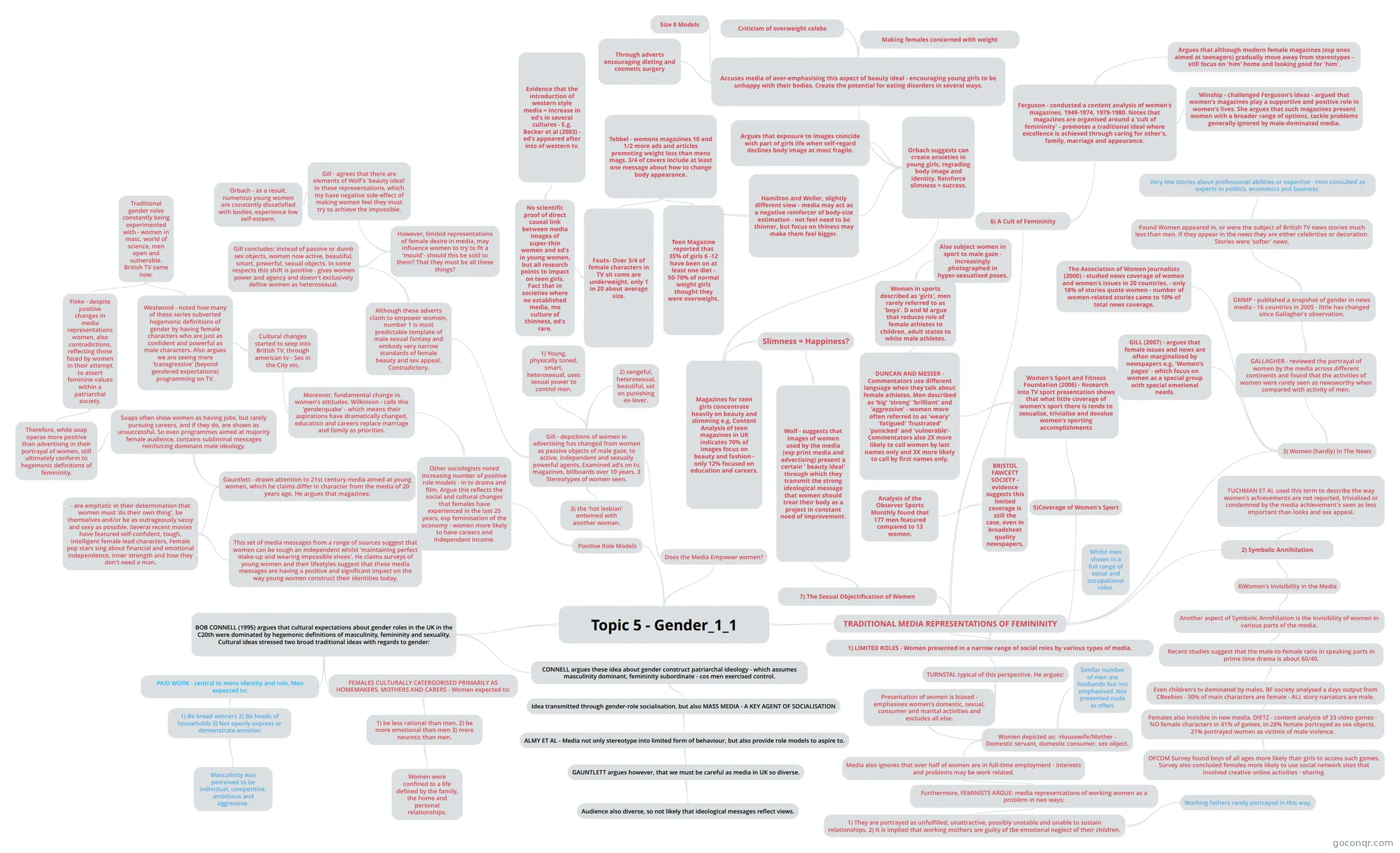
Mind map: Gender Roles and Media Representations in UK
Inhalt der Mindmap
Topic 5 - Gender_1_1
BOB CONNELL (1995) argues that cultural expectations about gender roles in the UK in the C20th were dominated by hegemonic definitions of masculinity, femininity and sexuality. Cultural ideas stressed two broad traditional ideas with regards to gender:
- PAID WORK - central to mens identity and role. Men expected to:
- 1) Be bread winners 2) Be heads of households 3) Not openly express or demonstrate emotion
- Masculinity was perceived to be individual, competitive, ambitious and aggressive.
- 1) Be bread winners 2) Be heads of households 3) Not openly express or demonstrate emotion
- FEMALES CULTURALLY CATERGORISED PRIMARILY AS HOMEMAKERS, MOTHERS AND CARERS - Women expected to:
- 1) be less rational than men. 2) be more emotional than men 3) more neurotic than men.
- Women were confined to a life defined by the family, the home and personal relationships.
- 1) be less rational than men. 2) be more emotional than men 3) more neurotic than men.
- CONNELL argues these idea about gender construct patriarchal ideology - which assumes masculinity dominant, femininity subordinate - cos men exercised control.
- Idea transmitted through gender-role socialisation, but also MASS MEDIA - A KEY AGENT OF SOCIALISATION
- ALMY ET AL - Media not only stereotype into limited form of behaviour, but also provide role models to aspire to.
- GAUNTLETT argues however, that we must be careful as media in UK so diverse.
- Audience also diverse, so not likely that ideological messages reflect views.
- GAUNTLETT argues however, that we must be careful as media in UK so diverse.
- ALMY ET AL - Media not only stereotype into limited form of behaviour, but also provide role models to aspire to.
- Idea transmitted through gender-role socialisation, but also MASS MEDIA - A KEY AGENT OF SOCIALISATION
- PAID WORK - central to mens identity and role. Men expected to:
TRADITIONAL MEDIA REPRESENTATIONS OF FEMININITY
- 1) LIMITED ROLES - Women presented in a narrow range of social roles by various types of media.
- Whilst men shown in a full range of social and occupational roles.
- TURNSTAL typical of this perspective. He argues:
- Presentation of women is biased - emphasises women's domestic, sexual, consumer and marital activities and excludes all else.
- Women depicted as: -Housewife/Mother - Domestic servant, domestic consumer, sex object.
- Similar number of men are husbands but not emphasised. Not presented nude as often.
- Media also ignores that over half of women are in full-time employment - interests and problems may be work related.
- Furthermore, FEMINISTS ARGUE: media representations of working women as a problem in two ways:
- 1) They are portrayed as unfulfilled, unattractive, possibly unstable and unable to sustain relationships. 2) It is implied that working mothers are guilty of tbe emotional neglect of their children.
- Working fathers rarely portrayed in this way.
- 1) They are portrayed as unfulfilled, unattractive, possibly unstable and unable to sustain relationships. 2) It is implied that working mothers are guilty of tbe emotional neglect of their children.
- Furthermore, FEMINISTS ARGUE: media representations of working women as a problem in two ways:
- Women depicted as: -Housewife/Mother - Domestic servant, domestic consumer, sex object.
- Presentation of women is biased - emphasises women's domestic, sexual, consumer and marital activities and excludes all else.
- 2) Symbolic Annihilation
- TUCHMAN ET AL used this term to describe the way women's achievements are not reported, trivialised or condemned by the media achievement's seen as less important than looks and sex appeal.
- 4)Women's Invisibility in the Media
- Another aspect of Symbolic Annihilation is the invisibility of women in various parts of the media.
- Recent studies suggest that the male-to-female ratio in speaking parts in prime time drama is about 60/40.
- Even children's tv dominated by males. BF society analysed a days output from CBeebies - 30% of main characters are female - ALL story narrators are male.
- Females also invisible in new media. DIETZ - content analysis of 33 video games - NO female characters in 41% of games, in 28% female portrayed as sex objects. 21% portrayed women as victims of male violence.
- OFCOM Survey found boys of all ages more likely than girls to access such games. Survey also concluded females more likely to use social network sites that involved creative online activities - sharing.
- Females also invisible in new media. DIETZ - content analysis of 33 video games - NO female characters in 41% of games, in 28% female portrayed as sex objects. 21% portrayed women as victims of male violence.
- Even children's tv dominated by males. BF society analysed a days output from CBeebies - 30% of main characters are female - ALL story narrators are male.
- Recent studies suggest that the male-to-female ratio in speaking parts in prime time drama is about 60/40.
- Another aspect of Symbolic Annihilation is the invisibility of women in various parts of the media.
- 3) Women (hardly) In The News
- GALLAGHER - reviewed the portrayal of women by the media across different continents and found that the activities of women were rarely seen as newsworthy when compared with activity of men.
- GMMP - published a snapshot of gender in news media - 16 countries in 2005 - little has changed since Gallagher's observation.
- Found Women appeared in, or were the subject of British TV news stories much less than men. If they appear in the news they are either celebrities or decoration. Stories were 'softer' news.
- Very few stories about professional abilities or expertise - men consulted as experts in politics, economics and business.
- Found Women appeared in, or were the subject of British TV news stories much less than men. If they appear in the news they are either celebrities or decoration. Stories were 'softer' news.
- GMMP - published a snapshot of gender in news media - 16 countries in 2005 - little has changed since Gallagher's observation.
- The Association of Women Journalists (2000) - studied news coverage of women and women's issues in 20 countries. - only 18% of stories quote women - number of women-related stories came to 10% of total news coverage.
- GILL (2007) - argues that female issues and news are often marginalised by newspapers e.g. 'Women's pages' - which focus on women as a special group with special emotional needs.
- GALLAGHER - reviewed the portrayal of women by the media across different continents and found that the activities of women were rarely seen as newsworthy when compared with activity of men.
- 5)Coverage of Women's Sport
- Women's Sport and Fitness Foundation (2006) - Research into TV sport presentation shows that what little coverage of women's sport there is tends to sexualise, trivialise and devalue women's sporting accomplishments
- BRISTOL FAWCETT SOCIETY - evidence suggests this limited coverage is still the case, even in broadsheet quality newspapers.
- Analysis of the Observer Sports Monthly found that 177 men featured compared to 13 women.
- DUNCAN AND MESSER - Commentators use different language when they talk about female athletes. Men described as 'big' 'strong' 'brilliant' and 'aggressive' - women more often referred to as 'weary' 'fatigued' 'frustrated' 'panicked' and 'vulnerable'- Commentators also 2X more likely to call women by last names only and 3X more likely to call by first names only.
- Women in sports described as 'girls', men rarely referred to as 'boys'. D and M argue that reduces role of female athletes to children, adult states to white male athletes.
- Also subject women in sport to male gaze - increasingly photographed in hyper-sexualised poses.
- Women in sports described as 'girls', men rarely referred to as 'boys'. D and M argue that reduces role of female athletes to children, adult states to white male athletes.
- BRISTOL FAWCETT SOCIETY - evidence suggests this limited coverage is still the case, even in broadsheet quality newspapers.
- Women's Sport and Fitness Foundation (2006) - Research into TV sport presentation shows that what little coverage of women's sport there is tends to sexualise, trivialise and devalue women's sporting accomplishments
- 6) A Cult of Femininity
- Ferguson - conducted a content analysis of women's magazines, 1949-1974, 1979-1980. Notes that magazines are organised around a 'cult of femininity' - promotes a traditional ideal where excellence is achieved through caring for other's, family, marriage and appearance.
- Argues that although modern female magazines (esp ones aimed at teenagers) gradually move away from stereotypes - still focus on 'him' home and looking good for 'him'.
- Winship - challenged Ferguson's ideas - argued that women's magazines play a supportive and positive role in women's lives. She argues that such magazines present women with a broader range of options, tackle problems generally ignored by male-dominated media.
- Ferguson - conducted a content analysis of women's magazines, 1949-1974, 1979-1980. Notes that magazines are organised around a 'cult of femininity' - promotes a traditional ideal where excellence is achieved through caring for other's, family, marriage and appearance.
- 7) The Sexual Objectification of Women
- Wolf - suggests that images of women used by the media (esp print media and advertising) present a certain ' beauty ideal' through which they transmit the strong ideological message that women should treat their body as a project in constant need of improvement.
- Slimness = Happiness?
- Magazines for teen girls concentrate heavily on beauty and slimming e.g. Content Analysis of teen magazines in UK indicates 70% of images focus on beauty and fashion - only 12% focused on education and careers.
- Orbach suggests can create anxieties in young girls, regrading body image and identity. Reinforce slimness = success.
- Accuses media of over-emphasising this aspect of beauty ideal - encouraging young girls to be unhappy with their bodies. Create the potential for eating disorders in several ways.
- Size 0 Models
- Criticism of overweight celebs
- Making females concerned with weight
- Through adverts encouraging dieting and cosmetic surgery
- Argues that exposure to images coincide with part of girls life when self-regard declines body image at most fragile.
- Hamilton and Weller, slightly different view - media may act as a negative reinforcer of body-size estimation - not feel need to be thinner, but focus on thiness may make them feel bigger.
- Teen Magazine reported that 35% of girls 6 -12 have been on at least one diet - 50-70% of normal weight girls thought they were overweight.
- Tebbel - womens magazines 10 and 1/2 more ads and articles promoting weight loss than mens mags. 3/4 of covers include at least one message about how to change body appearance.
- Fouts- Over 3/4 of female characters in TV sit coms are underweight, only 1 in 20 about average size.
- No scientific proof of direct causal link between media images of super-thin women and ed's in young women, but all research points to impact on teen girls. Fact that in societies where no established media, mo culture of thinness, ed's rare.
- Evidence that the introduction of western style media = increase in ed's in several cultures - E.g. Becker et al (2003) - ed's appeared after into of western tv.
- No scientific proof of direct causal link between media images of super-thin women and ed's in young women, but all research points to impact on teen girls. Fact that in societies where no established media, mo culture of thinness, ed's rare.
- Fouts- Over 3/4 of female characters in TV sit coms are underweight, only 1 in 20 about average size.
- Tebbel - womens magazines 10 and 1/2 more ads and articles promoting weight loss than mens mags. 3/4 of covers include at least one message about how to change body appearance.
- Teen Magazine reported that 35% of girls 6 -12 have been on at least one diet - 50-70% of normal weight girls thought they were overweight.
- Accuses media of over-emphasising this aspect of beauty ideal - encouraging young girls to be unhappy with their bodies. Create the potential for eating disorders in several ways.
- Orbach suggests can create anxieties in young girls, regrading body image and identity. Reinforce slimness = success.
- Magazines for teen girls concentrate heavily on beauty and slimming e.g. Content Analysis of teen magazines in UK indicates 70% of images focus on beauty and fashion - only 12% focused on education and careers.
- Slimness = Happiness?
- Wolf - suggests that images of women used by the media (esp print media and advertising) present a certain ' beauty ideal' through which they transmit the strong ideological message that women should treat their body as a project in constant need of improvement.
- 1) LIMITED ROLES - Women presented in a narrow range of social roles by various types of media.
Does the Media Empower women?
- Gill - depictions of women in advertising has changed from women as passive objects of male gaze, to active, independent and sexually powerful agents. Examined ad's on tv, magazines, billboards over 10 years. 3 Stereotypes of women seen.
- 1) Young, physically toned, smart, heterosexual, uses sexual power to control men.
- 2) vengeful, heterosexual, beautiful, set on punishing ex-lover.
- 3) the 'hot lesbian' entwined with another woman.
- Although these adverts claim to empower womwn, number 1 is most predictable template of male sexual fantasy and embody very narrow standards of female beauty and sex appeal. Contradictory.
- Gill concludes: instead of passive or dumb sex objects, women now active, beautiful, smart, powerful, sexual objects. In some respects this shift is positive - gives women power and agency and doesn't exclusively define women as heterosexual.
- However, limited representations of female desire in media, may influence women to try to fit a 'mould'- should this be sold to them? That they must be all these things?
- Gill - agrees that there are elements of Wolf's 'beauty ideal' in these representations, which my have negative side-effect of making women feel they must try to achieve the impossible.
- Orbach - as a result, numerous young women are constantly dissatisfied with bodies, experience low self-esteem.
- Gill - agrees that there are elements of Wolf's 'beauty ideal' in these representations, which my have negative side-effect of making women feel they must try to achieve the impossible.
- However, limited representations of female desire in media, may influence women to try to fit a 'mould'- should this be sold to them? That they must be all these things?
- Gill concludes: instead of passive or dumb sex objects, women now active, beautiful, smart, powerful, sexual objects. In some respects this shift is positive - gives women power and agency and doesn't exclusively define women as heterosexual.
- Gill - depictions of women in advertising has changed from women as passive objects of male gaze, to active, independent and sexually powerful agents. Examined ad's on tv, magazines, billboards over 10 years. 3 Stereotypes of women seen.
Positive Role Models
- Other sociologists noted increasing number of positive role models - in tv drama and film. Argue this reflects the social and cultural changes that females have experienced in the last 25 years, esp feminisation of the economy - women more likely to have careers and independent income.
- Moreover, fundamental change in women's attitudes. Wilkinson - calls this 'genderquake' - which means their aspirations have dramatically changed, education and careers replace marriage and family as priorities.
- Cultural changes started to seep into British TV, through american tv - Sex in the City etc.
- Westwood - noted how many of these series subverted hegemonic definitions of gender by having female characters who are just as confident and powerful as male characters. Also argues we are seeing more 'transgressive' (beyond gendered expectations) programming on TV.
- Traditional gender roles constantly being experimented with - women in masc. world of science, men open and vulnerable. British TV same now.
- Fiske - despite positive changes in media representations women, also contradictions, reflecting those faced by women in their attempt to assert feminine values within a patriarchal society.
- Therefore, while soap operas more positive than advertising in their portrayal of women, still ultimately conform to hegemonic definitions of femininity.
- Soaps often show women as having jobs, but rarely pursuing careers, and if they do, are shown as unsuccessful. So even programmes aimed at majority female audience, contains subliminal messages reinforcing dominant male ideology.
- Gauntlett - drawn attention to 21st century media aimed at young women, which he claims differ in character from the media of 20 years ago. He argues that magazines:
- - are emphatic in their determination that women must 'do their own thing', be themselves and/or be as outrageously sassy and sexy as possible. Several recent movies have featured self-confident, tough, intelligent female lead characters. Female pop stars sing about financial and emotional independence, inner strength and how they don't need a man.
- This set of media messages from a range of sources suggest that women can be tough an independent whilst 'maintaining perfect make-up and wearing impossible shoes'. He claims surveys of young women and their lifestyles suggest that these media messages are having a positive and significant impact on the way young women construct their identities today.
- - are emphatic in their determination that women must 'do their own thing', be themselves and/or be as outrageously sassy and sexy as possible. Several recent movies have featured self-confident, tough, intelligent female lead characters. Female pop stars sing about financial and emotional independence, inner strength and how they don't need a man.
- Gauntlett - drawn attention to 21st century media aimed at young women, which he claims differ in character from the media of 20 years ago. He argues that magazines:
- Soaps often show women as having jobs, but rarely pursuing careers, and if they do, are shown as unsuccessful. So even programmes aimed at majority female audience, contains subliminal messages reinforcing dominant male ideology.
- Therefore, while soap operas more positive than advertising in their portrayal of women, still ultimately conform to hegemonic definitions of femininity.
- Fiske - despite positive changes in media representations women, also contradictions, reflecting those faced by women in their attempt to assert feminine values within a patriarchal society.
- Traditional gender roles constantly being experimented with - women in masc. world of science, men open and vulnerable. British TV same now.
- Westwood - noted how many of these series subverted hegemonic definitions of gender by having female characters who are just as confident and powerful as male characters. Also argues we are seeing more 'transgressive' (beyond gendered expectations) programming on TV.
- Cultural changes started to seep into British TV, through american tv - Sex in the City etc.
- Moreover, fundamental change in women's attitudes. Wilkinson - calls this 'genderquake' - which means their aspirations have dramatically changed, education and careers replace marriage and family as priorities.
- Other sociologists noted increasing number of positive role models - in tv drama and film. Argue this reflects the social and cultural changes that females have experienced in the last 25 years, esp feminisation of the economy - women more likely to have careers and independent income.
Informationen
- Beschreibung
- A-Levels Sociology Mindmap am Topic 5 - Gender_1_1, erstellt von Alice Jane Bloom am 26/05/2015.
- Erstellt von
- Alice Jane Bloom
- Aufrufe
- 0
- Verlauf
-
- Erstellt von Alice Jane Bloom · 26 Mai 2015
- Kopiert von Alice Jane Bloom · 26 Mai 2015
- Kopiert von Alice Jane Bloom · 26 Mai 2015
- Bewertung