
Mindmap
Waves
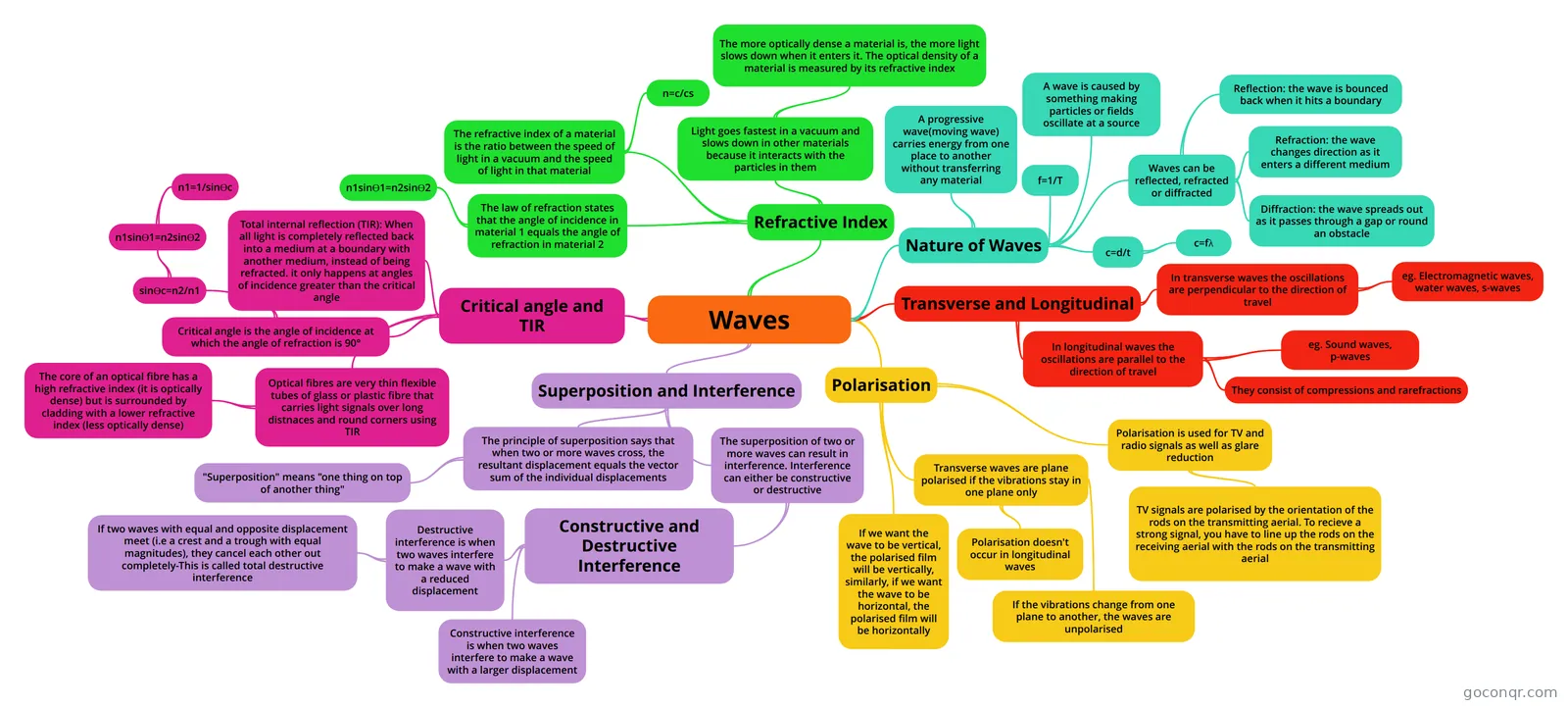
Mind map: Waves physics
Inhalt der Mindmap
Waves
Nature of Waves
- A progressive wave(moving wave) carries energy from one place to another without transferring any material
- A wave is caused by something making particles or fields oscillate at a source
- Waves can be reflected, refracted or diffracted
- Reflection: the wave is bounced back when it hits a boundary
- Refraction: the wave changes direction as it enters a different medium
- Diffraction: the wave spreads out as it passes through a gap or round an obstacle
- f=1/T
- c=d/t
- c=fλ
Transverse and Longitudinal
- In transverse waves the oscillations are perpendicular to the direction of travel
- eg. Electromagnetic waves, water waves, s-waves
- In longitudinal waves the oscillations are parallel to the direction of travel
- eg. Sound waves, p-waves
- They consist of compressions and rarefractions
- In transverse waves the oscillations are perpendicular to the direction of travel
Polarisation
- Transverse waves are plane polarised if the vibrations stay in one plane only
- If the vibrations change from one plane to another, the waves are unpolarised
- Polarisation doesn't occur in longitudinal waves
- If we want the wave to be vertical, the polarised film will be vertically, similarly, if we want the wave to be horizontal, the polarised film will be horizontally
- Polarisation is used for TV and radio signals as well as glare reduction
- TV signals are polarised by the orientation of the rods on the transmitting aerial. To recieve a strong signal, you have to line up the rods on the receiving aerial with the rods on the transmitting aerial
- Transverse waves are plane polarised if the vibrations stay in one plane only
Refractive Index
- The refractive index of a material is the ratio between the speed of light in a vacuum and the speed of light in that material
- n=c/cs
- Light goes fastest in a vacuum and slows down in other materials because it interacts with the particles in them
- The more optically dense a material is, the more light slows down when it enters it. The optical density of a material is measured by its refractive index
- The law of refraction states that the angle of incidence in material 1 equals the angle of refraction in material 2
- n1sinƟ1=n2sinƟ2
- The refractive index of a material is the ratio between the speed of light in a vacuum and the speed of light in that material
Critical angle and TIR
- Total internal reflection (TIR): When all light is completely reflected back into a medium at a boundary with another medium, instead of being refracted. it only happens at angles of incidence greater than the critical angle
- Critical angle is the angle of incidence at which the angle of refraction is 90°
- sinƟc=n2/n1
- n1sinƟ1=n2sinƟ2
- n1=1/sinƟc
- n1sinƟ1=n2sinƟ2
- sinƟc=n2/n1
- Optical fibres are very thin flexible tubes of glass or plastic fibre that carries light signals over long distnaces and round corners using TIR
- The core of an optical fibre has a high refractive index (it is optically dense) but is surrounded by cladding with a lower refractive index (less optically dense)
Superposition and Interference
- The superposition of two or more waves can result in interference. Interference can either be constructive or destructive
- Constructive and Destructive Interference
- Destructive interference is when two waves interfere to make a wave with a reduced displacement
- If two waves with equal and opposite displacement meet (i.e a crest and a trough with equal magnitudes), they cancel each other out completely-This is called total destructive interference
- Constructive interference is when two waves interfere to make a wave with a larger displacement
- Destructive interference is when two waves interfere to make a wave with a reduced displacement
- Constructive and Destructive Interference
- The principle of superposition says that when two or more waves cross, the resultant displacement equals the vector sum of the individual displacements
- "Superposition" means "one thing on top of another thing"
- The superposition of two or more waves can result in interference. Interference can either be constructive or destructive
Informationen
- Beschreibung
- Mindmap am Waves, erstellt von sarahstoddart am 27/05/2015.
- Erstellt von
- sarahstoddart
- Aufrufe
- 0
- Bewertung