
Mindmap
C1 Topic 2
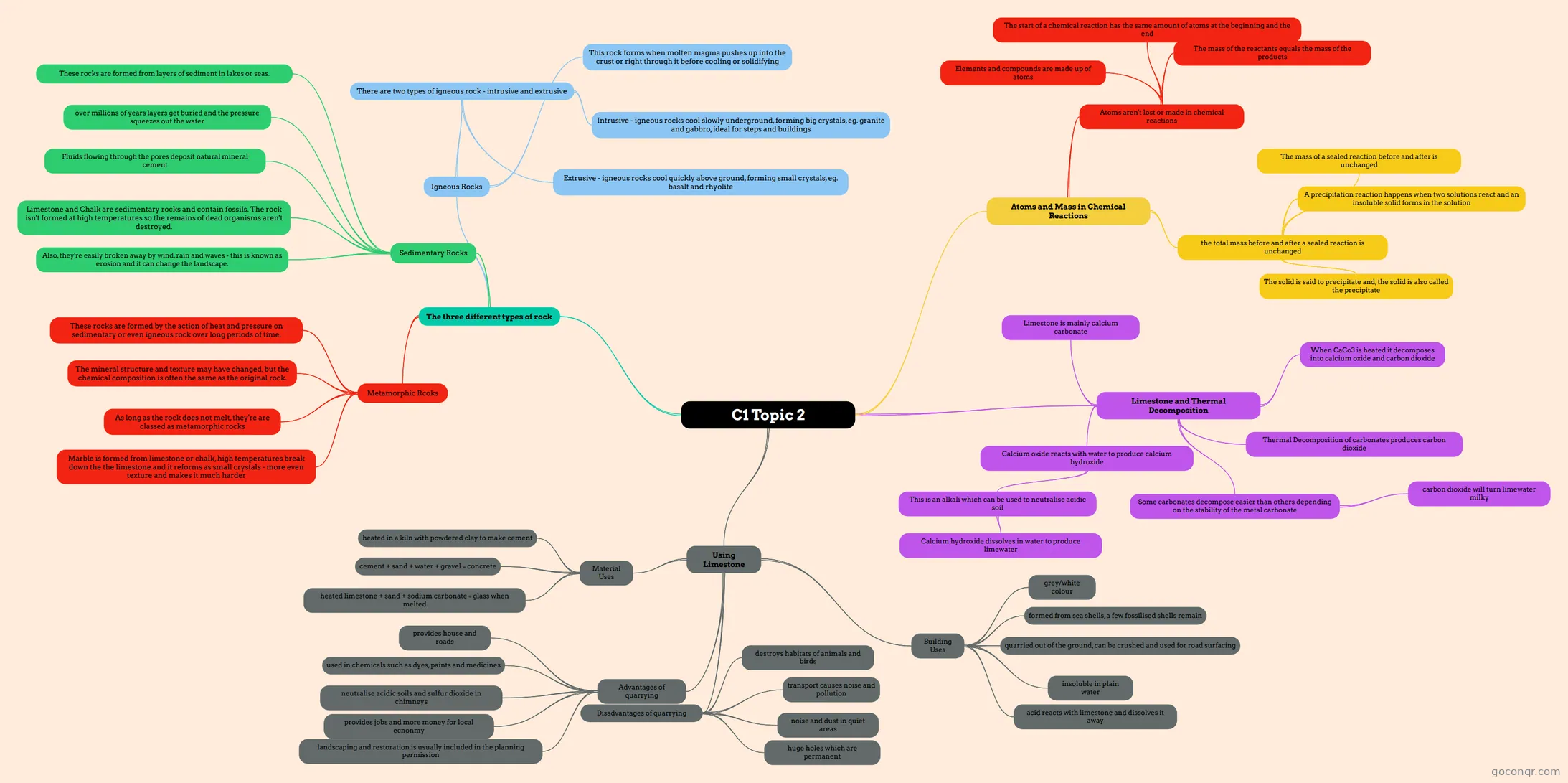
Mind map: C1 topic 2
Inhalt der Mindmap
C1 Topic 2
The three different types of rock
- Sedimentary Rocks
- These rocks are formed from layers of sediment in lakes or seas.
- Limestone and Chalk are sedimentary rocks and contain fossils. The rock isn't formed at high temperatures so the remains of dead organisms aren't destroyed.
- over millions of years layers get buried and the pressure squeezes out the water
- Also, they're easily broken away by wind, rain and waves - this is known as erosion and it can change the landscape.
- Fluids flowing through the pores deposit natural mineral cement
- Metamorphic Rcoks
- These rocks are formed by the action of heat and pressure on sedimentary or even igneous rock over long periods of time.
- The mineral structure and texture may have changed, but the chemical composition is often the same as the original rock.
- As long as the rock does not melt, they're are classed as metamorphic rocks
- Marble is formed from limestone or chalk, high temperatures break down the the limestone and it reforms as small crystals - more even texture and makes it much harder
- Igneous Rocks
- This rock forms when molten magma pushes up into the crust or right through it before cooling or solidifying
- There are two types of igneous rock - intrusive and extrusive
- Extrusive - igneous rocks cool quickly above ground, forming small crystals, eg. basalt and rhyolite
- Intrusive - igneous rocks cool slowly underground, forming big crystals, eg. granite and gabbro, ideal for steps and buildings
- Sedimentary Rocks
Atoms and Mass in Chemical Reactions
- Atoms aren't lost or made in chemical reactions
- Elements and compounds are made up of atoms
- The start of a chemical reaction has the same amount of atoms at the beginning and the end
- The mass of the reactants equals the mass of the products
- the total mass before and after a sealed reaction is unchanged
- The mass of a sealed reaction before and after is unchanged
- A precipitation reaction happens when two solutions react and an insoluble solid forms in the solution
- The solid is said to precipitate and, the solid is also called the precipitate
- Atoms aren't lost or made in chemical reactions
Limestone and Thermal Decomposition
- Limestone is mainly calcium carbonate
- When CaCo3 is heated it decomposes into calcium oxide and carbon dioxide
- Thermal Decomposition of carbonates produces carbon dioxide
- Some carbonates decompose easier than others depending on the stability of the metal carbonate
- carbon dioxide will turn limewater milky
- Calcium oxide reacts with water to produce calcium hydroxide
- This is an alkali which can be used to neutralise acidic soil
- Calcium hydroxide dissolves in water to produce limewater
- This is an alkali which can be used to neutralise acidic soil
Using Limestone
- Building Uses
- grey/white colour
- formed from sea shells, a few fossilised shells remain
- quarried out of the ground, can be crushed and used for road surfacing
- insoluble in plain water
- acid reacts with limestone and dissolves it away
- Material Uses
- heated in a kiln with powdered clay to make cement
- cement + sand + water + gravel = concrete
- heated limestone + sand + sodium carbonate = glass when melted
- Disadvantages of quarrying
- huge holes which are permanent
- noise and dust in quiet areas
- destroys habitats of animals and birds
- transport causes noise and pollution
- Advantages of quarrying
- provides house and roads
- used in chemicals such as dyes, paints and medicines
- neutralise acidic soils and sulfur dioxide in chimneys
- provides jobs and more money for local ecnonmy
- landscaping and restoration is usually included in the planning permission
- Building Uses
Informationen
- Beschreibung
- GCSE Chemistry (C1 Topic 2) Mindmap am C1 Topic 2, erstellt von Abdullah Sohail am 17/10/2015.
- Erstellt von
- Abdullah Sohail
- Aufrufe
- 2
- Bewertung