
Mindmap
2.0 DATABASE DESIGN
Inhalt der Mindmap
2.0 DATABASE DESIGN
2.1 & 2.2 ANSI-SPARC Three Level Architecture (Three Levels Data Abstraction)
- Key Objectives
- Data Abstraction
- Separates user applications from physical database details
- Data Independence
- Allows changes at one level without affecting others
- Data Abstraction
- Keyword characteristics degree of abstraction
- A framework for data modeling based on degrees of data abstraction
- Benefits
- Data Independence
- Improved Security
- Flexibility
- Simplified Maintenance
- What are Those Three Levels?
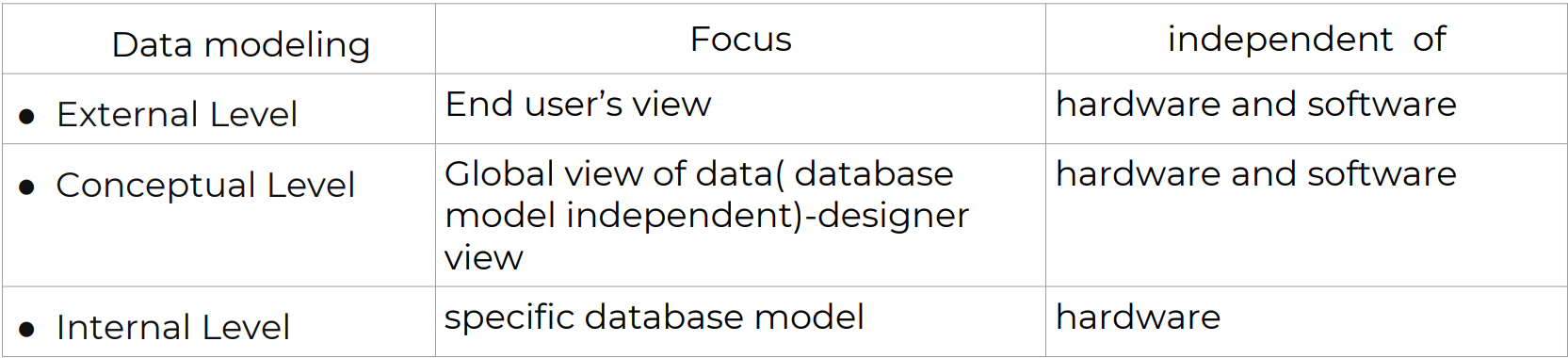
- External Model (USER’S VIEW)
- shows the end users' view of the data
- End users → use apps (Sales, Finance, HR) to get info
- External Schema → user’s way of seeing & accessing relevant data
- End users → use apps (Sales, Finance, HR) to get info
- Key Objectives
- external model
- application programmer’s view of data environment
- external schema
- representation of external view (end user’s perspective)
- external model
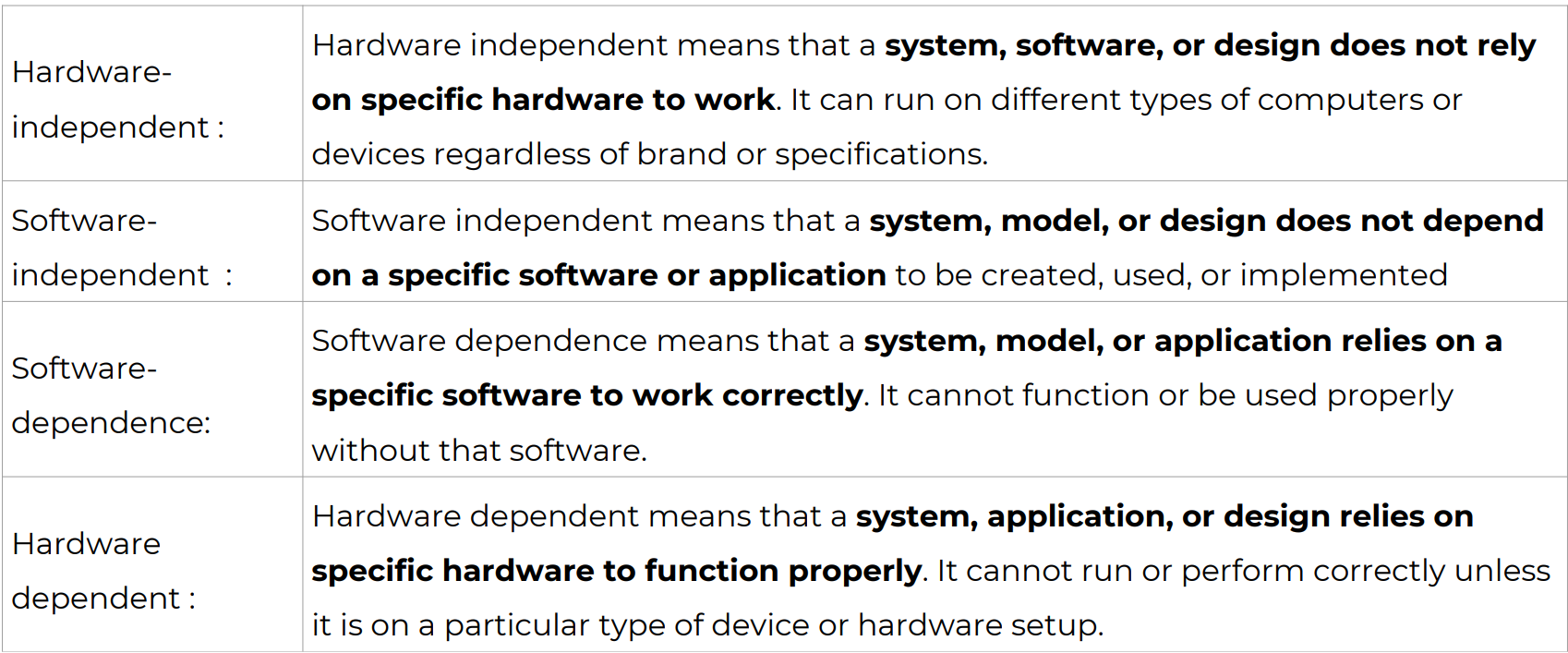
- Independent of
- Hardware
- Software
- Advantages
- User Needs
- Clarifies what data each user needs
- Validation
- Helps designers validate model & processes
- Security
- Improves security → users see only relevant data
- App
- Easier app development tailored to team needs
- User Needs
- shows the end users' view of the data
- Conceptual Model (DESIGNER’S VIEW)
- Shows complete view of entire database (organization-wide
- Combines all external views → entities, relationships, rules, processes
- Common model → Entity-Relationship (ER) Model
- Visual tool → ERD (Entity-Relationship Diagram)
- Common model → Entity-Relationship (ER) Model
- Combines all external views → entities, relationships, rules, processes
- Key Objectives
- Conceptual Model
- result of conceptual design process
- Conceptual Schema
- graphical representation of conceptual model
- Conceptual Model
- Independent of
- Software
- Hardware
- Advantages
- Clear Overview
- Independent from Software and Hardware
- Flexible Design (Logical Design)
- Shows complete view of entire database (organization-wide
- Internal Model (DATABASE ADMINISTRATOR)
- Connects Conceptual Model → DBMS (MySQL, Oracle, etc.)
- Must follow rules of DBMS + Conceptual Model
- Logical Independence → change DBMS/storage without altering conceptual model
- Internal Schema → shows how data is stored (using DBMS tools/features)
- Logical Independence → change DBMS/storage without altering conceptual model
- Must follow rules of DBMS + Conceptual Model
- Independent of
- Hardware
- Key Objectives
- Internal Model
- adapts conceptual model to specific DBMS
- Internal Schema
- representation using DBMS constructs
- Logical Independence
- hardware-independent (not affected by storage/OS changes)
- Internal Model
- Advantages
- Data Integrity & Consistency
- Security & Access Control
- Performance Optimization
- Physical Data Independence
- Efficient Storage Management
- Connects Conceptual Model → DBMS (MySQL, Oracle, etc.)
- External Model (USER’S VIEW)
- Key Objectives
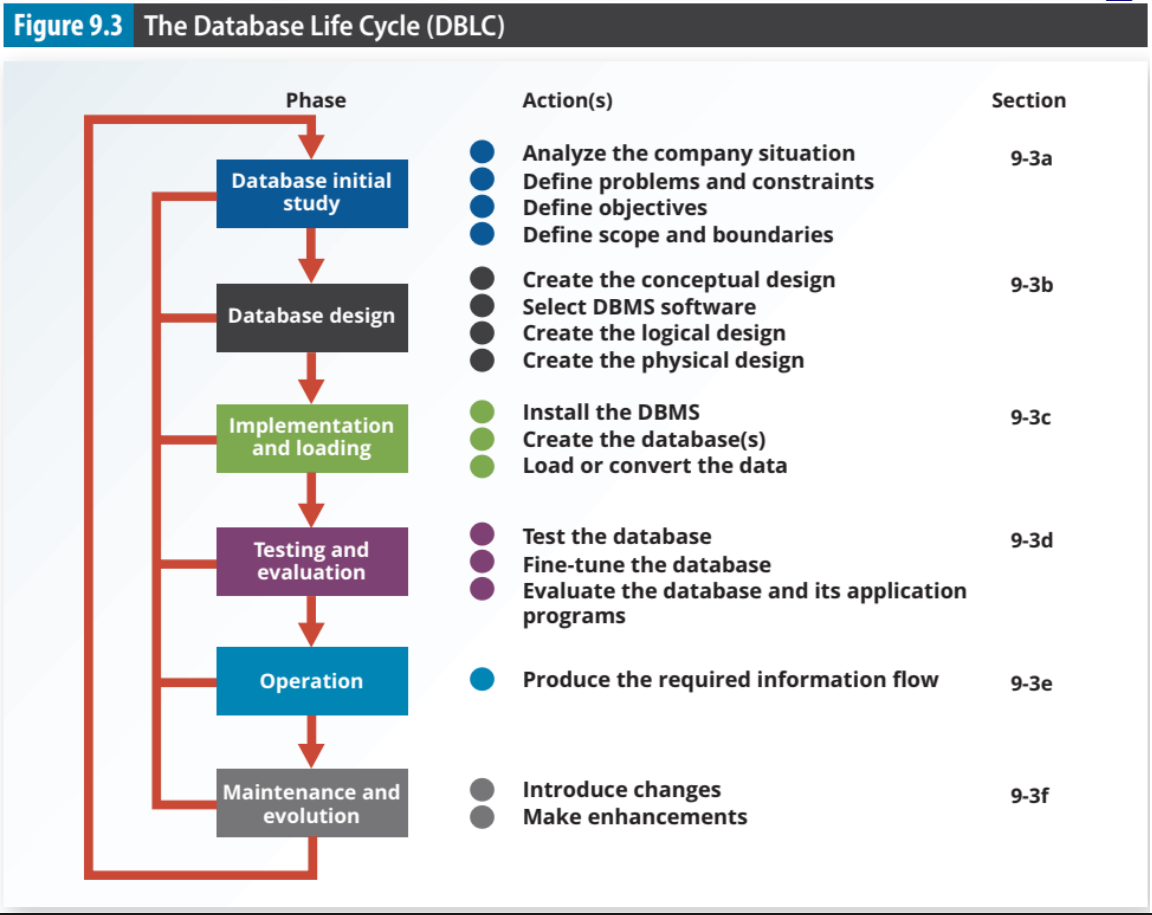
2.3 & 2.4 Database Life Cycle (DBLC)
- Phase
- Phase 1 : Database initial study
- Analyze the company situation
- Define problems and constraints
- Define objectives
- Define scope and boundaries
- Phase 2 : Database design
- Create conceptual design
- DBMS Software selection
- Create logical design
- Create Physical design
- Phase 3 : Implementation and Loading
- Install the DBMS
- Create the Database(s)
- Load or Convert the Data
- Phase 5 : Operation
- Produce the required information flow
- Phase 4 : Testing and evaluation
- Test the database
- Fine-tuning the database
- Evaluate the Database and Its Application Programs
- Phase 6 : Maintenance and Evolution
- Introduce Changes
- Make enhancements
- Phase 1 : Database initial study
- Phase
2.5 Database Language and Data Model
- Database Language
- What is database language?
- Enables users to:
- Create & manage database structures
- Manipulate data → add, delete, modify
- Execute queries → transform raw data → useful information
- Enables users to:
- What is database language?
- Data Modeling and Data Model
- Data Model
- defines how data is structured, stored, and manipulated within a database
- Importances
- Enhances Organizational Understanding
- Provides a Common Vision
- Clarifies Data Usage Across Roles
- Guides Application Development
- Facilitates Communication
- Ensures a Holistic View of Data
- Supports Better Decision-Making
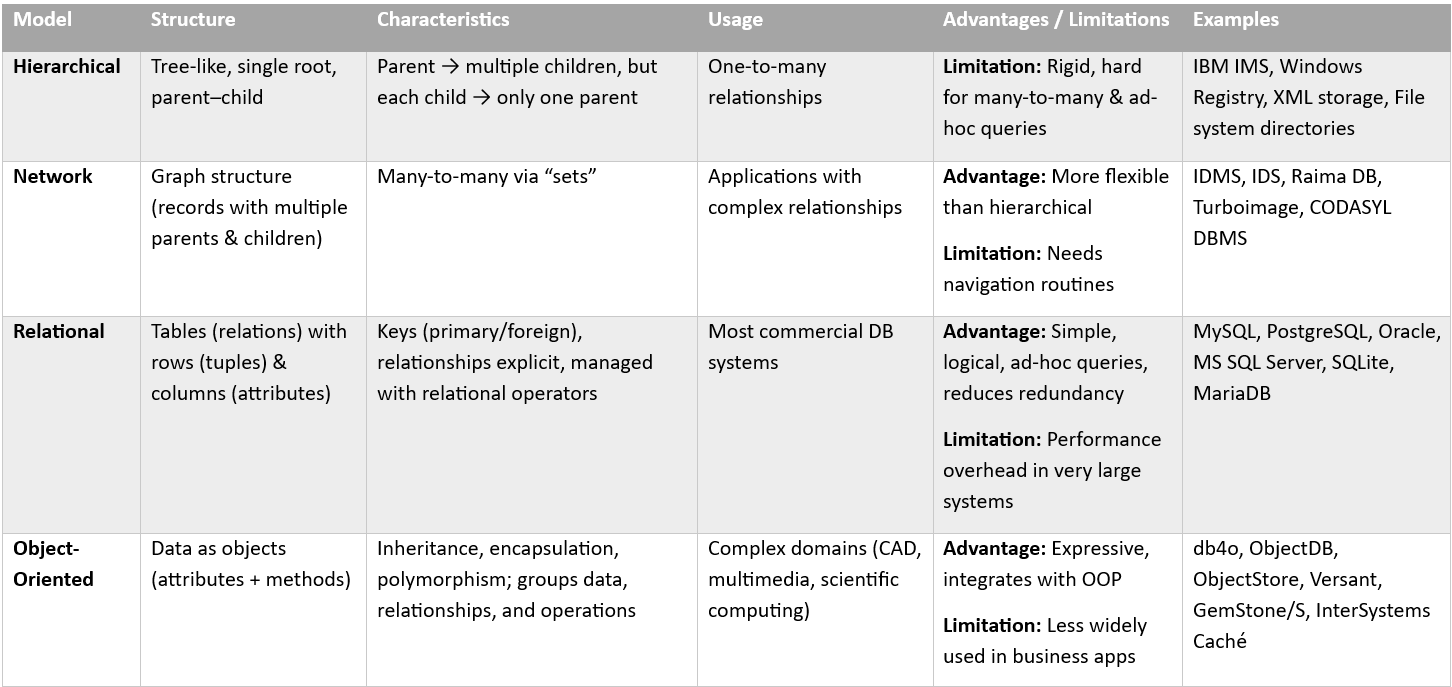
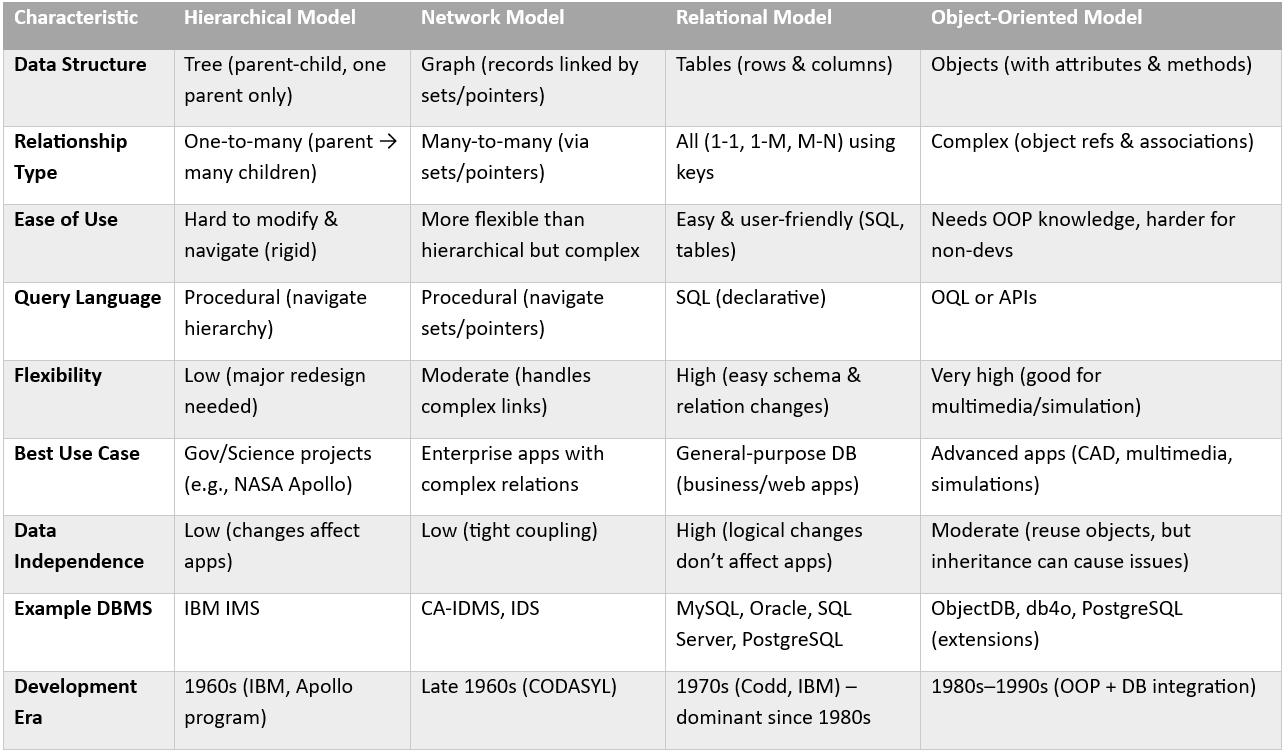
- Types
- Differentiate Data Model
- Basic Building Blocks
- entities
- a person, place, thing, concept, or event about which data will be collected and stored
- attributes
- An attribute is a characteristic of an entity or object
- relationships
- is an association between entities
- One-to-many (1 : M)
- Many-to-many (M:N)
- One-to-one (1 : 1)
- is an association between entities
- constraints
- is a restriction placed on the data
- to ensure data integrity
- help to enforce business rules in the database design
- normally expressed in the form of rules
- entities
- Data Modelling
- Process of creating a specific data model
- Based on a problem domain → defined real-world area with clear scope & boundaries
- Process of creating a specific data model
- Data Model
- Database Language
Bilder und Dateien der Mindmap
Informationen
- Beschreibung
- Information Technology Mindmap am 2.0 DATABASE DESIGN, erstellt von AMIR MUJAHID am 10/09/2025.
- Erstellt von
- AMIR MUJAHID
- Aufrufe
- 1
- Bewertung