
Mindmap
Electron Structure
Inhalt der Mindmap
Electron Structure
Energy levels/ Quantum shells
- Principle Quantum number
- Describes the position of the shell in the atom.
- The larger the principle quantum number is the further away it is from the nucleus,
- 1n
- Energy level - 1
- Maximum number of electrons - 2
- 2n
- Energy level - 2
- Maximum number of electrons - 8
- 3n
- Energy level - 3
- Maximum number of electrons- 18
- 4n
- Energy level - 4
- Maximum number of electrons - 32
- Principle Quantum number
Orbitals and Subshells
- S-Subshell
- Spherical shape
- Has just 1 orbital
- Holds up to 2 electrons
- P-Subshell
- Consists of 3 orbitals
- Orbitals are dumbbell shaped
- Holds up to 6 electrons
- Consists of 3 orbitals
- D-Subshell
- Consists of 5 orbitals
- Complex shape
- Holds up to 10 electrons
- F-Orbitals
- Complex shape
- Consists of 7 orbitals
- Holds up to 14 electrons
- Definition: An atomic orbital is the volume of space within an atom that can hold up to 2 electrons with opposite spins
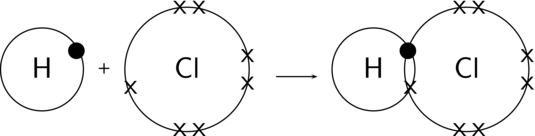
- Key definition: A covalent bond is the strong electrostatic attraction between a shared pair of electrons and the nuclei of the bonded atom
- Key definition: A dative bond is a bond where the shared pair of electrons has been donated by the same atom
- The ammonium ion contains a dative bond
- The oxonium ion contains a dative bond
- Definition: A simple covalent lattice is a 3-d structure of molecules bonded together by weak IMF
- Definition: A giant Covalent lattice is a 3d lattice structure of atoms bonded together by strong covalent bonds
- Key definition: A dative bond is a bond where the shared pair of electrons has been donated by the same atom
- Key definition: A covalent bond is the strong electrostatic attraction between a shared pair of electrons and the nuclei of the bonded atom
- S-Subshell
Periodic table
- Arranged based on the reactivity and properties of elements
- Reactivity is dependent on outer shell electrons
- Can be divided into blocks depending on which subshell contains the outermost electron
- Group 1 and 2 are the S-block
- The transition metals are the D-block
- Group 3 to 0 are the P-block
- Arranged based on the reactivity and properties of elements
Box diagrams
- As orbitals have varying shapes they are often represented as boxes
- Each box can hold up to 2 electrons which are represented as arrows
- ^ l l v
- ^ l
- ^ l
- ^ l
- ^ l l v
- 1) Electrons should be added one at a time 2) the lowest available energy level is to be filled first 3) Each energy level must be filled before the higher energy level is filled 4)When a subtle is filled up with electrons each orbital is filled singularly before pairing starts 5) An orbital can hold up to 2 electrons, each with opposite spins.
Electron configurations
- s
- 1
- Number of electrons in subshell
- 1
- Principle Quantum Number
- Sub-shell type
- 1
- s
Bonding
- Metallic
- positively charged ions held together by a sea of delocalised electrons
- Properties
- Conducts electricity
- delocalised electrons free to move and carry the charge
- Insoluble in water
- No interactions with water molecules
- Variable melting and boiling points
- the more positive the ion the more it attracts the electrons the higher the melting point
- Conducts electricity
- Covalent
- Simple molecular structures
- Molecules held together by weak IMF
- Atoms bonded by strong covalent bonds
- Properties
- Low melting and boiling points
- Weak IMFS need little energy to overcome
- Not conductors of electricity
- Soluble only in non polar substances
- Forces between solvent and covalent molecule weaken lattice and it dissolves
- Low melting and boiling points
- Macromolecules
- Millions of atoms bonded by millions of strong covalent bods
- Properties
- High melting and boiling point
- Strong covalent bonds need a lot of energy to overcome
- Non-soluble
- No interaction between water molecules
- Conductivity?
- Only graphite (delocalised e- move through and carry the charge)
- High melting and boiling point
- Simple molecular structures
- Ionic
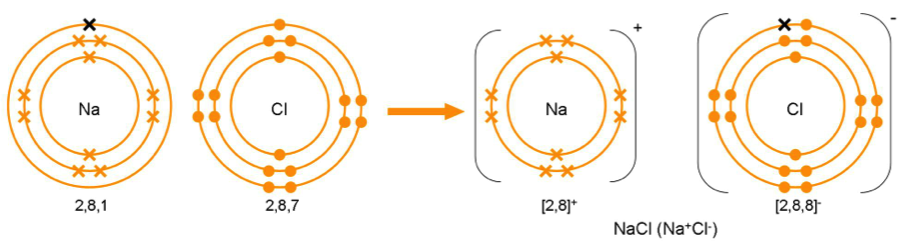
- Definition: Ionic bonding is the electrostatic force of attraction between positive and negative ions
- Takes place between metals and non-metals
- Metal forms a positive ion by losing electrons
- Cations
- Non-metal forms a negative ion by gaining electrons
- Anions
- Attraction between ions depends on, Charge and Size
- The larger the charge the larger the force of attraction
- The smaller the atom the larger the force of attraction
- Metal forms a positive ion by losing electrons
- In exam only the 2nd half of this diagram is needed
- Metal ion should always have an empty outer shell (this isn't shown on this diagram)
- Structure
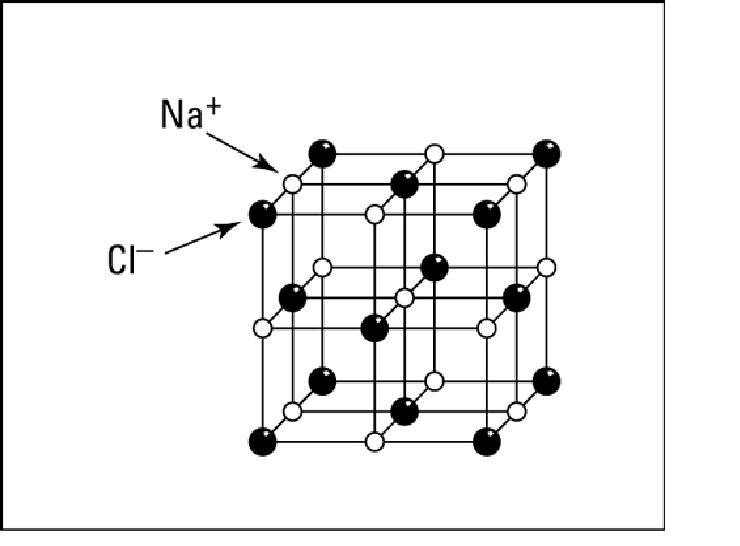
- Ionic compounds form Giant ionic lattices
- Each Cl ion is surrounded by 6 Na ions and vice versa
- 6:6 Cordination
- Each ion is attracted by the oppositely charged ions surrounding it
- Only draw the outer shell
- Only the final diagram needs to be drawn in an exam
- Double and triple covalent bonds are also possible
- Each Cl ion is surrounded by 6 Na ions and vice versa
- Properties
- High melting and boiling points
- Solid at RT
- Large amounts of energy are required to overcome the strong electrostatic forces between ions
- Conducts electricity IN SOLUTION
- When solid ions are in fixed positions and can't move through the structure therefore cannot carry the charge
- When in solution the lattice has been broken down so the ions are free to move and carry the current
- When solid ions are in fixed positions and can't move through the structure therefore cannot carry the charge
- Soluble in water
- Polar water molecules break down lattice by surrounding each ion by water molecules forming a solution
- High melting and boiling points
- Metallic
Bilder und Dateien der Mindmap
Informationen
- Beschreibung
- AS - Level Chemistry Mindmap am Electron Structure, erstellt von Alice Butterworth am 09/01/2016.
- Erstellt von
- Alice Butterworth
- Aufrufe
- 6
- Bewertung