
Mindmap
Special Senses
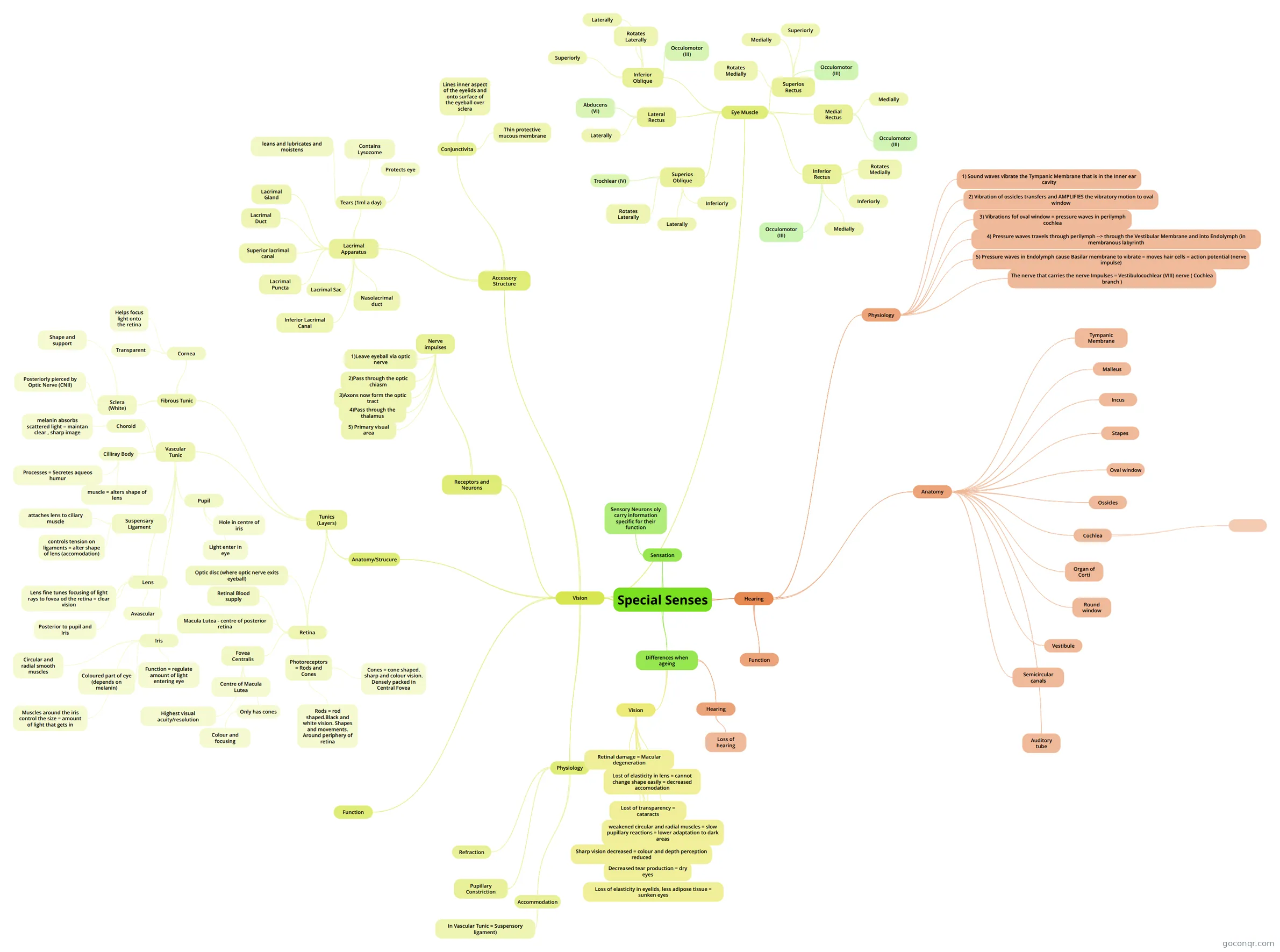
Mind map: Special senses
Inhalt der Mindmap
Special Senses
Vision
- Function
- Accessory Structure
- Conjunctivita
- Thin protective mucous membrane
- Lines inner aspect of the eyelids and onto surface of the eyeball over sclera
- Lacrimal Apparatus
- Lacrimal Gland
- Lacrimal Duct
- Lacrimal Puncta
- Lacrimal Sac
- Inferior Lacrimal Canal
- Nasolacrimal duct
- Superior lacrimal canal
- Tears (1ml a day)
- Contains Lysozome
- Protects eye
- leans and lubricates and moistens
- Conjunctivita
- Eye Muscle
- Superios Rectus
- Superiorly
- Medially
- Rotates Medially
- Occulomotor (III)
- Medial Rectus
- Medially
- Occulomotor (III)
- Superios Oblique
- Inferiorly
- Laterally
- Rotates Laterally
- Trochlear (IV)
- Lateral Rectus
- Laterally
- Abducens (VI)
- Inferior Rectus
- Inferiorly
- Medially
- Rotates Medially
- Occulomotor (III)
- Inferior Oblique
- Superiorly
- Laterally
- Rotates Laterally
- Occulomotor (III)
- Superios Rectus
- Anatomy/Strucure
- Tunics (Layers)
- Fibrous Tunic
- Cornea
- Transparent
- Helps focus light onto the retina
- Sclera (White)
- Shape and support
- Posteriorly pierced by Optic Nerve (CNII)
- Cornea
- Vascular Tunic
- Choroid
- melanin absorbs scattered light = maintan clear , sharp image
- Cilliray Body
- Processes = Secretes aqueos humur
- muscle = alters shape of lens
- Suspensary Ligament
- attaches lens to ciliary muscle
- controls tension on ligaments = alter shape of lens (accomodation)
- Lens
- Avascular
- Posterior to pupil and Iris
- Lens fine tunes focusing of light rays to fovea od the retina = clear vision
- Iris
- Coloured part of eye (depends on melanin)
- Circular and radial smooth muscles
- Function = regulate amount of light entering eye
- Muscles around the iris control the size = amount of light that gets in
- Pupil
- Hole in centre of iris
- Light enter in eye
- Choroid
- Retina
- Photoreceptors = Rods and Cones
- Rods = rod shaped.Black and white vision. Shapes and movements. Around periphery of retina
- Cones = cone shaped. sharp and colour vision. Densely packed in Central Fovea
- Optic disc (where optic nerve exits eyeball)
- Retinal Blood supply
- Macula Lutea - centre of posterior retina
- Fovea Centralis
- Centre of Macula Lutea
- Highest visual acuity/resolution
- Only has cones
- Colour and focusing
- Photoreceptors = Rods and Cones
- Fibrous Tunic
- Tunics (Layers)
- Physiology
- Refraction
- Accommodation
- In Vascular Tunic = Suspensory ligament)
- Pupillary Constriction
- Receptors and Neurons
- Nerve impulses
- 1)Leave eyeball via optic nerve
- 2)Pass through the optic chiasm
- 3)Axons now form the optic tract
- 4)Pass through the thalamus
- 5) Primary visual area
- Nerve impulses
Hearing
- Function
- Anatomy
- Tympanic Membrane
- Round window
- Malleus
- Incus
- Stapes
- Oval window
- Ossicles
- Cochlea
- Organ of Corti
- Vestibule
- Semicircular canals
- Auditory tube
- Physiology
- 1) Sound waves vibrate the Tympanic Membrane that is in the Inner ear cavity
- 2) Vibration of ossicles transfers and AMPLIFIES the vibratory motion to oval window
- 3) Vibrations fof oval window = pressure waves in perilymph cochlea
- 4) Pressure waves travels through perilymph --> through the Vestibular Membrane and into Endolymph (in membranous labyrinth
- 5) Pressure waves in Endolymph cause Basilar membrane to vibrate = moves hair cells = action potential (nerve impulse)
- The nerve that carries the nerve Impulses = Vestibulocochlear (VIII) nerve ( Cochlea branch )
Differences when ageing
- Vision
- Lost of elasticity in lens = cannot change shape easily = decreased accomodation
- Lost of transparency = cataracts
- weakened circular and radial muscles = slow pupillary reactions = lower adaptation to dark areas
- Sharp vision decreased = colour and depth perception reduced
- Retinal damage = Macular degeneration
- Decreased tear production = dry eyes
- Loss of elasticity in eyelids, less adipose tissue = sunken eyes
- Hearing
- Loss of hearing
- Vision
Sensation
- Sensory Neurons oly carry information specific for their function
Informationen
- Beschreibung
- About the eye and its muscles and the neurons = vision . also about hearing and the anatomy of the eras.
- Erstellt von
- gregory daniels
- Aufrufe
- 11
- Tags
- Verlauf
-
- Erstellt von Addeana · 31 Jan 2016
- Kopiert von gregory daniels · 31 Jan 2016
- Bewertung