
Mindmap
Flooding
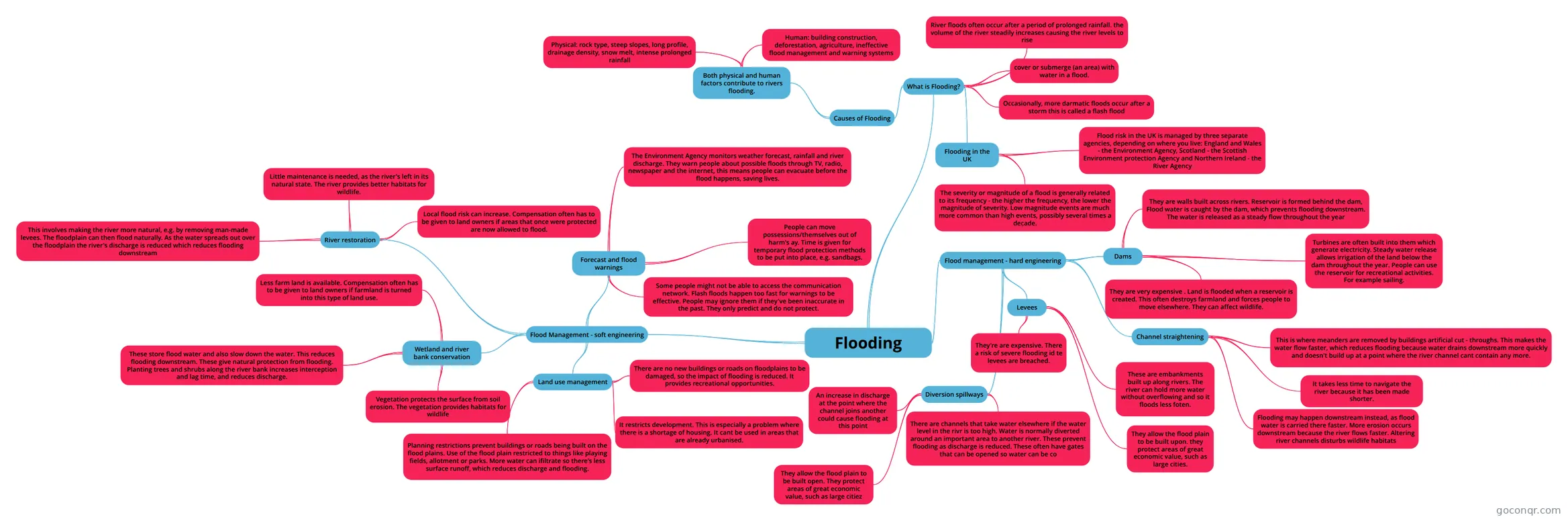
Mind map: Flooding
Inhalt der Mindmap
Flooding
What is Flooding?
- cover or submerge (an area) with water in a flood.
- River floods often occur after a period of prolonged rainfall. the volume of the river steadily increases causing the river levels to rise
- Occasionally, more darmatic floods occur after a storm this is called a flash flood
- Causes of Flooding
- Both physical and human factors contribute to rivers flooding.
- Physical: rock type, steep slopes, long profile, drainage density, snow melt, intense prolonged rainfall
- Human: building construction, deforestation, agriculture, ineffective flood management and warning systems
- Both physical and human factors contribute to rivers flooding.
- Flooding in the UK
- Flood risk in the UK is managed by three separate agencies, depending on where you live: England and Wales - the Environment Agency, Scotland - the Scottish Environment protection Agency and Northern Ireland - the River Agency
- The severity or magnitude of a flood is generally related to its frequency - the higher the frequency, the lower the magnitude of severity. Low magnitude events are much more common than high events, possibly several times a decade.
Flood Management - soft engineering
- Land use management
- Planning restrictions prevent buildings or roads being built on the flood plains. Use of the flood plain restricted to things like playing fields, allotment or parks. More water can ifiltrate so there's less surface runoff, which reduces discharge and flooding.
- There are no new buildings or roads on floodplains to be damaged, so the impact of flooding is reduced. It provides recreational opportunities.
- It restricts development. This is especially a problem where there is a shortage of housing. It cant be used in areas that are already urbanised.
- River restoration
- This involves making the river more natural, e.g. by removing man-made levees. The floodplain can then flood naturally. As the water spreads out over the floodplain the river's discharge is reduced which reduces flooding downstream
- Little maintenance is needed, as the river's left in its natural state. The river provides better habitats for wildlife.
- Local flood risk can increase. Compensation often has to be given to land owners if areas that once were protected are now allowed to flood.
- Forecast and flood warnings
- The Environment Agency monitors weather forecast, rainfall and river discharge. They warn people about possible floods through TV, radio, newspaper and the internet, this means people can evacuate before the flood happens, saving lives.
- People can move possessions/themselves out of harm's ay. Time is given for temporary flood protection methods to be put into place, e.g. sandbags.
- Some people might not be able to access the communication network. Flash floods happen too fast for warnings to be effective. People may ignore them if they've been inaccurate in the past. They only predict and do not protect.
- Wetland and river bank conservation
- These store flood water and also slow down the water. This reduces flooding downstream. These give natural protection from flooding. Planting trees and shrubs along the river bank increases interception and lag time, and reduces discharge.
- Vegetation protects the surface from soil erosion. The vegetation provides habitats for wildlife
- Less farm land is available. Compensation often has to be given to land owners if farmland is turned into this type of land use.
- Land use management
Flood management - hard engineering
- Diversion spillways
- An increase in discharge at the point where the channel joins another could cause flooding at this point
- There are channels that take water elsewhere if the water level in the rivr is too high. Water is normally diverted around an important area to another river. These prevent flooding as discharge is reduced. These often have gates that can be opened so water can be co
- They allow the flood plain to be built open. They protect areas of great economic value, such as large citiez
- Dams
- They are walls built across rivers. Reservoir is formed behind the dam, Flood water is caught by the dam, which prevents flooding downstream. The water is released as a steady flow throughout the year
- Turbines are often built into them which generate electricity. Steady water release allows irrigation of the land below the dam throughout the year. People can use the reservoir for recreational activities. For example sailing.
- They are very expensive . Land is flooded when a reservoir is created. This often destroys farmland and forces people to move elsewhere. They can affect wildlife.
- Channel straightening
- This is where meanders are removed by buildings artificial cut - throughs. This makes the water flow faster, which reduces flooding because water drains downstream more quickly and doesn't build up at a point where the river channel cant contain any more.
- It takes less time to navigate the river because it has been made shorter.
- Flooding may happen downstream instead, as flood water is carried there faster. More erosion occurs downstream because the river flows faster. Altering river channels disturbs wildlife habitats
- Levees
- They're are expensive. There a risk of severe flooding id te levees are breached.
- These are embankments built up along rivers. The river can hold more water without overflowing and so it floods less foten.
- They allow the flood plain to be built upon. they protect areas of great economic value, such as large cities.
- Diversion spillways
Informationen
- Beschreibung
- Mindmap am Flooding, erstellt von Emily Smith am 22/02/2016.
- Erstellt von
- Emily Smith
- Aufrufe
- 0
- Bewertung
Mehr zu Flood and River Management