Mindmap
Phobias
Inhalt der Mindmap
Phobias
Emotional: excessive fear, anxiert and pain cued by specific thing
Behavioural approach to explaining:
- Two process model:
- Classical conditioning - Phobias acquired through association of NS and UCR: NS because CS
- Key Study: Little Albert (Watson and Rayner) developed fear of white rat through bang, which generalised white fluffy objects
- Operant conditioning - Phobias maintained through negative reinforcement
- Social learning - phobia behaviour modelled by others
- Classical conditioning - Phobias acquired through association of NS and UCR: NS because CS
- - Some may report specific incident but others may not (CC) Social learning, fear response acquired through observing reaction to a buzzer (Bandura and Rosenthal)
- Two process model:
Behavioural: avoidance, faint or free
Cognitive: not helped by rational argument, unreasonableness of behaviour recognised
Behavioural approach to treating:
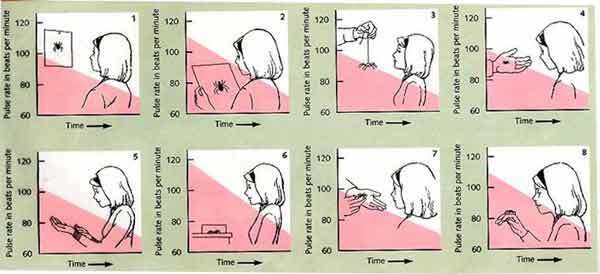
- Systematic de-sensitisation (SD)
- Counterconditioning - phobic stimulus associated with new response of relaxation
- Reciprocal inhibition - relaxation inhibits the anxiety (Wolpe)
- Relaxation - deep breathing, focusing on peaceful scene, progressive muscle relexation
- Desensitisation hierarchy - from least to most fearful, relaxation practised at every step
- + 75% effective (McGrath et al) - Not all phobias work less well for ancient fears (Ohman et al)
- Flooding
- One long session with the most fearful stimulus
- Continues until anxiety subsides
- Can be in vivo or vertical reality
- - Individual differences + may be more effective than SD and quicker (Choy et al)
- Systematic de-sensitisation (SD)