
Mindmap
B2 - POLLUTION
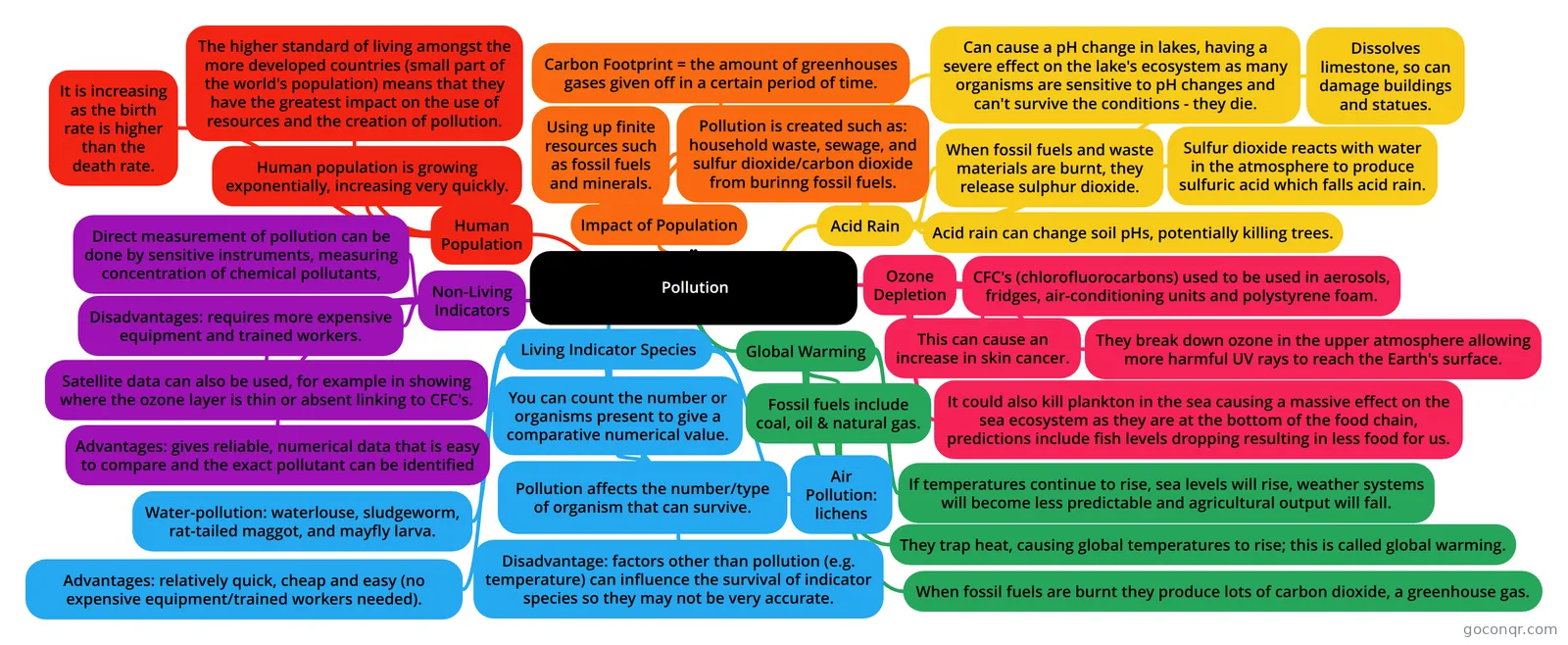
Mind map: Pollution
Inhalt der Mindmap
B2 - POLLUTION
Pollution
- Human Population
- Human population is growing exponentially, increasing very quickly.
- The higher standard of living amongst the more developed countries (small part of the world's population) means that they have the greatest impact on the use of resources and the creation of pollution.
- It is increasing as the birth rate is higher than the death rate.
- Impact of Population
- Using up finite resources such as fossil fuels and minerals.
- Pollution is created such as: household waste, sewage, and sulfur dioxide/carbon dioxide from burinng fossil fuels.
- Carbon Footprint = the amount of greenhouses gases given off in a certain period of time.
- Acid Rain
- When fossil fuels and waste materials are burnt, they release sulphur dioxide.
- Sulfur dioxide reacts with water in the atmosphere to produce sulfuric acid which falls acid rain.
- Acid rain can change soil pHs, potentially killing trees.
- Dissolves limestone, so can damage buildings and statues.
- Can cause a pH change in lakes, having a severe effect on the lake's ecosystem as many organisms are sensitive to pH changes and can't survive the conditions - they die.
- Ozone Depletion
- CFC's (chlorofluorocarbons) used to be used in aerosols, fridges, air-conditioning units and polystyrene foam.
- They break down ozone in the upper atmosphere allowing more harmful UV rays to reach the Earth's surface.
- This can cause an increase in skin cancer.
- It could also kill plankton in the sea causing a massive effect on the sea ecosystem as they are at the bottom of the food chain, predictions include fish levels dropping resulting in less food for us.
- Global Warming
- Fossil fuels include coal, oil & natural gas.
- When fossil fuels are burnt they produce lots of carbon dioxide, a greenhouse gas.
- They trap heat, causing global temperatures to rise; this is called global warming.
- If temperatures continue to rise, sea levels will rise, weather systems will become less predictable and agricultural output will fall.
- Fossil fuels include coal, oil & natural gas.
- Living Indicator Species
- Pollution affects the number/type of organism that can survive.
- You can count the number or organisms present to give a comparative numerical value.
- Water-pollution: waterlouse, sludgeworm, rat-tailed maggot, and mayfly larva.
- Air Pollution: lichens
- Advantages: relatively quick, cheap and easy (no expensive equipment/trained workers needed).
- Disadvantage: factors other than pollution (e.g. temperature) can influence the survival of indicator species so they may not be very accurate.
- Pollution affects the number/type of organism that can survive.
- Non-Living Indicators
- Direct measurement of pollution can be done by sensitive instruments, measuring concentration of chemical pollutants,
- Satellite data can also be used, for example in showing where the ozone layer is thin or absent linking to CFC's.
- Advantages: gives reliable, numerical data that is easy to compare and the exact pollutant can be identified
- Disadvantages: requires more expensive equipment and trained workers.
- Human Population
Informationen
- Beschreibung
- GCSE Biology Mindmap am B2 - POLLUTION, erstellt von Rebecca Pinnock am 18/05/2016.
- Erstellt von
- Rebecca Pinnock
- Aufrufe
- 3
- Bewertung