
Mindmap
Secondary Language Acquisition Theories

Inhalt der Mindmap
Secondary Language Acquisition Theories
Interaction Hypothesis
- Michael Long
- The development of language proficiency is promoted by face-to-face interaction and communication.
- Children Learn developmental language skills through interaction with cargivers
Socio cultural Theory
- Wertsch theory based on the work of Lev Vygotsky
- Human mental function, including language acquisition,is the result of participating in culturally integrated social activities.
- Children develop language skills as a result of interaction between peers through socialization. Putting children in peer social settings will enhance their language skills
Universal Grammar
- Noam Chomsky
- All languages share the same grammatical features that build cognition of that language. It is how the language utilizes grammar that makes it unique.
- Teaching second languages can benefit from the similarities in structure of the language itself when compared to the second language.
Input Hypothesis
- Stephen Krasher
- Language Acquisition takes place when learners receive input just beyond their current level of 2nd language comptence, however there must be some comprehensible input for learning to take place.
- Transfer of new language components only make sense if there is some relatability between the two languages. Using a common visual aid can help with the concept between two languages.
Acquisition Learning Hypothesis
- Stephen Krasher
- 2nd language is a subconscious process of incidentally picking up a language. This is different than learning a 1st language which involves a conscious and intentional process.
- Teachers must identify how language is being picked up and provide structure for learners to apply rules.
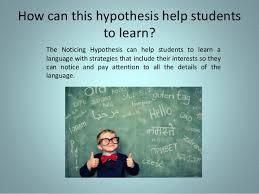
Noticing Hypothesis
- Richard Schmidt
- Learners notice the ways in which their language structure differs in syntax from the 2nd language. The noticing of these gaps forces the learner to process the differences and apply the rules that they know to the 2nd language.
Semantics
- Acquisition of meaning is more important than sounds or sentence structure. Meanings are broken into 4 categories: lexical, grammatical, semantic, and pragmatic. Each meaning contribution affects second language development.
- The semantics of languages can be an obstacle to second language learners. By immersing semantic interpretations into lessons, we may help with the learning process.
Bilder und Dateien der Mindmap




Informationen
- Beschreibung
- Mind map of Secondary Language Acquisition Theories and Class room implications
- Erstellt von
- Bill Knudsen
- Aufrufe
- 92
- Tags
- Bewertung