
Mindmap
Deontology
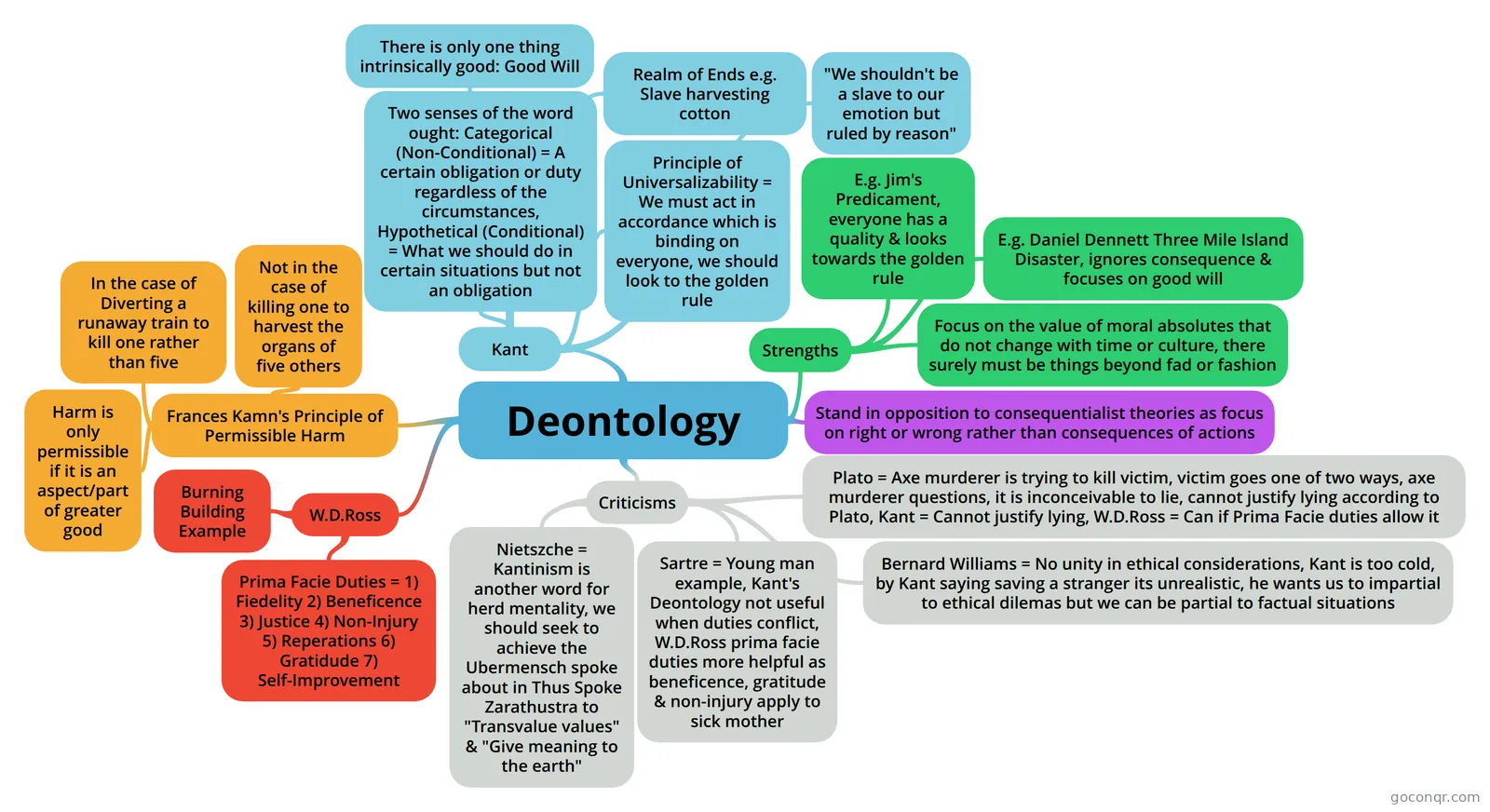
Mind map: deontology ethics
Inhalt der Mindmap
Deontology
Strengths
- Focus on the value of moral absolutes that do not change with time or culture, there surely must be things beyond fad or fashion
- E.g. Daniel Dennett Three Mile Island Disaster, ignores consequence & focuses on good will
- E.g. Jim's Predicament, everyone has a quality & looks towards the golden rule
Stand in opposition to consequentialist theories as focus on right or wrong rather than consequences of actions
W.D.Ross
- Prima Facie Duties = 1) Fiedelity 2) Beneficence 3) Justice 4) Non-Injury 5) Reperations 6) Gratidude 7) Self-Improvement
- Burning Building Example
Criticisms
- Plato = Axe murderer is trying to kill victim, victim goes one of two ways, axe murderer questions, it is inconceivable to lie, cannot justify lying according to Plato, Kant = Cannot justify lying, W.D.Ross = Can if Prima Facie duties allow it
- Bernard Williams = No unity in ethical considerations, Kant is too cold, by Kant saying saving a stranger its unrealistic, he wants us to impartial to ethical dilemas but we can be partial to factual situations
- Sartre = Young man example, Kant's Deontology not useful when duties conflict, W.D.Ross prima facie duties more helpful as beneficence, gratitude & non-injury apply to sick mother
- Nietszche = Kantinism is another word for herd mentality, we should seek to achieve the Ubermensch spoke about in Thus Spoke Zarathustra to "Transvalue values" & "Give meaning to the earth"
Frances Kamn's Principle of Permissible Harm
- Harm is only permissible if it is an aspect/part of greater good
- In the case of Diverting a runaway train to kill one rather than five
- Not in the case of killing one to harvest the organs of five others
Kant
- Two senses of the word ought: Categorical (Non-Conditional) = A certain obligation or duty regardless of the circumstances, Hypothetical (Conditional) = What we should do in certain situations but not an obligation
- Principle of Universalizability = We must act in accordance which is binding on everyone, we should look to the golden rule
- There is only one thing intrinsically good: Good Will
- "We shouldn't be a slave to our emotion but ruled by reason"
- Realm of Ends e.g. Slave harvesting cotton
Informationen
- Beschreibung
- A level [A-Level] Religious Education (RE) (Unit 3) Mindmap am Deontology, erstellt von Kieran Deaville am 06/12/2016.
- Erstellt von
- Kieran Deaville
- Aufrufe
- 0
- Bewertung