
Mindmap
Homeostasis
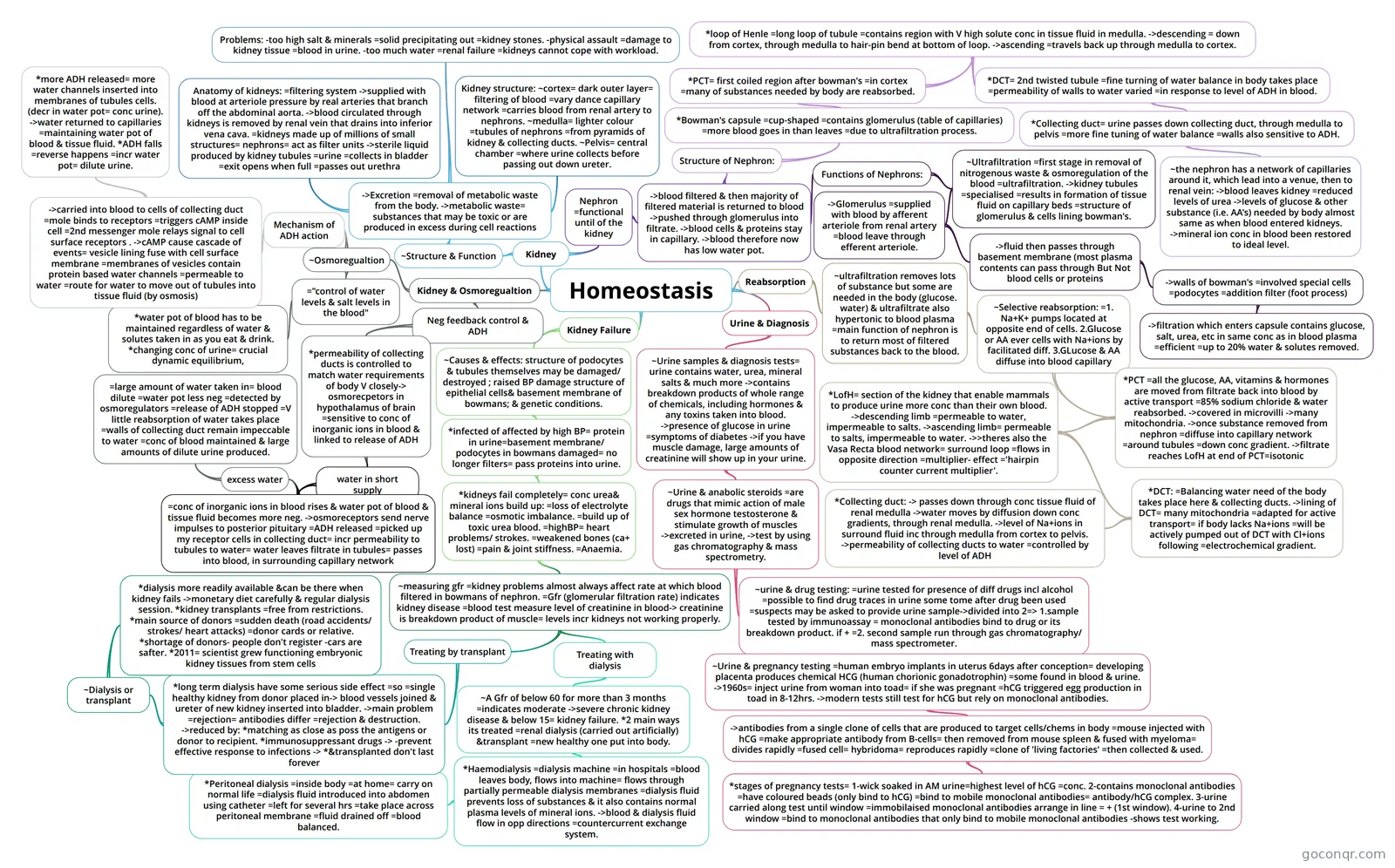
Mind map: Homeostasis and kidney function
Inhalt der Mindmap
Homeostasis
Kidney
- ~Structure & Function
- ->Excretion =removal of metabolic waste from the body. ->metabolic waste= substances that may be toxic or are produced in excess during cell reactions
- Anatomy of kidneys: =filtering system ->supplied with blood at arteriole pressure by real arteries that branch off the abdominal aorta. ->blood circulated through kidneys is removed by renal vein that drains into inferior vena cava. =kidneys made up of millions of small structures= nephrons= act as filter units ->sterile liquid produced by kidney tubules =urine =collects in bladder =exit opens when full =passes out urethra
- Kidney structure: ~cortex= dark outer layer= filtering of blood =vary dance capillary network =carries blood from renal artery to nephrons. ~medulla= lighter colour =tubules of nephrons =from pyramids of kidney & collecting ducts. ~Pelvis= central chamber =where urine collects before passing out down ureter.
- Problems: -too high salt & minerals =solid precipitating out =kidney stones. -physical assault =damage to kidney tissue =blood in urine. -too much water =renal failure =kidneys cannot cope with workload.
- ->Excretion =removal of metabolic waste from the body. ->metabolic waste= substances that may be toxic or are produced in excess during cell reactions
- Nephron =functional until of the kidney
- ->blood filtered & then majority of filtered material is returned to blood ->pushed through glomerulus into filtrate. ->blood cells & proteins stay in capillary. ->blood therefore now has low water pot.
- Structure of Nephron:
- *Bowman's capsule =cup-shaped =contains glomerulus (table of capillaries) =more blood goes in than leaves =due to ultrafiltration process.
- *PCT= first coiled region after bowman's =in cortex =many of substances needed by body are reabsorbed.
- *loop of Henle =long loop of tubule =contains region with V high solute conc in tissue fluid in medulla. ->descending = down from cortex, through medulla to hair-pin bend at bottom of loop. ->ascending =travels back up through medulla to cortex.
- *DCT= 2nd twisted tubule =fine turning of water balance in body takes place =permeability of walls to water varied =in response to level of ADH in blood.
- *Collecting duct= urine passes down collecting duct, through medulla to pelvis =more fine tuning of water balance =walls also sensitive to ADH.
- ~the nephron has a network of capillaries around it, which lead into a venue, then to renal vein: ->blood leaves kidney =reduced levels of urea ->levels of glucose & other substance (i.e. AA's) needed by body almost same as when blood entered kidneys. ->mineral ion conc in blood been restored to ideal level.
- *Collecting duct= urine passes down collecting duct, through medulla to pelvis =more fine tuning of water balance =walls also sensitive to ADH.
- *DCT= 2nd twisted tubule =fine turning of water balance in body takes place =permeability of walls to water varied =in response to level of ADH in blood.
- *loop of Henle =long loop of tubule =contains region with V high solute conc in tissue fluid in medulla. ->descending = down from cortex, through medulla to hair-pin bend at bottom of loop. ->ascending =travels back up through medulla to cortex.
- *PCT= first coiled region after bowman's =in cortex =many of substances needed by body are reabsorbed.
- *Bowman's capsule =cup-shaped =contains glomerulus (table of capillaries) =more blood goes in than leaves =due to ultrafiltration process.
- Functions of Nephrons:
- ~Ultrafiltration =first stage in removal of nitrogenous waste & osmoregulation of the blood =ultrafiltration. ->kidney tubules =specialised =results in formation of tissue fluid on capillary beds =structure of glomerulus & cells lining bowman's.
- ->Glomerulus =supplied with blood by afferent arteriole from renal artery =blood leave through efferent arteriole.
- ->fluid then passes through basement membrane (most plasma contents can pass through But Not blood cells or proteins
- ->walls of bowman's =involved special cells =podocytes =addition filter (foot process)
- ->filtration which enters capsule contains glucose, salt, urea, etc in same conc as in blood plasma =efficient =up to 20% water & solutes removed.
- ->walls of bowman's =involved special cells =podocytes =addition filter (foot process)
- ->fluid then passes through basement membrane (most plasma contents can pass through But Not blood cells or proteins
- ->Glomerulus =supplied with blood by afferent arteriole from renal artery =blood leave through efferent arteriole.
- ~Ultrafiltration =first stage in removal of nitrogenous waste & osmoregulation of the blood =ultrafiltration. ->kidney tubules =specialised =results in formation of tissue fluid on capillary beds =structure of glomerulus & cells lining bowman's.
- Structure of Nephron:
- ->blood filtered & then majority of filtered material is returned to blood ->pushed through glomerulus into filtrate. ->blood cells & proteins stay in capillary. ->blood therefore now has low water pot.
- ~Structure & Function
Urine & Diagnosis
- ~Urine samples & diagnosis tests= urine contains water, urea, mineral salts & much more ->contains breakdown products of whole range of chemicals, including hormones & any toxins taken into blood. ->presence of glucose in urine =symptoms of diabetes ->if you have muscle damage, large amounts of creatinine will show up in your urine.
- ~Urine & anabolic steroids =are drugs that mimic action of male sex hormone testosterone & stimulate growth of muscles ->excreted in urine, ->test by using gas chromatography & mass spectrometry.
- ~urine & drug testing: =urine tested for presence of diff drugs incl alcohol =possible to find drug traces in urine some tome after drug been used =suspects may be asked to provide urine sample->divided into 2=> 1.sample tested by immunoassay = monoclonal antibodies bind to drug or its breakdown product. if + =2. second sample run through gas chromatography/ mass spectrometer.
- ~Urine & pregnancy testing =human embryo implants in uterus 6days after conception= developing placenta produces chemical HCG (human chorionic gonadotrophin) =some found in blood & urine. ->1960s= inject urine from woman into toad= if she was pregnant =hCG triggered egg production in toad in 8-12hrs. ->modern tests still test for hCG but rely on monoclonal antibodies.
- ->antibodies from a single clone of cells that are produced to target cells/chems in body =mouse injected with hCG =make appropriate antibody from B-cells= then removed from mouse spleen & fused with myeloma= divides rapidly =fused cell= hybridoma= reproduces rapidly =clone of 'living factories' =then collected & used.
- *stages of pregnancy tests= 1-wick soaked in AM urine=highest level of hCG =conc. 2-contains monoclonal antibodies =have coloured beads (only bind to hCG) =bind to mobile monoclonal antibodies= antibody/hCG complex. 3-urine carried along test until window =immobilaised monoclonal antibodies arrange in line = + (1st window). 4-urine to 2nd window =bind to monoclonal antibodies that only bind to mobile monoclonal antibodies -shows test working.
- ->antibodies from a single clone of cells that are produced to target cells/chems in body =mouse injected with hCG =make appropriate antibody from B-cells= then removed from mouse spleen & fused with myeloma= divides rapidly =fused cell= hybridoma= reproduces rapidly =clone of 'living factories' =then collected & used.
- ~Urine & pregnancy testing =human embryo implants in uterus 6days after conception= developing placenta produces chemical HCG (human chorionic gonadotrophin) =some found in blood & urine. ->1960s= inject urine from woman into toad= if she was pregnant =hCG triggered egg production in toad in 8-12hrs. ->modern tests still test for hCG but rely on monoclonal antibodies.
- ~urine & drug testing: =urine tested for presence of diff drugs incl alcohol =possible to find drug traces in urine some tome after drug been used =suspects may be asked to provide urine sample->divided into 2=> 1.sample tested by immunoassay = monoclonal antibodies bind to drug or its breakdown product. if + =2. second sample run through gas chromatography/ mass spectrometer.
- ~Urine & anabolic steroids =are drugs that mimic action of male sex hormone testosterone & stimulate growth of muscles ->excreted in urine, ->test by using gas chromatography & mass spectrometry.
- ~Urine samples & diagnosis tests= urine contains water, urea, mineral salts & much more ->contains breakdown products of whole range of chemicals, including hormones & any toxins taken into blood. ->presence of glucose in urine =symptoms of diabetes ->if you have muscle damage, large amounts of creatinine will show up in your urine.
Kidney Failure
- ~Causes & effects: structure of podocytes & tubules themselves may be damaged/ destroyed ; raised BP damage structure of epithelial cells& basement membrane of bowmans; & genetic conditions.
- *infected of affected by high BP= protein in urine=basement membrane/ podocytes in bowmans damaged= no longer filters= pass proteins into urine.
- *kidneys fail completely= conc urea& mineral ions build up: =loss of electrolyte balance =osmotic imbalance. =build up of toxic urea blood. =highBP= heart problems/ strokes. =weakened bones (ca+ lost) =pain & joint stiffness. =Anaemia.
- ~measuring gfr =kidney problems almost always affect rate at which blood filtered in bowmans of nephron. =Gfr (glomerular filtration rate) indicates kidney disease =blood test measure level of creatinine in blood-> creatinine is breakdown product of muscle= levels incr kidneys not working properly.
- Treating with dialysis
- ~A Gfr of below 60 for more than 3 months =indicates moderate ->severe chronic kidney disease & below 15= kidney failure. *2 main ways its treated =renal dialysis (carried out artificially) &transplant =new healthy one put into body.
- *Haemodialysis =dialysis machine =in hospitals =blood leaves body, flows into machine= flows through partially permeable dialysis membranes =dialysis fluid prevents loss of substances & it also contains normal plasma levels of mineral ions. ->blood & dialysis fluid flow in opp directions =countercurrent exchange system.
- *Peritoneal dialysis =inside body =at home= carry on normal life =dialysis fluid introduced into abdomen using catheter =left for several hrs =take place across peritoneal membrane =fluid drained off =blood balanced.
- *Haemodialysis =dialysis machine =in hospitals =blood leaves body, flows into machine= flows through partially permeable dialysis membranes =dialysis fluid prevents loss of substances & it also contains normal plasma levels of mineral ions. ->blood & dialysis fluid flow in opp directions =countercurrent exchange system.
- ~A Gfr of below 60 for more than 3 months =indicates moderate ->severe chronic kidney disease & below 15= kidney failure. *2 main ways its treated =renal dialysis (carried out artificially) &transplant =new healthy one put into body.
- Treating by transplant
- *long term dialysis have some serious side effect =so =single healthy kidney from donor placed in-> blood vessels joined & ureter of new kidney inserted into bladder. ->main problem =rejection= antibodies differ =rejection & destruction. ->reduced by: *matching as close as poss the antigens or donor to recipient. *immunosuppressant drugs -> -prevent effective response to infections -> *&transplanted don't last forever
- ~Dialysis or transplant
- *dialysis more readily available &can be there when kidney fails ->monetary diet carefully & regular dialysis session. *kidney transplants =free from restrictions. *main source of donors =sudden death (road accidents/ strokes/ heart attacks) =donor cards or relative. *shortage of donors- people don't register -cars are safter. *2011= scientist grew functioning embryonic kidney tissues from stem cells
- ~Dialysis or transplant
- *long term dialysis have some serious side effect =so =single healthy kidney from donor placed in-> blood vessels joined & ureter of new kidney inserted into bladder. ->main problem =rejection= antibodies differ =rejection & destruction. ->reduced by: *matching as close as poss the antigens or donor to recipient. *immunosuppressant drugs -> -prevent effective response to infections -> *&transplanted don't last forever
- Treating with dialysis
- ~measuring gfr =kidney problems almost always affect rate at which blood filtered in bowmans of nephron. =Gfr (glomerular filtration rate) indicates kidney disease =blood test measure level of creatinine in blood-> creatinine is breakdown product of muscle= levels incr kidneys not working properly.
- *kidneys fail completely= conc urea& mineral ions build up: =loss of electrolyte balance =osmotic imbalance. =build up of toxic urea blood. =highBP= heart problems/ strokes. =weakened bones (ca+ lost) =pain & joint stiffness. =Anaemia.
- *infected of affected by high BP= protein in urine=basement membrane/ podocytes in bowmans damaged= no longer filters= pass proteins into urine.
- ~Causes & effects: structure of podocytes & tubules themselves may be damaged/ destroyed ; raised BP damage structure of epithelial cells& basement membrane of bowmans; & genetic conditions.
Kidney & Osmoregualtion
- ~Osmoregualtion
- Mechanism of ADH action
- ->carried into blood to cells of collecting duct =mole binds to receptors =triggers cAMP inside cell =2nd messenger mole relays signal to cell surface receptors . ->cAMP cause cascade of events= vesicle lining fuse with cell surface membrane =membranes of vesicles contain protein based water channels =permeable to water =route for water to move out of tubules into tissue fluid (by osmosis)
- *more ADH released= more water channels inserted into membranes of tubules cells. (decr in water pot= conc urine). ->water returned to capillaries =maintaining water pot of blood & tissue fluid. *ADH falls =reverse happens =incr water pot= dilute urine.
- ->carried into blood to cells of collecting duct =mole binds to receptors =triggers cAMP inside cell =2nd messenger mole relays signal to cell surface receptors . ->cAMP cause cascade of events= vesicle lining fuse with cell surface membrane =membranes of vesicles contain protein based water channels =permeable to water =route for water to move out of tubules into tissue fluid (by osmosis)
- ="control of water levels & salt levels in the blood"
- *water pot of blood has to be maintained regardless of water & solutes taken in as you eat & drink. *changing conc of urine= crucial dynamic equilibrium,
- Mechanism of ADH action
- Neg feedback control & ADH
- *permeability of collecting ducts is controlled to match water requirements of body V closely-> osmorecpetors in hypothalamus of brain =sensitive to conc of inorganic ions in blood & linked to release of ADH
- water in short supply
- =conc of inorganic ions in blood rises & water pot of blood & tissue fluid becomes more neg. ->osmoreceptors send nerve impulses to posterior pituitary =ADH released =picked up my receptor cells in collecting duct= incr permeability to tubules to water= water leaves filtrate in tubules= passes into blood, in surrounding capillary network
- excess water
- =large amount of water taken in= blood dilute =water pot less neg =detected by osmoregulators =release of ADH stopped =V little reabsorption of water takes place =walls of collecting duct remain impeccable to water =conc of blood maintained & large amounts of dilute urine produced.
- excess water
- =conc of inorganic ions in blood rises & water pot of blood & tissue fluid becomes more neg. ->osmoreceptors send nerve impulses to posterior pituitary =ADH released =picked up my receptor cells in collecting duct= incr permeability to tubules to water= water leaves filtrate in tubules= passes into blood, in surrounding capillary network
- water in short supply
- *permeability of collecting ducts is controlled to match water requirements of body V closely-> osmorecpetors in hypothalamus of brain =sensitive to conc of inorganic ions in blood & linked to release of ADH
- ~Osmoregualtion
Reabsorption
- ~ultrafiltration removes lots of substance but some are needed in the body (glucose. water) & ultrafiltrate also hypertonic to blood plasma =main function of nephron is to return most of filtered substances back to the blood.
- ~Selective reabsorption: =1. Na+K+ pumps located at opposite end of cells. 2.Glucose or AA ever cells with Na+ions by facilitated diff. 3.GLucose & AA diffuse into blood capillary
- *PCT =all the glucose, AA, vitamins & hormones are moved from filtrate back into blood by active transport =85% sodium chloride & water reabsorbed. ->covered in microvilli ->many mitochondria. ->once substance removed from nephron =diffuse into capillary network =around tubules =down conc gradient. ->filtrate reaches LofH at end of PCT=isotonic
- *LofH= section of the kidney that enable mammals to produce urine more conc than their own blood. ->descending limb =permeable to water, impermeable to salts. ->ascending limb= permeable to salts, impermeable to water. ->>theres also the Vasa Recta blood network= surround loop =flows in opposite direction =multiplier- effect ='hairpin counter current multiplier'.
- *DCT: =Balancing water need of the body takes place here & collecting ducts. ->lining of DCT= many mitochondria =adapted for active transport= if body lacks Na+ions =will be actively pumped out of DCT with Cl+ions following =electrochemical gradient.
- *Collecting duct: -> passes down through conc tissue fluid of renal medulla ->water moves by diffusion down conc gradients, through renal medulla. ->level of Na+ions in surround fluid inc through medulla from cortex to pelvis. ->permeability of collecting ducts to water =controlled by level of ADH
- *DCT: =Balancing water need of the body takes place here & collecting ducts. ->lining of DCT= many mitochondria =adapted for active transport= if body lacks Na+ions =will be actively pumped out of DCT with Cl+ions following =electrochemical gradient.
- *LofH= section of the kidney that enable mammals to produce urine more conc than their own blood. ->descending limb =permeable to water, impermeable to salts. ->ascending limb= permeable to salts, impermeable to water. ->>theres also the Vasa Recta blood network= surround loop =flows in opposite direction =multiplier- effect ='hairpin counter current multiplier'.
- *PCT =all the glucose, AA, vitamins & hormones are moved from filtrate back into blood by active transport =85% sodium chloride & water reabsorbed. ->covered in microvilli ->many mitochondria. ->once substance removed from nephron =diffuse into capillary network =around tubules =down conc gradient. ->filtrate reaches LofH at end of PCT=isotonic
- ~Selective reabsorption: =1. Na+K+ pumps located at opposite end of cells. 2.Glucose or AA ever cells with Na+ions by facilitated diff. 3.GLucose & AA diffuse into blood capillary
- ~ultrafiltration removes lots of substance but some are needed in the body (glucose. water) & ultrafiltrate also hypertonic to blood plasma =main function of nephron is to return most of filtered substances back to the blood.
Informationen
- Beschreibung
- A2 BIO Mindmap am Homeostasis, erstellt von S M am 30/12/2016.
- Erstellt von
- S M
- Aufrufe
- 0
- Bewertung