
Mindmap
Digestive
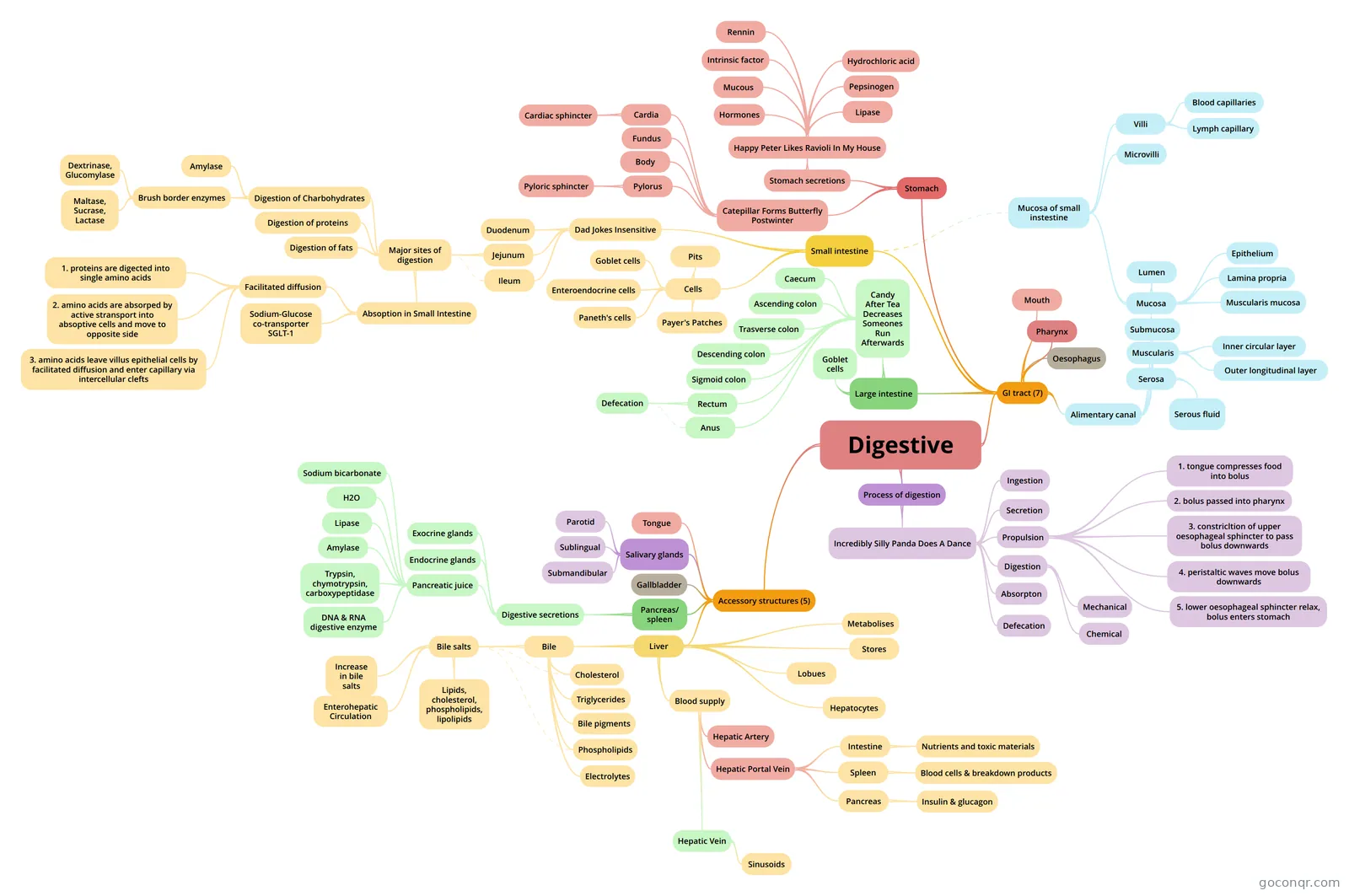
Mind map: Digestive system
Inhalt der Mindmap
Digestive
GI tract (7)
- Mouth Pharynx Oesophagus Stomach Small intestine Large Intestine Anus
- Mouth
- Thick stratified squamous epithelium - abrasion Made of: Lips, cheeks, palate, tongue
- Pharynx
- Pathway for GI tract and respiratory connects: mouth to oesophagus and mouth to trachea
- Oesophagus
- Extends from pharynx to upper part of stomach, penetrating the diaphram Lines with stratified squamous epithelium Skeletal muscle at the top and smooth muscle at the bottom
- Stomach
- 3 layers of muscularis: circulaer layer longitudinal layer oblique layer Hollow and very elastic to allow for consuption of food Meal empties after 4 hours
- Stomach secretions
- Happy Peter Likes Ravioli In My House
- Hydrochloric acid
- Activates pepsin and lipase Breaks up connective tissue in meat and plant cell walls in vegetables - liquifies food into Chyme Converts FERRIC ions to FERROUS ions Fe+3 - Fe+2 Protection - destroys bacteria and pathogens
- Pepsinogen
- Inactive form of pepsin - as it would destroy lining of stomach wall Requires hydrochloc acid for activation Splits proteins into polypeptides and peptides pH level of 1.5-3.5 very acidic
- Lipase
- Starts the breakdown of lipids into Fatty acids and Glycerol
- Rennin
- Secreted by gastic gland in children and not in adults Coagulates milk proteins (casein) which helps absorption of nutrients in the small intestine Decreases with age as milk amount decreases
- Intrinsic factor
- Secreted in stomach to help absorp of B12 in small intestine
- Mucous
- lines stomach mucosa to hep protect against gastric ulcers, errosion, acids etc
- Hormones
- Serotonin & somatostatin to regulate gastic motility Gastrin and histamine to regulate hydrochloric acid secretion
- Hydrochloric acid
- Happy Peter Likes Ravioli In My House
- Catepillar Forms Butterfly Postwinter
- Cardia
- Cardiac sphincter
- Open for food to enter
- Cardiac sphincter
- Fundus
- Body
- Pylorus
- Pyloric sphincter
- Opens for food to exit
- Pyloric sphincter
- Cardia
- Small intestine
- Organ of digestion and absorption
- Dad Jokes Insensitive
- Duodenum
- First 25 cm Curves around head of the pancreas
- Jejunum
- Next 2.4 meters Covered in serosa and suspended by the mesentary
- Major sites of digestion
- Digestion of Charbohydrates
- - Maltose (DISACCHARIDE) + maltase (ENZYME) = glucose+glucose (MONOSACCHARIDE) - Sucrose (DISACCHARIDE) + sucrase (ENZYME) = glucose+fructose (MONOSACCHARIDE) - Lactose (DISACCHARIDE) + lactase (ENZYME) = galactose+glucose (MONOSACCHARIDE)
- Amylase
- Amylase (in saliva) surts starch into oligosaccharides Does not work inconditions where pH is lower that 4.5 - not in the stomach 50% of starch is already digested before it reaches small intestine Pancreatic amylase is secreted and completes starch digestion within 10 minutes
- Brush border enzymes
- Dextrinase, Glucomylase
- Act upon oligosaccharides with more than 3 simple sugars
- Maltase, Sucrase, Lactase
- Dextrinase, Glucomylase
- Digestion of proteins
- Protein peptides + protease digested into single amino acids
- Digestion of fats
- Aided by secretions from pancreas and liver
- Absoption in Small Intestine
- Monosaccharides like Glucose, Fructose and Galactose are not small enough to be absorped through the plasma membrane into the cell
- Facilitated diffusion
- 1. proteins are digected into single amino acids
- By pancreatic proteases and by brush border enzymes
- 2. amino acids are absorped by active stransport into absoptive cells and move to opposite side
- 3. amino acids leave villus epithelial cells by facilitated diffusion and enter capillary via intercellular clefts
- 1. proteins are digected into single amino acids
- Sodium-Glucose co-transporter SGLT-1
- Hitch a lift on SGLT-1
- Digestion of Charbohydrates
- Ileum
- Last 3.6 meters Covered with serosa and suspended by the mesentery
- Duodenum
- Cells
- Goblet cells
- Secrete mucous
- Enteroendocrine cells
- Secrete hormones
- Pits
- Are found between villi and cells that line the pits secrete a watery misture called intestinal juice
- Paneth's cells
- Secrete lysozyme (antibacterial)
- Payer's Patches
- Lymphoid follicles at the end of intestine
- Goblet cells
- Large intestine
- Lined with simple colunmar epithelium Begins as caecum and appendix Large intestine reabsorb water and elecrolytes from indigestible food Absorb Vit K and Vit B from enteric bacteria Eliminate undigested residues
- Goblet cells
- Secrete mucous
- Candy After Tea Decreases Someones Run Afterwards
- Caecum
- Appendix attached to the bottom Appendix contains lymphoid tissue/immune defense
- Ascending colon
- travels up right side of the body to the level of the right kidney
- Trasverse colon
- travels across abdomen from right to left towards the spleen
- Descending colon
- runs down the left side of the abdomen and enters pelvis
- Sigmoid colon
- s-shaped leading down the pelvis
- Rectum
- straight portion which runs down through the pelvis and ends at the anal canal
- Defecation
- 1. Peristaltic waves push waste from sigmoid colon into the rectum 2. Rectum involuntary contraction push fecal matter downwards 3. Filling of rectu stimulates stretch receptors 4. Defecation reflex 5. Relaxation of the internal anal sphincter 6. Voluntary relaxation of the extrnal anal sphincter 7. Defecation
- Anus
- voluntary external sphincter and involuntary internal sphincter
- Caecum
- Alimentary canal
- Mucosa
- Inner layer of GI epithelium Role of mucosa varies: In stomach it is secretion In intestine it is absorption
- Lumen
- Epithelium
- Lamina propria
- Muscularis mucosa
- Mucosa of small instestine
- Specialised fo absoprtion
- Villi
- Finger like projections that increase surface area
- Blood capillaries
- Found in the core of the villi
- Lymph capillary
- (lacteal) Found in the core of the villi
- Microvilli
- Simple epithelial cells that cover the villi have microvilli on surface - finger like projections
- Submucosa
- 2nd layer that is highly vascular - it is the areolar connective tissue layer Attaches mucosa to muscularis Contains most GI nerves
- Muscularis
- Mainly made up of smooth muscle except: In mouth, pharynx, upper oesophagus & in the external anal sphincter it is skeletal - voluntary contraction and relaxation Propulsion is generated by contraction of muscularis
- Inner circular layer
- Outer longitudinal layer
- Serosa
- Outer most layer It attaches organ to surrounding tissues
- Serous fluid
- Reduces friction as it moves across other abdominal organs
- Mucosa
Accessory structures (5)
- Tongue Saliva glands Gallbladder Liver Pancreas/spleen
- Salivary glands
- Small glaands under the mucous membrane on tongue. Made of: 99.5% water, 0.05% solutes ph: 6.8 - 7 Moisten food, secrete amylase to begin charbohydrate digestion, cleanse teeth (lysozyme), make a bolus, dissolve food
- Parotid
- Sublingual
- Submandibular
- Liver
- Bile
- Bile is produced in the liver It emulsifies fats Breaks down fat into smaller globules that enzymes can digest more efficiently
- Bile salts
- Bile salts are made in the liver
- Lipids, cholesterol, phospholipids, lipolipids
- Bile salts are used by the small intestine for emulsification and absorption of ...
- Increase in bile salts
- Intense itching of the skin (pruritis) Extraction via sweat glands Interferes with absorption of water
- Enterohepatic Circulation
- Recycling of bile salts in the body
- Cholesterol
- Triglycerides
- Are then broken down into Fatty Acids and Glycerol
- Bile pigments
- Phospholipids
- Electrolytes
- Metabolises
- Charbohydrates Proteins Fats
- Stores
- Charbohydrates Fats Vitamins and Minerals
- Lobues
- Made of 4 lobules which made of thousands of lobules Functioning units of the liver
- Hepatocytes
- Are liver cells. Liver can lose 3/4 of cells before it stops working Is the only organ that can regenerate itself
- Blood supply
- Hepatic Artery
- To the liver Oxygenated blood
- Hepatic Portal Vein
- To the liver Venous blood (no oxygen)
- Intestine
- Nutrients and toxic materials
- Spleen
- Blood cells & breakdown products
- Pancreas
- Insulin & glucagon
- Hepatic Vein
- Away from the liver
- Sinusoids
- Vascular channels to allow exchange between blood and hepatocytes (liver cells)
- Hepatic Artery
- Bile
- Pancreas/ spleen
- Digestive secretions
- Exocrine glands
- Secretes digestive enzymes through ducts
- Endocrine glands
- Ductless glands that produce hormones that are released into the bloodstream
- Pancreatic juice
- H2O
- Sodium bicarbonate
- Netralises stomach's acidic chyme
- Lipase
- Breakdown lipids into fally acids and glycerol
- Amylase
- Breakdown of charbohydrates
- Trypsin, chymotrypsin, carboxypeptidase
- Break down of proteins into short chain amino acids
- DNA & RNA digestive enzyme
- Nucleases
- Exocrine glands
- Digestive secretions
- Gallbladder
- Stores and concentrates bile that it produces in the liver
- Tongue
- Skelettal muscle. While mastication tongue grips food, moves around the mouth, mixedwith saliva and forms bolus During deglutition tongue collects food, pushes down the back of mouth, down the pharynx Aids speech
Process of digestion
- Incredibly Silly Panda Does A Dance
- Ingestion
- Secretion
- Propulsion
- 1. tongue compresses food into bolus
- 2. bolus passed into pharynx
- Misdirection if prevented by the tongue blocking oral cavity, spft palate blocking nasal cavity and epiglottis blocking the larynx
- 3. constricltion of upper oesophageal sphincter to pass bolus downwards
- 4. peristaltic waves move bolus downwards
- oesophagus above bolus constrict and below bolus relax
- 5. lower oesophageal sphincter relax, bolus enters stomach
- Digestion
- Mechanical
- Chemical
- Absorpton
- Defecation
- Incredibly Silly Panda Does A Dance
Informationen
- Beschreibung
- Anatomy Mindmap am Digestive, erstellt von Ksenia Wells am 11/06/2017.
- Erstellt von
- Ksenia Wells
- Aufrufe
- 0
- Bewertung