
Notizen
The Blast Furnace
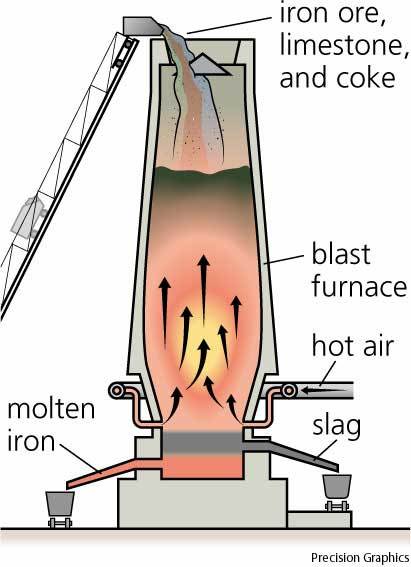
Inhalt der Notizen (1)
Seite 1
1. RAW MATERIALS added from the top.
Haematite (Fe2O3), Limestone (CaCO3), Coke (C)
2. HOT AIR blasted through the furnace from the bottom.
Oxygen reacts with coke to form Carbon Dioxide (CO2).
C (s) + O2 (g) --> CO2 (g)
Carbon dioxide reacts with more hot coke to form Carbon Monoxide (CO).
CO2 (g) + C (s) --> 2CO (g)
Carbon Monoxide is a reducing agent. It reduces iron oxide to form pure molten iron.
Fe2O3 (s) + 3CO (g) --> 2Fe (l) + 3CO2 (g)
3. MOLTEN IRON formed. It sinks to the bottom of the furnace. Run off into moulds.
4. SLAG (CaSiO3) formed by reaction between silicon dioxide (an impurity) and limestone (more specifically, calcium oxide).
CaO (s) + SiO4 (s) --> CaSiO3 (l)
Tapped off, allowed to cool until it reaches a solid, then used to make roads.
Informationen
- Beschreibung
- The extraction of iron from haematite using a blast furnace.
- Erstellt von
- noelle loh
- Aufrufe
- 173
- Tags
- Bewertung
Mehr zu Iron Extraction and Steelmaking