
Notizen
GENETICS
Inhalt der Notizen (2)
Seite 1
Unit 2: GENETICS QUIZ
The Nature of Heredity:
All organisms use cell division and cell reproduction to grow and reproduce
Multicellular organisms use cell division for growth/ repair, whereas unicellular organisms use it as a means of reproduction
Key feature: Passing of chromosomes from the parent cell to the daughter cells(NOTE: Chromosomes carry info. for traits, so traits are passed from parents to offspring - a process called heredity
Genetic Material:
Genetics: The scientific study of heredity and variation
Genetic MAterial: All material in an organism that stores genetic info.
NOTE: In a chromosome, genetic info is contained in a molecule of deoxyribonucleic acid (or DNA)
Instructions occur as distinct sequences of info. along a DNA molecule - Each of these sequences of genetic info is called a gene.
Genes carry info that helps to produce a particular trait of an organism
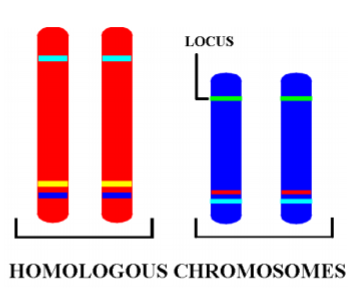
EACH gene occupies a specific location or locus on a chromosome
Chromosomes:
Found in the nucleus of all eukaryotic cells in most multicellular organisms
Chromosomes occur in sets;
Diploid cells have two sets of chromosomes
Haploid cells have half the normal number of chromosomes
NOTE: Both mitochondria and chloroplast contain small amounts of genetic material
Reproduction:
Asexual reproduction:
almost always involves cell division
cell division: two chromosomes of the parent cell are divided such that each of two daughter cells receives one copy of each chromosome
ADVANTAGES
parent organism does not have to seek out a mate
doesn't need to perform specialized mating behaviors
results in heredity that is direct and invariable.
Sexual Reproduction:
individuals are reproduced from the fusion of two cells
cells usually come from diff. parent cells
offspring obtain half genetic material from one parent and the other half from the other parent
results in genetically variable offspring and contain equal amounts of genetic info. from each parent.
DISADVANTAGES:
must have specialized organisms to produce sex cells
producing mating calls can attract mates AND prey
sex is biologically costly and possibly risky
offspring can inherit genetic info that can make them weak and UNABLE TO SURVIVE
DNA and The Code of Life:
Chromosomes are passed to offspring through Gametes
Genetic material is contained in the nucleus
The Chemical Composition of DNA:
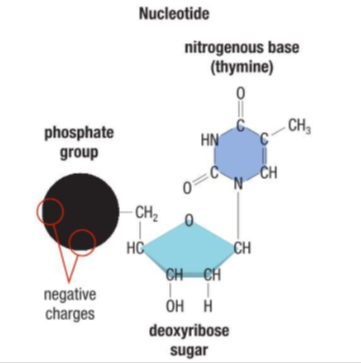
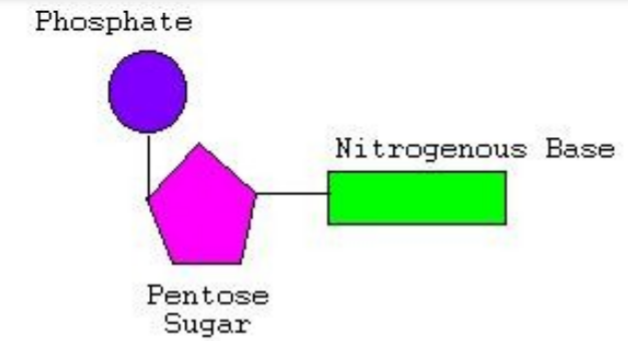
DNA has main components:
Pentose sugar(cyclic, 5-carbon sugar)
prophase group with a negative charge
nitrogenous base
Together, all three are a nucleotide - repeating unit of DNA
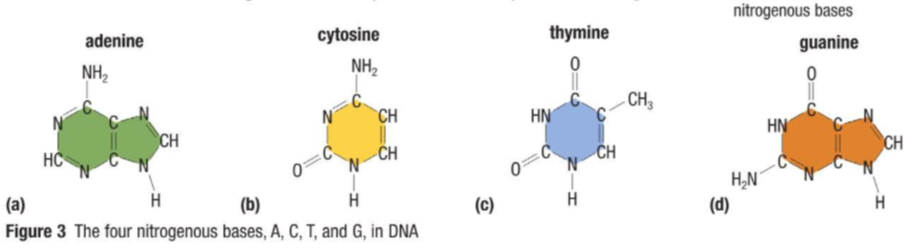
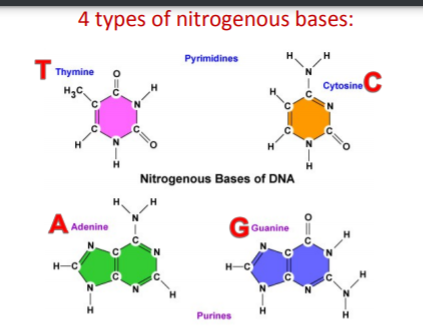
Possible bases for the nucleotides of DNA - Adenine(A), guanine (G), thymine ( T), and cytosine(C)
Key relationships among the nitrogenous bases in DNA:
The Amount of Adenine is always equal to the amount of thymine
The amount of guanine is always equal to the amount of cytosine
The structure of the DNA molecule:
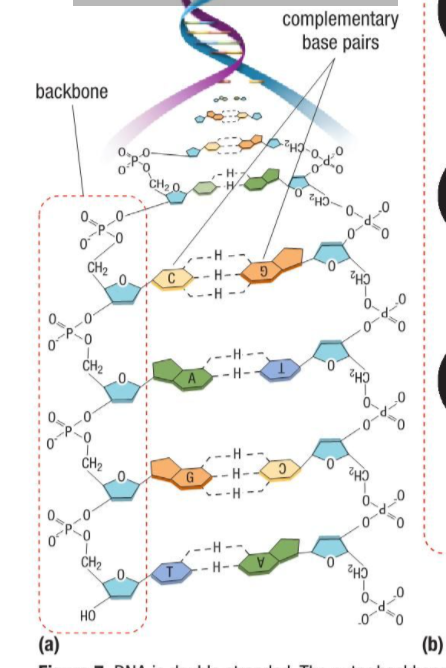
The molecular structure of DNA is a double helix
The model accounted for:
DNA is made o pentose sugar, a phosphate group, and one of four nitrogenous bases
The proportion of adenine and thymine is equal, and the proportion of guanine and cytosine is equal
DNA has the shape of a helix or corkscrew
DNA is made up of 2 strands of repeating NA nucleotides that run in opposite directions
The chemical backbone of a DNA strand is made up of alternating phosphate groups and pentose sugars
Attached to backbone - nitrogenous bases
The bases of one strand are paired with the bases of other strands - ie. thymine with adenine and cytosine with guanine
This is called complementary base pairing!!!
Sine bases = complementary, there is no need to know the nucleotide base sequence for both strands
QUESTION:
What is the complementary base strand for TTGACAGTAAAA?
= AACTGTCATTTT
Cloning and Reproduction:
In both plant and animal cell cytokinesis, separation occurs at the midpoint along the original spindle fibers
Cloning:
many organisms reproduce asexually by mitotic cell division
CLoning - the process of forming identical offspring from a single cell or tissue
Plant cloning - some plants have the ability to reproduce through their seeds
Animal cloning: ie/ dolly the sheep, obtained a body cell from the adult sheep he wished to clone and an unfertilized egg from a second sheep
Sexual Reproduction: adding variety
Sexual reproduction offers variety as the offspring inherit traits from 2 parents
2 processes:
The formation of haploid sex cells or gametes ( contain genetic info from parents)
the second process is fertilization - when 2 sex cells produce a zygote(first cell of the new individual)
Modes of sexual reproduction:
Most species have two types of sex cells
Animals: reproductive organs produce sex cells are the tests(which produce sperm cells) and the ovaries(produce egg cells)
Many species - distinct male and female individuals
They possess only one type of sex organ and have the ability to make 1 kind of sex cell
Other species = hermaphroditic -composed of individuals that take both male and female gametes
Meiosis:
2 stage cell division in which the resulting daughter cells have half the # of chromosomes as the parent cell
The process where haploid cells are formed
2 stages
Since gametes half only half chromosomes, they are haploid
In humans, the haploid number is 23 chromosomes, diploid is 46.
REsu;t of sexual reproduction is offspring receive genetic material from each parent in a form of haploid gametes, combined - 2 gametes produce a zygote that contains a complete set of chromosomes
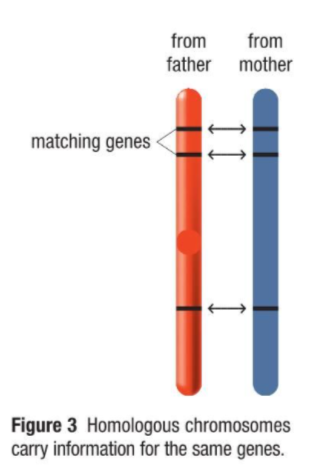
Each of the 23 chromosomes you receive from your father is matched by 23 chromosomes from your mother
Paired chromosomes = homologous chromosomes
Similar in shape, size and carry genetic info for the same genes
Fertilization occurs when a haploid sperm cell (n = 23) unites with a haploid egg cells (n = 23) to form a diploid zygote cell(2n = 46)
Meiosis I:
DNA replication occurs
Beginning of prophase I, chromosomes start to shorten and thicken
Each chromosome is replicated during interphase and now consists of 2 sister chromatids joined at the centromere
Nuclear membrane dissolves, centrioles separate to opposite poles, spindle fibers for,
Chromosomes come together in homologous pairs
Each chromosome of pair is composed of a pair of sister chromatids
Structure = tetrad because each pair of chromosomes is composed of four chromatids
sister chromatids intertwine, mating homologous chromosomes, called synapsis
Prohphse continues, intertwined chromatids from different chromosomes break and reattach to each other
Exchanges sections in a process called crossing over - results in recombination of genetic info. between nonsister chromatids
During metaphase I:
tetrads migrate toward the center of the cell and align centromeres across the middle of the cell
anaphase I:
homologous chromosomes head to opposite poles of the cell
reduction division occurs
Once chromosomes from each pair will be found in the daughter cell
*Each chromosome in new cell consists of sister chromatids
Telophase I:
membrane begins forming around chromosomes at each end of cell divides
each daughter nucleus receives only one member of each original chromosome pair
Cells are now haploid
meiosis II:
Begins immediately after telophase I and the first cell division
Haploid daughter cells - contain 1 set of chromosomes(chromosomes with 2 chromates)
Due to crossing over, sister chromatids are not identical
No duplication of DNA between mI and mII
Prophase II:
beginning of cell division
Nuclear membrane dissolves and spindle fibers form
Metaphase II:
arrangement of chromosomes (each with 2 chromatids) across the center of the cell
Anaphase II:
sister chromatids separate and move to opposite poles of the cell
nuclear membrane beings to form around chromatids (now chromosomes)
Telophase II:
The second nuclear division is completed and the second division of cytoplasm follows
4 daughter haploid cells have been produced
Random assortment of Homologous chromosomes:
In meiosis I. homologous chromosomes pair up during prophase I and metaphase I
Separated during anaphase I
Each daughter cell now = haploid(receiving one chromosome from each pair)
The daughter can recive another chromosome of each homologous pair
RANDOM ASSORTMENT
# of possible combinations of chromosomes depends on the # of chromosome pairs
Diploid organism - # of pairs/combinations = 2^n
In humans - 2^23 - over 8 million possible combinations
Gametogenesis:
formation of sex cells - gametogenesis
Production of sperm cells - spermatogenesis
Production of egg cells - oogenesis
In oogenesis, the cytoplasm of the female gametes do not divide equally during each cell division of meiosis
one daughter cells receive most of the cytoplasm
Other cells die and the final product of oogenesis is a single egg cell
In spermatogenesis, the cytoplasm divides equally during each cell division, resulting in the formation of four equal sized sperm cells
Males produce many sex cells compared to females
Karyotypes:
a picture of chromosomes that have been arranged according to #, size, and shape
Sex chromosomes and sex determination:
Sex chromosomes consist of matching homologous chromosomes in female and a partially matching pair in males
Males - one chromosome is much smaller than the other
Females - larger 2 chromosomes is a homolog to the sex chromosomes in a female
Parts of Z and Y chromosomes contain matching regions that let them undergo synapsis and behave as a homologous pair during meiosis
Auotsomes = non sex chromsomes
Pattern = XX - Female, XY - Male
Individuals inherit an X chromosome from father and X from mother are Female,
Individuals who Received a Y from father and X from mother are Male
Abnormal Meiosis or Fertilization:
During meiosis, entire chromosomes can be lost or gained from cells
Result of nondisjunction - occurs when homologous chromosomes fail to separate during meiosis
Result: One of the daughter cells will have an extra chromosome, whereas the other one will have a missing one
Cells with extras chromosomes or are missing one cannot function normally
In humans, nondisjunction results in gametes with 24 or 22 chromosomes
If a gamete with 24 chromosomes joins with a normal gamete(23 chr.) from opposite sex, resulting zygote will have 47 chromosomes instead of 46
Zygote has; 22 pairs of chromosomes and 3 copies of one chromosome, referred to as trisomy
If a gamete with 22 chromosomes jins with a normal gamete, the resulting zygote will have 45 chromosomes
It will be missing one of its homologous chromosomes for the remaining pair, known as monosomy.
nondisjunction Disorders:
Down syndrome - a chromosomal abnormality in which there is an extra chromosomes number 21 ( trisomy 21)
There is extra genetic info and unpaired chromosomes in every cell
Cytoplasmic Inheritance:
DNA can be found in the mitochondria and chloroplasts
Origin of cytoplasmic DNA:
Chloroplasts and mitochondria originated as a prokaryotic organism
Mitochondria and chloroplasts are able to reproduce independently with the cytoplasm, thereby producing copies of their DNA
Asexual reproduction and cytoplasmic inheritance:
As the parent cell divides, each daughter cell obtains approximately equal numbers of cytoplasmic material
Most male gametes are small and contain little cytoplasm unlike females
During fertilization, male gametes do not usually contribute organelles to new zygote
Zygote inherits cytoplasmic DNA from the female gamete
MATERNAL INHERITANCE
mitochondria in an individual are always genetic clones of the mitochondria from the mother
Parental inheritance - inheritance if cytoplasmic DNA from only the male gamete
Sometimes both female and male gametes contribute
Cytoplasmic inheritance and genetic variations:
Mitochondria in daughter cells are not really genetically identical
Chloroplast can be separated at random during cell division making it possible for each daughter cell to receive a different mix of chloroplasts
In humans, a number of rare genetic disorders are attributed to mitochondrial DAN. Since the genes in mitochondria often influence cellular respiration these disorders are associated with energy metabolism.
POWERPOINTS:
Introduction to Genetics and Mitosis:
Terminology:
Genetics: Science of genes, heredity, and variation of inherited characteristics
Chromosomes: Found within cells - made up of many molecules of DNA
DNA: A molecule that carries genetic information
Gene: A portion or subunit of DNA that codes for a particular trait/characteristic
Locus(pl. LOCI): Where a particular gene is located on a chromosome
Sexual vs Asexual Reproduction:
Asexual: w individual produced by a single parent through cell division
Genetically identical offspring
No need to mate
Sexual = Individuals produced through the fusion of sex cells
Genetic variability - Adaptability?
costly
Principles of cell Division:
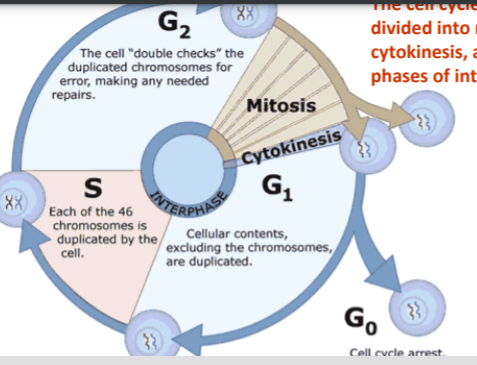
A single cell makes two ells by an equal split of nuclear contents in a process called mitosis
Cytokinesis refers to the equal split of cytoplasm and the organelles within it
The parent cell is the cell that divides
Daughter or sister cells - the 2 cells that result from the division, they are genderless!
The cell cycle:
Interphase(the period between cell divisions)
growth, duplication of genetics info, preparation for mitosis
Cloning
Forming identical offspring from a single cell or tissue
Structure of DNA and Mutations:
Chemical composition of DNA:
3 main components:
pentose sugar(5 carbon ring)
phosphate group with a negative charge
Nitrogenous Base
*3 components together = nucleotide
Thymine and Cytosine = single ringed - Pyrimidines
Guanine and adenine = double-ringed - Purines
DNA has a phosphate sugar backbone and bases pair up in the middle of the molecule - a with t and g with c
Point Mutations:
Replicating cells do not copy genetic info in DNA accurately;
Base pair substitutions - One nitrogen base is accidentally replaced with another base
Insertions - One or more nitrogenous bases are inserted during the copying process
Deletions - One or more nitrogenous bases are deleted during the copying process
Meiosis:
Meiosis vs Mitosis:
e goal of mitosis is to create 2 genetically identical diploid daughter cells from one parent cell
The goal of meiosis is to create 4 gametes(haploid sex cells(ie sperm, egg) from one parent cell
Homologous chromosomes:
Pair of chromosomes containing the same gene sequences (each derived from one parent)
the same genes found on homologous chromosomes BUT NOT necessarily the same alleles
Allele: Different version of the same gene
ie/ curly hair vs straight hair allele
Meiosis:
Sexual reproduction
occurs in germ cells
one parent cell produces 4 gametes
eachgamete cells contain different genetic inforamtin
2 divisions(starts with 46 double-stranded chromosomes):
after 1st division - 23 double-stranded chromosomes
after 2nd division - 23 single-stranded chromosomes
Meiosis I:
DNA Replications
Two identical copies of each chromatid(sister chromatids) are attached at the centromere to form a double-stranded chromosome
Early Prohphas I:
nuclear envelope dissolves
Asters form
Centrioles move towards the poles of the cell
Metaphase I:
Homologous pairs align along the equator of the cell
Spindle fibers attach to the pair of sister chromatids
Anaphase I:
Homologs separate and move to opposite poles
Sister chromatids remain attached at their centromeres
Telophase I:
Nuclear envelope resembles
Pairs of sister chromatids are found in each haploid daughter cell
Cytokinesis
Meiosis II:
Prophase II:
Nuclear envelope dissolves
Spindle fibers form
Centrioles move towards poles
*NOTES: Don't need interphase as you don't need to duplicate DNA
Metaphase II:
Chromosomes align along the equator of the cell
Spindle fibers attach to centromeres of sister chromatids
Anaphase II:
Spindle fibers contract and pull sister chromatids apart
Telophase II:
Nuclear envelope reassembles
Chromosomes uncoil becoming chromatin
Spindle fibers disappear
Cytokinesis divides each cell into 2 nonidentical haploid cells
RESULT:
23 single chromosomes
Gamete Production:
Spermatogenesis: Sperm production
Diploid spermatogonia - primary spermatocytes - 4 spermatids
Oogensis: Egg production
Oogonia - primary
oocytes - 1 egg +polar bodies
Polar bodies - Nonfunctioning reproductive cell; a by-product of meiosis, dies overtime
How does meiosis produce variations?
Crossing over - exchange of genetic info. between homologous chromosomes
Occurs in prophase in meiosis I generates diversity
Independent assortment:
The homolog of one chromosome can be inherited with either homolog of a second chromosomes
Lining up
Mistakes In meiosis:
Karyotyping:
To study human chromosomes
A karyotype is a photographic inventory of individual chromosomes
A karyotype usually shows 22 pairs of autosomes and one pair of sex chromosomes
Alteration of chromosomes number:
Non-disjunction: Results in abnormal chromosomes numbers
Failure in chromosomes separation
homologous chromosomes fail to move apart properly during meiosis I
Sister chromatids separate during meiosis II
Monosomy - Fertilized egg cell is missing a chromosome - 45 chromosomes
Trisomy - Fertizlied cell has an extra chromosome - 47 chromosomes
An abnormal number of sex chromosomes:
Non-disjunction can also produce gametes with extra or missing sex chromosomes
Unusual numbers of sex chromosomes do not upset the genetic balance as much as the unusual number of autosomes
Usually offspring are viable
Sexual Reproduction:
Male and female gametes do not contribute equal amounts of cytoplasm
Male gametes have much less cytoplasm than female eggs
Sperm do not contribute mitochondria - or chloroplasts to the zygote
The zygote will have the same mitochondrial DNA as a mother - maternal inhertiance
Mitochondria / chloroplasts often do not separate evenly during cell division - genetic variation in an organism
Seite 2
Informationen
- Beschreibung
- Grade 11 Biology Notiz am GENETICS, erstellt von RS - 11PE 653060 Lorne Park SS am 21/05/2021.
- Erstellt von
- RS - 11PE 653060 Lorne Park SS
- Aufrufe
- 2
- Bewertung